AI model tier list: can real paid usage beat official benchmarks?
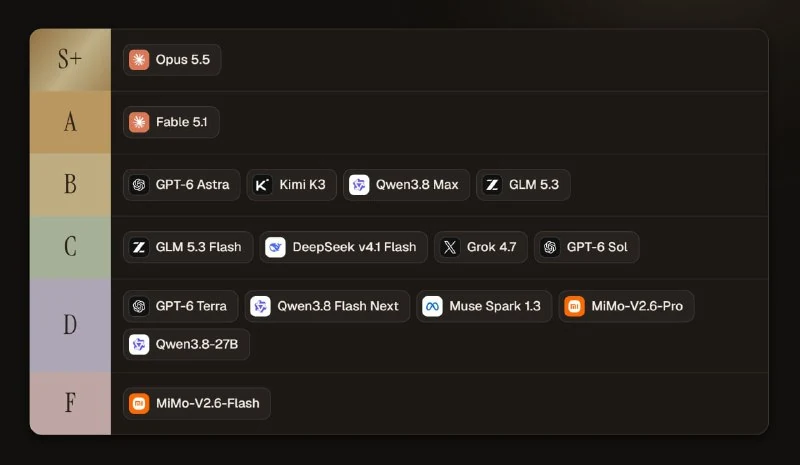
A tier list of AI models built from real paid usage is being discussed as a possible alternative to official benchmarks.
AI model tier list: can real paid usage beat official benchmarks?
A tier list of AI models is circulating online, and it may be more accurate than most official benchmarks.
The key difference is that it is not based on test tasks, but on real usage with paid workloads. That means rankings are shaped not only by synthetic metrics, but also by practical usefulness, cost, and hands-on experience.
This raises a natural question: is real paid usage a better indicator of AI model quality than standard benchmarks?
Why it matters
AnalysisReal paid usage can reveal strengths that synthetic tests miss, but it is harder to reproduce and depends heavily on specific workflows.
Discuss in community
Share your questions and insights with developers
Related in Ecosystem
Practical guides, core terminology, and agent skills
Qwen4-Max released: 50% fewer tokens and lower per-task cost
Qwen4-Max introduces a MoE architecture, a 1M-token context window, built-in image support, and significantly lower token usage and cost.
Frontier Models
The most powerful class of artificial intelligence at the forefront of global research (Claude 3.7 Sonnet, OpenAI o3/GPT-4.5, Gemini 2.0 Pro), defining the limits of modern reasoning, autonomy, and coding capabilities.
Qwen-4 Max Officially Released: Model for Agents and Long-Horizon Tasks
Qwen-4 Max is positioned as a model for agentic and long-horizon tasks, with lower token usage and reduced cost compared with Qwen-3.8.
Part II. AI Agent Architecture: From Model to Memory and Tools
A deep engineering dive: tokenization, KV-cache, sampling determinism, the training stack, quantization, context engineering, the safety stack, production RAG, ReAct, and multi-agent swarm systems.