Tencent releases Hy4 Flash, a Claude Haiku competitor with 1M-token context
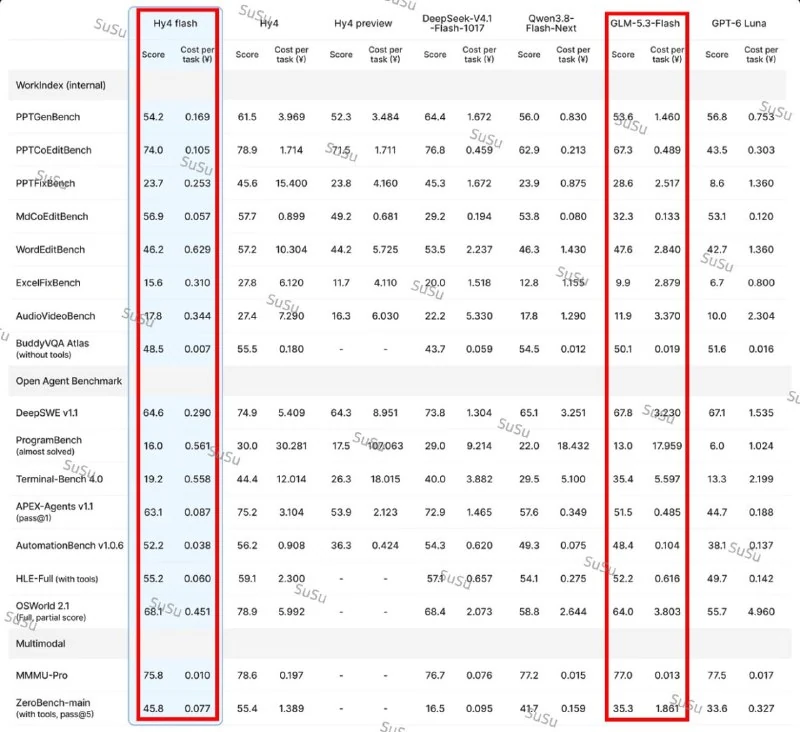
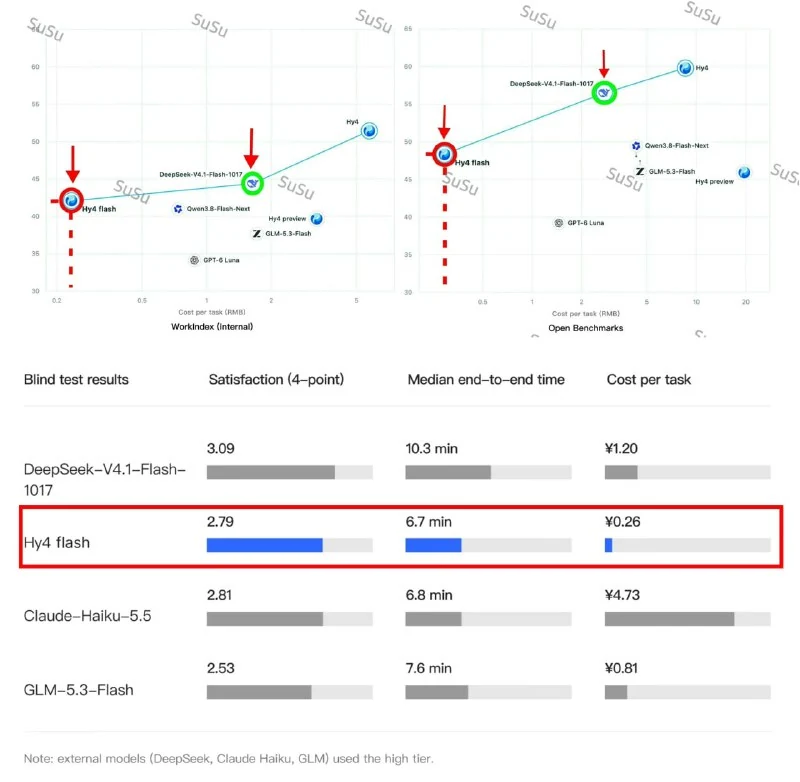
Tencent has released Hy4 Flash, a native multimodal model with a 1M-token context window and low inference costs. The company says it is comparable to Claude Haiku 5.5 in High mode for everyday tasks.
Tencent has released Hy4 Flash, a native multimodal model positioned as a competitor to Claude Haiku.
- 224B total parameters, of which only 12B are active.
- 1M-token context window.
- Native multimodality.
- Pricing: $0.07 per 1M input tokens and $0.281 per 1M output tokens.
- Cached input tokens: $0.003 per 1M.
- Tencent says the model is comparable to Claude Haiku 5.5 in High mode for everyday tasks.
- Task execution cost is 18x lower.
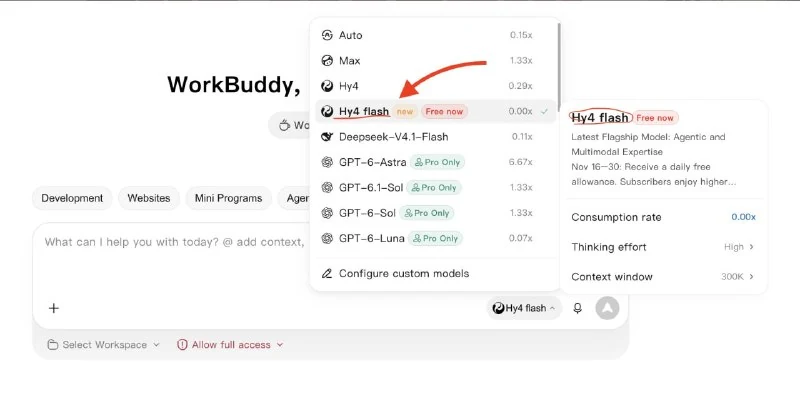
Until November 30, the model can also be used for free in WorkBuddy.
Why it matters
AnalysisHy4 Flash illustrates how sparse active parameters and aggressive caching can make large-context multimodal AI cheaper for routine workloads. For developers, it could mean lower-cost agents, assistants, and document-heavy applications.
Discuss in community
Share your questions and insights with developers
Related in Ecosystem
Practical guides, core terminology, and agent skills
Google Gemini Pro (Model with Infinite Context)
The flagship working model from Google DeepMind featuring a record context window of over 2 million tokens. Capable of analyzing entire books, lengthy videos, and massive codebases in a single query.
Gemini Flash & Pro (Google Gemini)
A family of multimodal models from Google DeepMind that combines a record context window (up to 2 million tokens), extreme generation speed (over 150 tokens/sec), and native perception of video and audio.
Qwen4-Max released: 50% fewer tokens and lower per-task cost
Qwen4-Max introduces a MoE architecture, a 1M-token context window, built-in image support, and significantly lower token usage and cost.
Part I. AI Agent Architecture: The Foundations
The eleven foundational building blocks of modern autonomous agents: model taxonomy, the agentic runtime loop, advanced prompting, distillation, skills architecture, memory systems, function calling, and FinOps.