Open-source method nearly doubles RTX 3090 compute performance
The GitHub project gpu-unlock bypasses NVIDIA's software limit on GeForce 30-series tensor cores, raising FP16/BF16 throughput and accelerating LLM prefill without patching drivers.
Open-source method nearly doubles RTX 3090 compute performance
The open-source project gpu-unlock collected more than 5,000 GitHub stars within days.
What NVIDIA limits on GeForce 30
GeForce 30-series cards such as RTX 3080, RTX 3090 and RTX 3090 Ti have tensor cores capable of multiplying matrices in FP16 and BF16 with FP32 accumulation. This is the operation used to train and run neural networks. Because these are gaming GPUs, NVIDIA intentionally limits the speed of that operation by half — classic market segmentation: if you want to do ML, buy an ML GPU rather than a gaming card.
The restriction is implemented as an instruction-issue speed divider, and its value lives in registers that are normally not writable. That makes a direct bypass impossible.
How gpu-unlock works
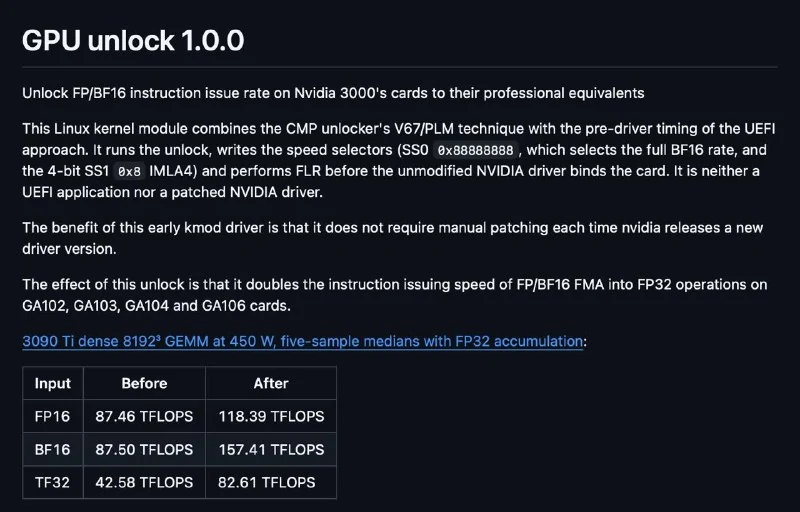
The author found a way around it by reusing a technique previously invented for unlocking similar limits on CMP 170HX mining cards, packaged as a Linux kernel module.
The module runs during boot, before the NVIDIA driver starts, sets the full speed, and only then hands the card to the stock driver. The key point is that it works before the driver, so users do not need to patch the driver after every update or reflash the BIOS.
Reported numbers
For the RTX 3090 Ti, the repository reports GEMM 8192 results at 450 W:
- BF16: 87.5 → 157.4 TFLOPS
- FP16: 87.5 → 118.4 TFLOPS
- TF32: 42.6 → 82.6 TFLOPS
On real workloads the gain is more modest but still meaningful: LLM prefill is accelerated by roughly 14–36%, and computation results remain bit-exact.
Windows and installation
The original repository is Linux-only, but third-party Windows ports already exist, such as AD103_win_unlocker.
Installation instructions are available in the repository.
Why it matters
AnalysisIt demonstrates that vendor software segmentation can be bypassed at the kernel level, squeezing more AI performance from existing gaming GPUs while introducing potential compatibility, stability and warranty considerations.
Discuss in community
Share your questions and insights with developers
Related in Ecosystem
Practical guides, core terminology, and agent skills
AI helps increase throughput of Nvidia RTX 3000 and 4000 GPUs
New GitHub projects, gpu-unlock and gpu-unlock-ada, claim to help increase the throughput of Nvidia RTX 3000 and 4000 series GPUs.
Open-source project with 74 skills for game development
A GitHub open-source project called awesome-gamedev-agent-skills brings together 74 skills for Unity, Godot, Unreal Engine and other game engines, with automatic skill selection and support for Claude Code and Codex.
10 GitHub repositories that will help you become an AI engineer in 90 days
Becoming an AI engineer today isn't all about models and prompts. Most of the real work is built around agents, RAG systems, orchestration, vector databases, and AI infrastructure.
Top GitHub Repositories for SEO and Keyword Research
8 battle-tested open-source GitHub repositories for semantic keyword discovery, technical audits, and Generative Engine Optimization (GEO).
Nvidia's Monopoly and the CUDA Platform
An analysis of Nvidia's technological and economic dominance in the AI market. The CUDA (Compute Unified Device Architecture) platform, created in 2006, transformed ordinary gaming GPUs into the planet's primary computational tool, making it difficult for competitors like AMD and Intel to break this monopoly.
TensorRT-LLM & SGLang High-Speed Engines
Deeply compiled computational engines for extreme optimization of language model inference on NVIDIA servers, utilizing graph optimization, FlashAttention-3, and advanced routing.