Huffman Coding: How an MIT Student Found a Compression Method Still Used 75 Years Later

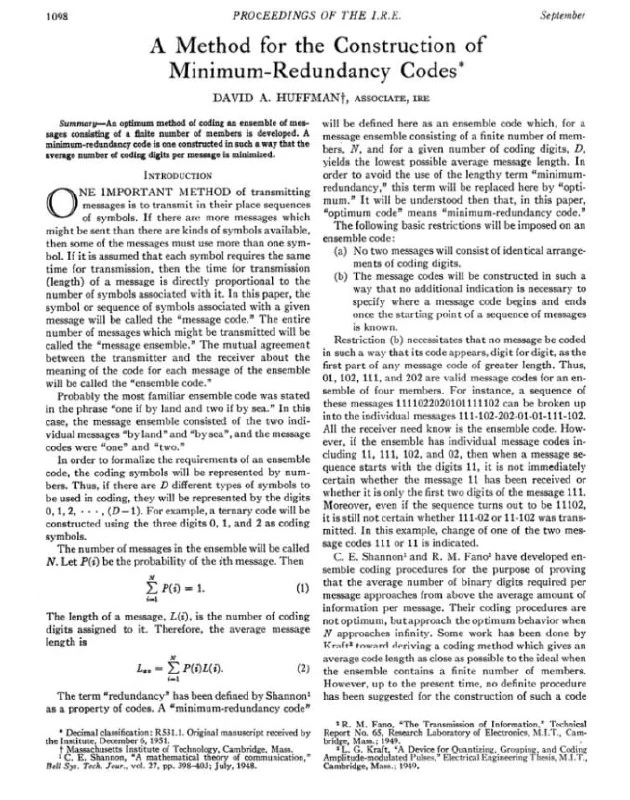
In 1951, MIT graduate student David Huffman devised an efficient variable-length binary code that remains central to formats like ZIP, GZIP, JPEG, and MP3.
In 1951, David Huffman, a graduate student at the Massachusetts Institute of Technology (MIT), was given a problem that even Claude Shannon and his teacher Robert Fano had failed to solve. He had to find the most efficient way to encode symbols using binary codes of variable length while taking the frequency of each symbol into account.
For several months, Huffman tried one approach after another, but no solution emerged. Eventually, he was about to discard his notes and start preparing for his final exam when he suddenly had an insight.
Instead of building the coding tree from the top down, he decided to go in reverse: start from the bottom and repeatedly combine the two least frequent symbols.
That is how Huffman coding was born — an algorithm that produces the minimum average code-word length among all binary prefix codes for a given set of symbol frequencies.
Seventy-five years later, the algorithm is still used in formats such as ZIP, GZIP, JPEG, and MP3.
Why it matters
AnalysisHuffman coding is a foundational example of how a simple change in perspective can solve a long-standing optimization problem. Its continued use in widely adopted formats shows that elegant algorithmic ideas can remain relevant for decades.
Discuss in community
Share your questions and insights with developers
Related in Ecosystem
Practical guides, core terminology, and agent skills
Context Distillation & Token Squeezing
Methods for automatically removing excess words, syntactic noise, formatting spaces, and outdated messages before sending prompts to the model, optimizing budget and accelerating inference.
KV-Cache Offloading & Compression
Hardware and algorithmic methods for temporarily offloading Key-Value Cache (KV-Cache) from expensive GPU VRAM to system RAM or fast NVMe SSDs.
50 Visual Design Styles: A Foundational Guide for Design Systems, UI/UX, and Art Direction
A complete visual dictionary of 50 design styles: aesthetic analysis, color palettes, typography pairings, design system rules, and precise AI control.
How to Integrate Monobank Acquiring Without a Developer via Vibe-Coding
A step-by-step guide to integrating Monobank online payments: FOP compliance, terminal setup, ECDSA webhook verification, robust UX, and security test matrix.
Bob Martin publishes coding rules for AI agents
Uncle Bob’s ub-mode skill sets guardrails for AI coding agents, requiring minimal changes, real tests, and root-cause fixes.
OpenAI introduces GPT-6.1 Terra with lower API pricing and real-world coding tests
OpenAI introduced GPT-6.1 Terra, about 50% cheaper than GPT-5.6 Terra, with benchmark results from fixing 105 bugs in real repositories.