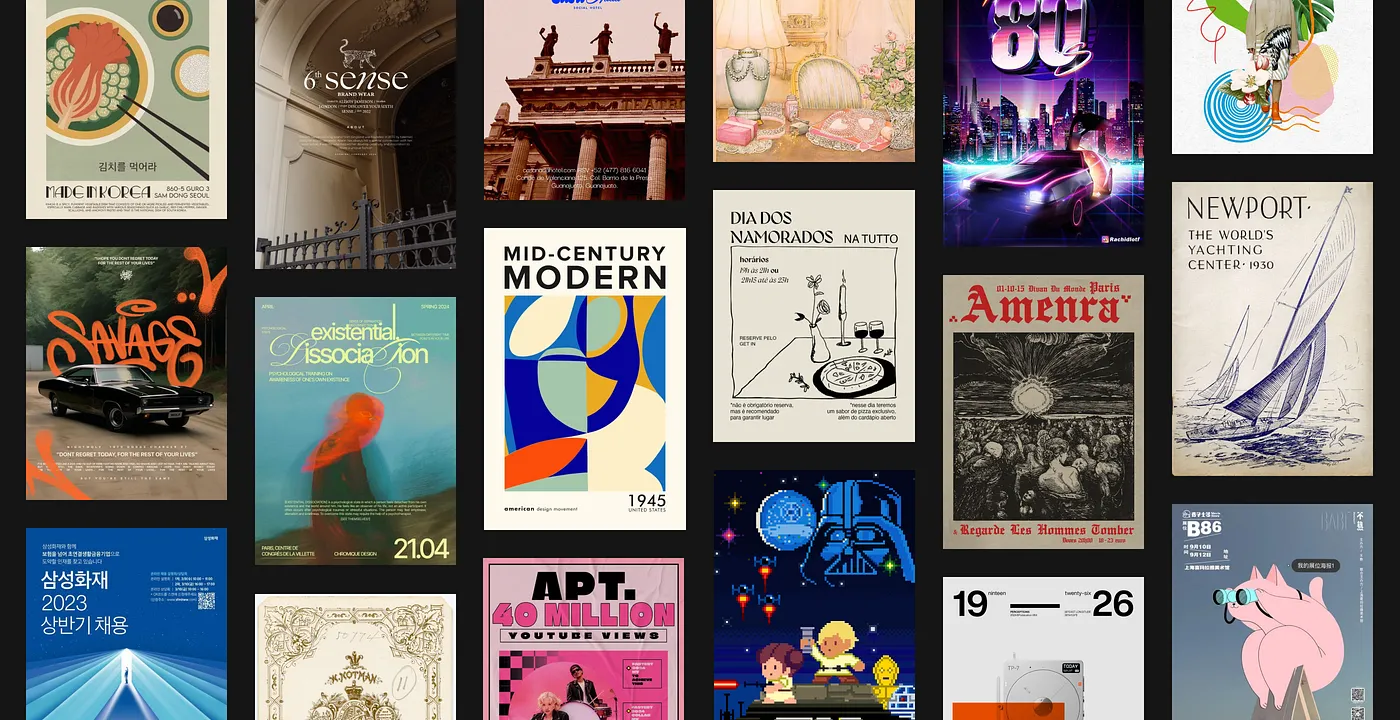
 50 visual design styles for design systems and art direction
When a designer or product team begins designing a new interface, digital ecosystem, or brand, they almost inevitably fall into the trap of vague formulations: "make something clean", "we want a cozy feeling", "we need modern minimalism".
But "clean" or "modern" are subjective abstractions. For one client, "modern" means Scandinavian light wood and quiet restraint; for another, it means neon cyberpunk or monolithic brutalist slabs.
The lack of a clear visual vocabulary leads to two major problems in today's industry:
- Weak, faceless design systems: products look like Figma Community templates copied from one another, lacking their own character and recognizable DNA.
- Semantic deafness of artificial intelligence: when creating concepts in Midjourney, Flux, or v0, abstract descriptions produce template garbage because neural networks need precise cultural and stylistic markers.
📌 Source and authorship: This foundational guide is based on the material "50 Design Styles Every Designer Should Know for Better Prompting" by product designer Himanshu Bhardwaj (UX Planet). We transformed his original taxonomy into a practical guide for building design systems, art direction, developer briefing, and precise communication with generative AI.
1. Why Designers Need a Visual Dictionary: From Design Systems to Art Direction
A design style is not superficial decoration or a random set of colors. It is a complete engineered visual system, shaped by material culture, history, architecture, the technologies of its time, and philosophy.
Mastery of 50 design styles gives professionals three foundational advantages:
- Designing expressive design systems: instead of using yet another default blue and gray cards, you deliberately build system tokens (border-radius, texture, typography, spacing) grounded in the aesthetic code of a specific movement (for example, the strict grid of Bauhaus, modular blocks of Bento Box, or the warm organic balance of Japandi).
- Crystal-clear briefing for teams and clients: when you tell a client, layout engineer, or 3D modeler, "We are building an interface at the intersection of Neo-Brutalism and Utilitarian," the team develops a concrete mental model with thick borders, monospaced fonts, and no unnecessary decoration.
- Precise control of generative AI: computer vision models were trained on millions of labeled objects. When you name a style by its exact name, the neural network instantly activates the required aesthetic cluster in latent space.
2. Anatomy of Style: Translating Aesthetics into UI Tokens and AI Prompts
For a style to come alive in a real product, it must be decomposed into four constituent levels:
- Philosophy and Mood (Mood & Intent): What emotion does the style evoke? (For example, Neoclassical conveys authority and reliability; Kawaii conveys safety and appeal.)
- Interface Tokens (Design System Tokens):
- Type pairing: a contrasting serif for luxury, a clean grotesque for modernism, and a monospace font for industrial systems.
- Color scheme: primary colors, semantic contrasts, and accents.
- Geometry and surfaces: border-radius (from 0px in Brutalism to 24px in Bento), stroke weight, and textures (concrete, frosted glass, metal, paper).
- Grid and Composition Rules: symmetry, modular cards, generous negative space, or deliberately dense rhythm.
- AI Generation Formula (AI Prompting & Moodboarding): how to quickly generate visual references and background assets for a client presentation.
Below is the full classification of 50 styles, grouped by key design paradigms.
3. Classics and Historic Grandeur (Styles 1–5)
These directions embody centuries of European cultural heritage. They are essential for creating brands with rich histories, conservative financial products, premium services, and elite physical goods.
1. Neoclassical
 Neoclassical design style
Neoclassical style is based on the monumental grandeur of ancient Greece and Rome. It revives ideals of strict order, flawless golden ratio proportions, and restrained nobility.
- Application domains:
Fintech and private banking,Academic institutions,Luxury branding,Museums. - Design system elements:
- Typography: classic serif typefaces with refined strokes (Didot, Bodoni, Cinzel).
- Palette: ivory, deep emerald, antique gold, marble gray.
- Geometry: absolute symmetry, thin gold accent lines, no arbitrary radii (strict 0px or 4px).
- Mood: authoritative, majestic, respectable, timeless.
- Stylistic pitfalls: avoid bright neon colors, plastic surfaces, and accidental asymmetry.
- AI prompt formula for concepts:
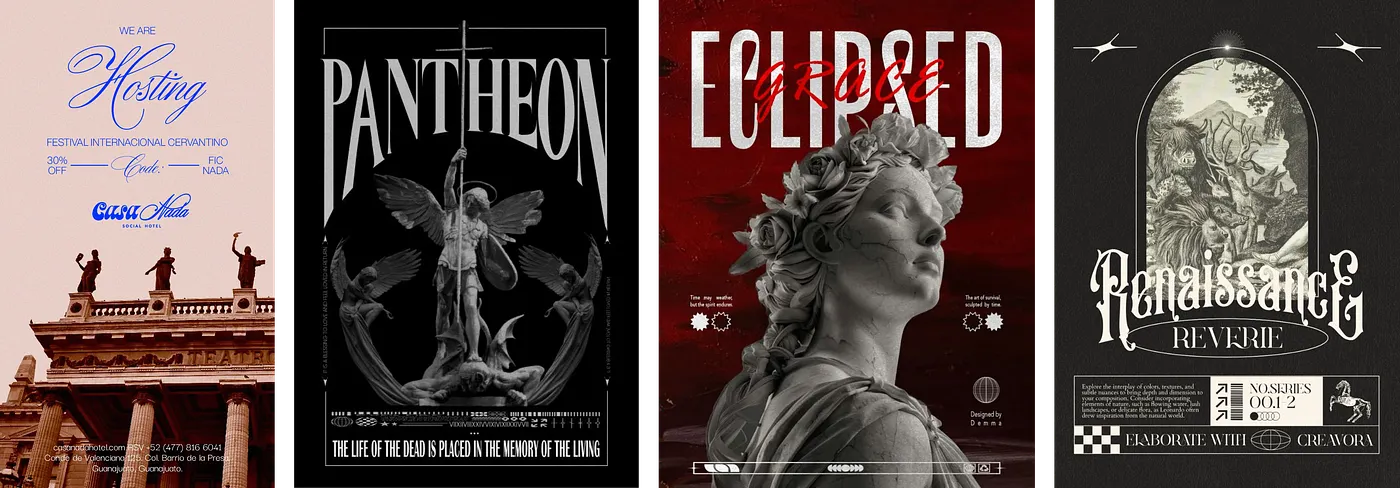
2. Baroque
 Baroque design style
Baroque is a triumph of emotion, abundant detail, and dramatic movement born in 17th-century Europe. The style rejects dry asceticism in favor of complex stucco, gilding, rich fabrics, and deep shadows.
- Application domains:
Premium cosmetics,Wine and liqueur brands,Theater festivals,Jewelry sector. - Design system elements:
- Typography: ornate display typefaces with rich ligatures and swashes.
- Palette: ruby velvet, royal blue, 24-karat gold, deep black.
- Geometry: flowing wave-like contours, multi-layered decorative frames, high chiaroscuro contrast.
- Mood: passionate, ceremonial, opulent, theatrical.
- Stylistic pitfalls: flat minimalist fills and pastel lifelessness destroy the drama of the style.
- AI prompt formula for concepts:
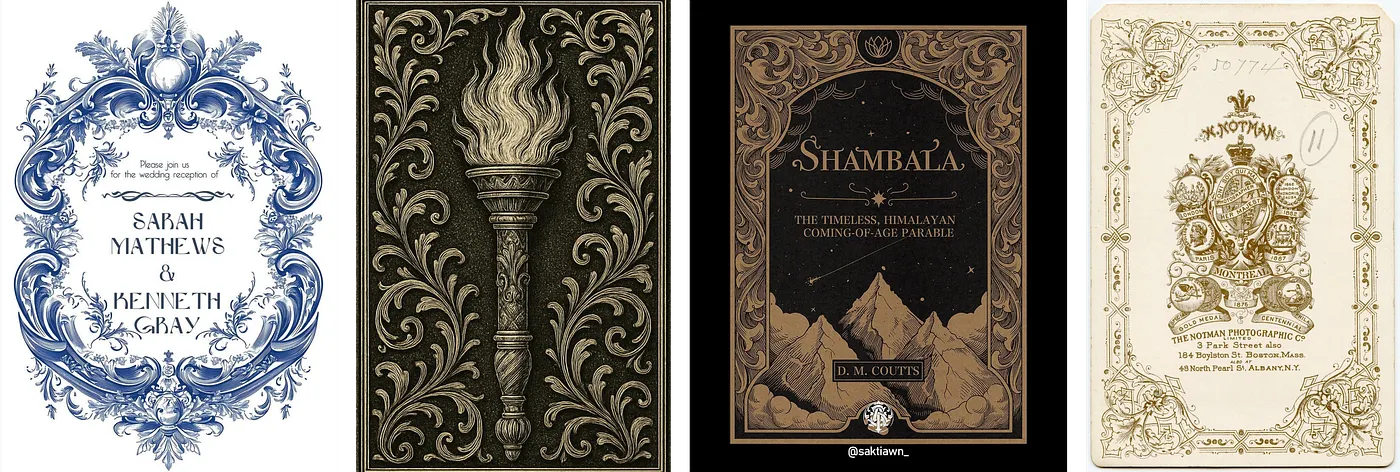
3. Filigree
 Filigree design style
Filigree comes from the jewelry art of weaving thin gold or silver wires into intricate lacework. In graphic design, it transforms into refined micro-lines, banknote-style patterns, and family crests.
- Application domains:
Certificates and diplomas,Exclusive invitations,Secure documents,Elite brands. - Design system elements:
- Typography: engraved typefaces, exquisite monograms.
- Palette: metallic silver, platinum, matte graphite.
- Geometry: ultra-thin contours (0.5-1px), guilloché patterns, mirrored lace patterns.
- Mood: jewelry-grade, ceremonial, rare, noble.
- Stylistic pitfalls: thick bold borders and simplified flat vector shapes.
- AI prompt formula for concepts:
4. Acanthus
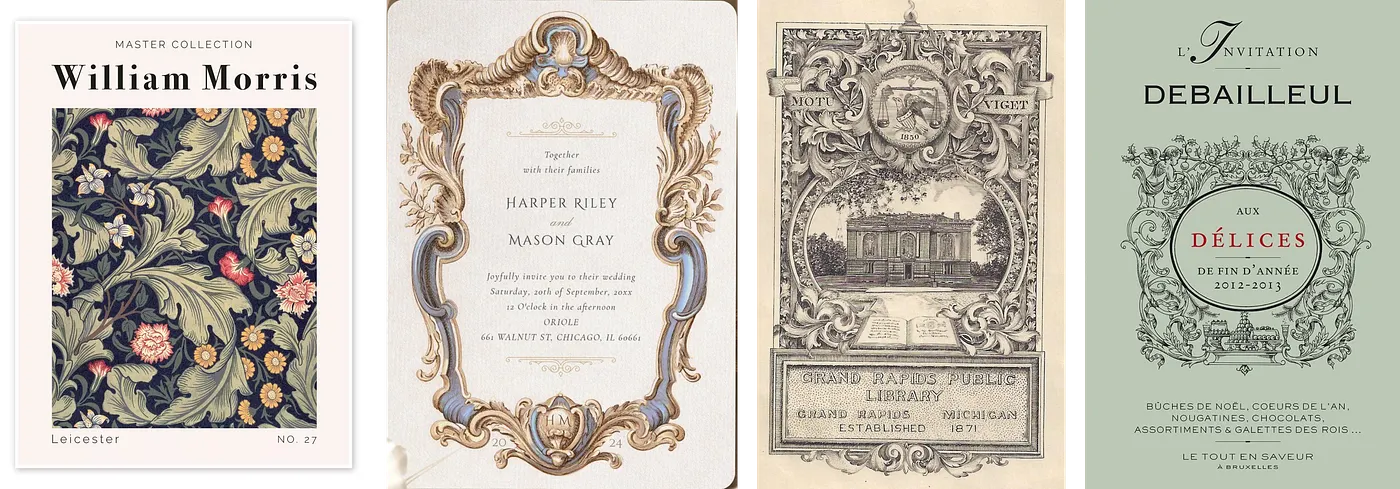 Acanthus style in visual ornaments
The acanthus ornament, inspired by the Mediterranean plant, is a classic symbol of endurance, immortalized in the Corinthian capitals of ancient temples. It adds natural monumentality and architectural nobility to a system.
- Application domains:
Architectural firms,Premium real estate,Wedding identity,Crests. - Design system elements:
- Typography: Roman monumental serifs (Trajan, Cinzel).
- Palette: sandstone, warm terracotta, antique bronze, olive leaf.
- Geometry: bas-relief volumes, symmetrical curved stems, natural stone texture.
- Mood: enduring, classic, naturally monumental.
- Stylistic pitfalls: cybernetic angles and low-poly polygonal graphics.
- AI prompt formula for concepts:
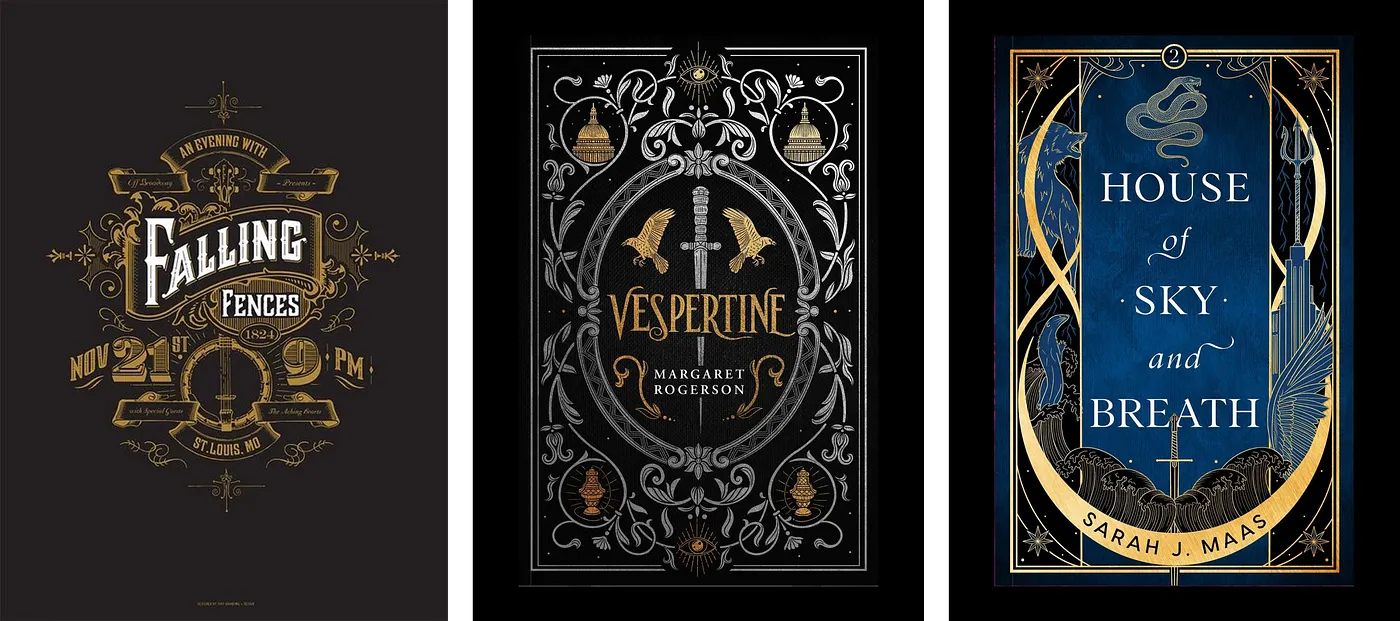
5. Victorian
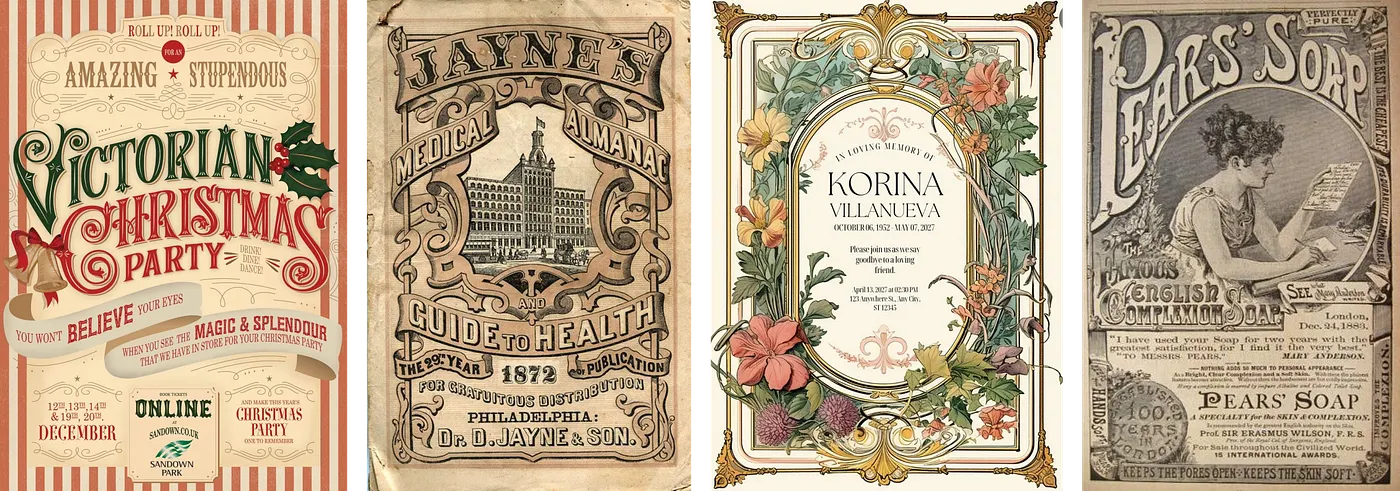 Victorian design style
The Victorian aesthetic of the 19th-century British Empire emerged at the intersection of the Industrial Revolution and romantic nostalgia for the past: engraved illustrations, heavy silks, damask wallpapers, and complex multi-tiered typography.
- Application domains:
Apothecary and craft brands,Tea and coffee houses,Historical novels,Pubs. - Design system elements:
- Typography: elaborate Victorian typefaces, combining grotesques with decorative serifs on a single surface.
- Palette: burgundy, dark emerald, polished walnut, mahogany, antique brass.
- Geometry: damask patterns, engraving hatching, decorative corner ornaments.
- Mood: substantial, vintage, respectable, mysterious.
- Stylistic pitfalls: modern plastic, neon glow, sterile white backgrounds.
- AI prompt formula for concepts:
4. Modernism, Geometry, and Twentieth-Century Avant-Garde (Styles 6–10)
The twentieth century rejected historical ornamentation in favor of function, material purity, and mathematical clarity. This block is the foundation of most modern digital products.
6. Art Deco
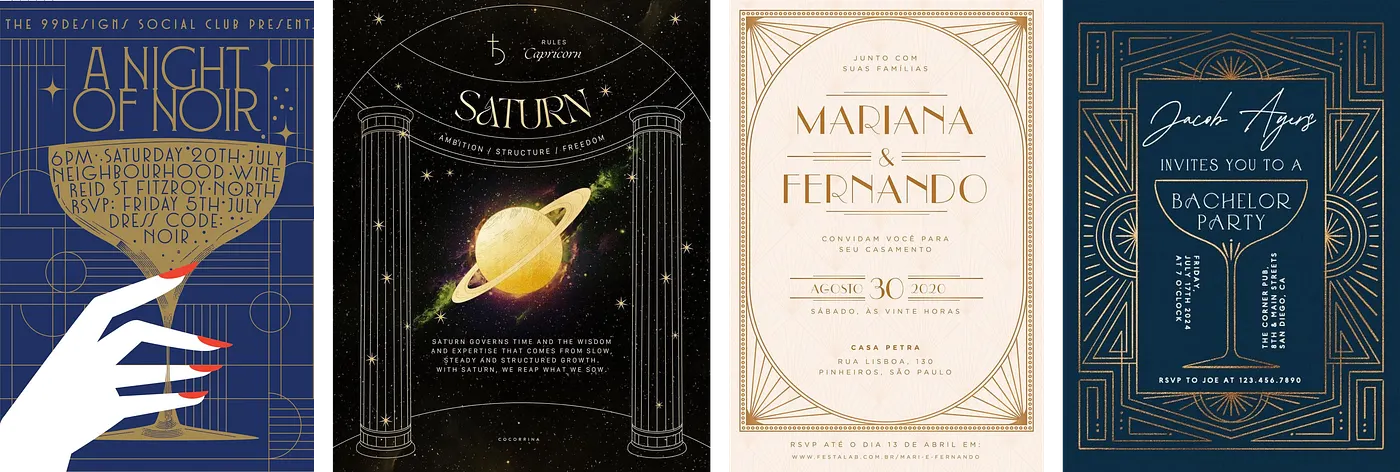 Art Deco graphic style
The Art Deco of the roaring twenties combined the technological optimism of industrialization with the luxury of the golden jazz age: mirror symmetry, stepped pyramids, sunburst patterns, and gleaming chrome.
- Use cases:
Luxury real estate,Cocktail bars,Film festivals,Luxury hotels. - Design system elements:
- Typography: geometric elongated grotesques with distinctive high crossbars (Metropolis, Broadway).
- Palette: deep charcoal black, matte gold, emerald, platinum.
- Geometry: chevrons, sunbursts, sharp angles, strict vertical symmetry.
- Mood: cinematic, prestigious, refined, energetic.
- Style traps: rounded organic blobs and washed-out pastel colors.
- AI formula for concepts:
7. Art Nouveau
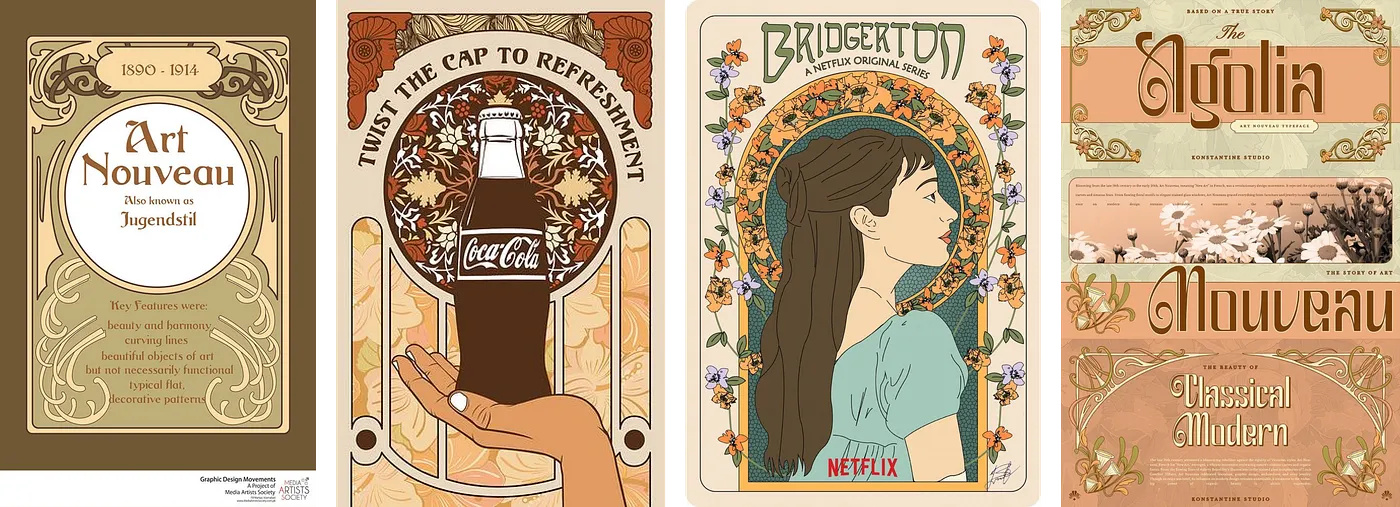 Art Nouveau style
Art Nouveau (turn of the nineteenth to twentieth century) is a poetic manifesto for a return to nature: flowing wave-like lines (whiplash), flexible flower stems, stained-glass techniques, and feminine graceful silhouettes.
- Use cases:
Organic premium cosmetics,Bio products,Illustrations,Floral design. - Design system elements:
- Typography: pliable letterforms with asymmetric curved descenders.
- Palette: muted sage, pale terracotta, dusty rose, warm gold.
- Geometry: asymmetric flowing contours, smooth radii, stained-glass black outlines.
- Mood: romantic, natural, graceful, sensual.
- Style traps: rigid 90-degree angles and cold industrial metal.
- AI formula for concepts:
8. Bauhaus
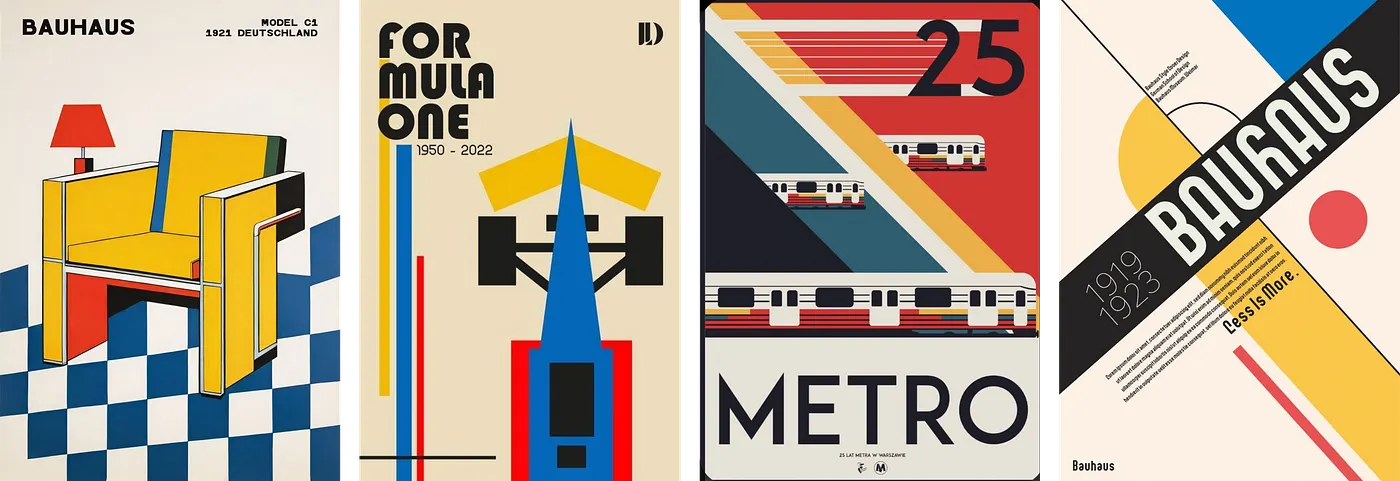 Bauhaus graphic style
Bauhaus is the foundation of modern UI/UX design. The principle form follows function rejects any unnecessary decoration in favor of basic geometry (circle, square, triangle) and a three-component color system.
- Use cases:
SaaS design systems,Infographics,Architecture,Analytics services. - Design system elements:
- Typography: strict neutral grotesques (Futura, Helvetica, Neue Haas Grotesk).
- Palette: primary color triad (red, ultramarine blue, saturated yellow) on a neutral background.
- Geometry: rigid modular grid, 0px radius, generous negative white space.
- Mood: rational, functional, progressive, engineering.
- Style traps: three-dimensional soft shadows, gradients, blurs, and decorative swirls.
- AI formula for concepts:
9. Brutalism
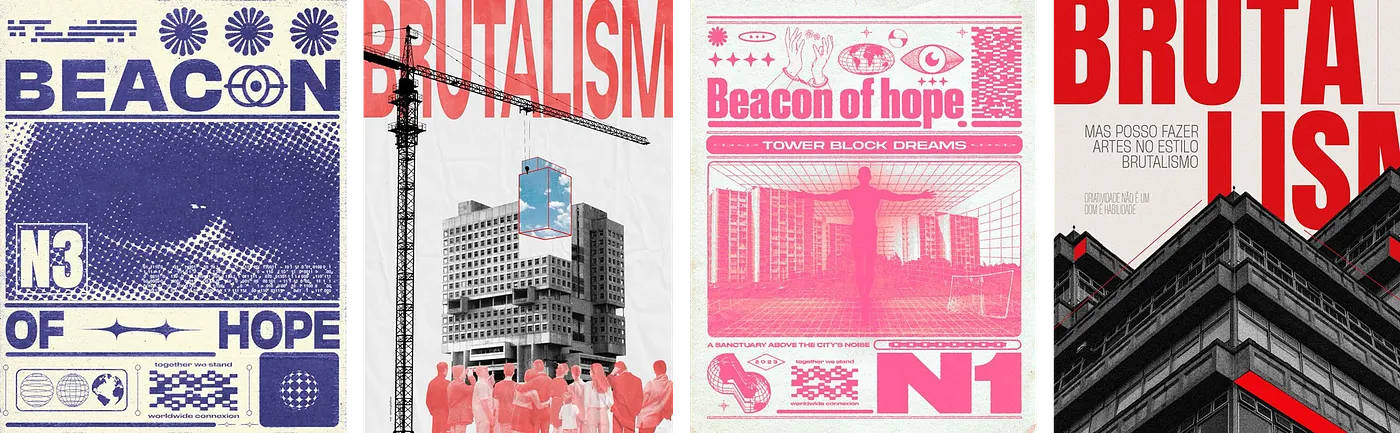 Brutalism style in architecture and interfaces
Brutalism emerged in postwar architecture as a cult of the honesty of raw concrete (béton brut). In digital environments, it is a rejection of artificial polish in favor of monospaced fonts, gray tones, and monolithic strength.
- Use cases:
Architecture catalogs,Art galleries,Underground streetwear,Indie products. - Design system elements:
- Typography: monospaced system fonts (JetBrains Mono, Courier, IBM Plex Mono).
- Palette: graded concrete grays, graphite, asphalt, occasional signal accents.
- Geometry: sharp angles (0px), massive monolithic containers, absence of decorative gradients.
- Mood: honest, severe, uncompromising, raw.
- Style traps: glamorous highlights, soft shadows, delicate pastels.
- AI formula for concepts:
10. Utilitarian
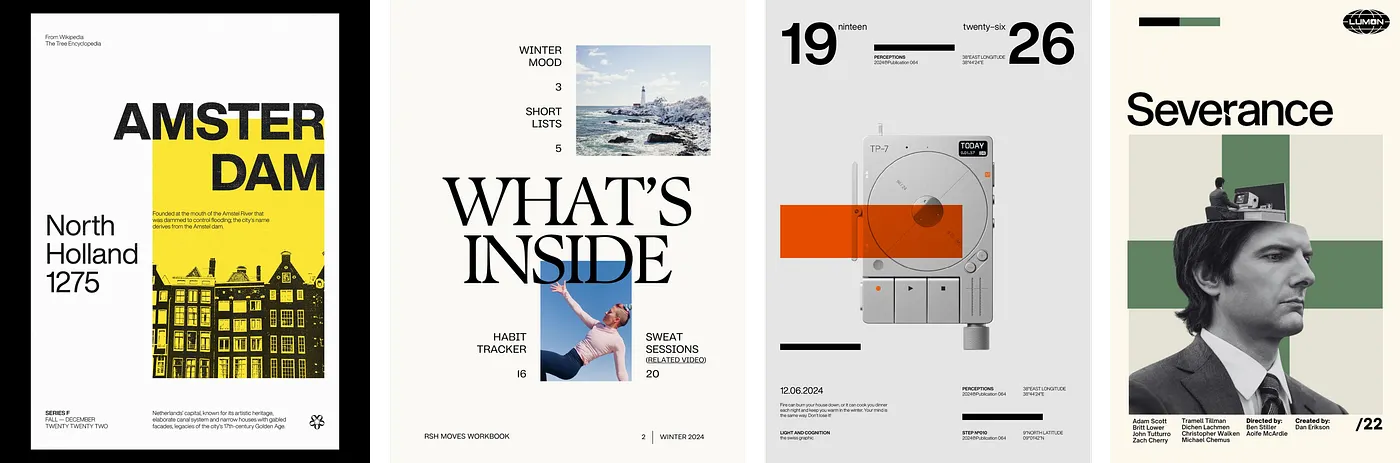 Utilitarian industrial style
Utilitarianism subordinates every pixel to absolute functionality. Inspired by military equipment, technical manuals, barcodes, and warehouse markings, it creates a sense of fail-safe reliability.
- Use cases:
B2B dashboards,Complex equipment interfaces,Technical terminals,Tactical apparel. - Design system elements:
- Typography: technical stencil or monospaced grotesques (DIN Pro, Space Mono).
- Palette: dark olive, matte black, warning orange or danger yellow.
- Geometry: coordinate grids, barcodes, serial indices, rectangular switches.
- Mood: reliable, pragmatic, engineering, load-ready.
- Style traps: decorative vignettes, blurs, artistic romanticism.
- AI formula for concepts:
5. Natural, Cozy, and Craft Aesthetics (Styles 11–15)
These aesthetics push back against digital burnout. They are built around tactility, natural materials, the imperfect beauty of handmade work, and coziness.
11. Japandi
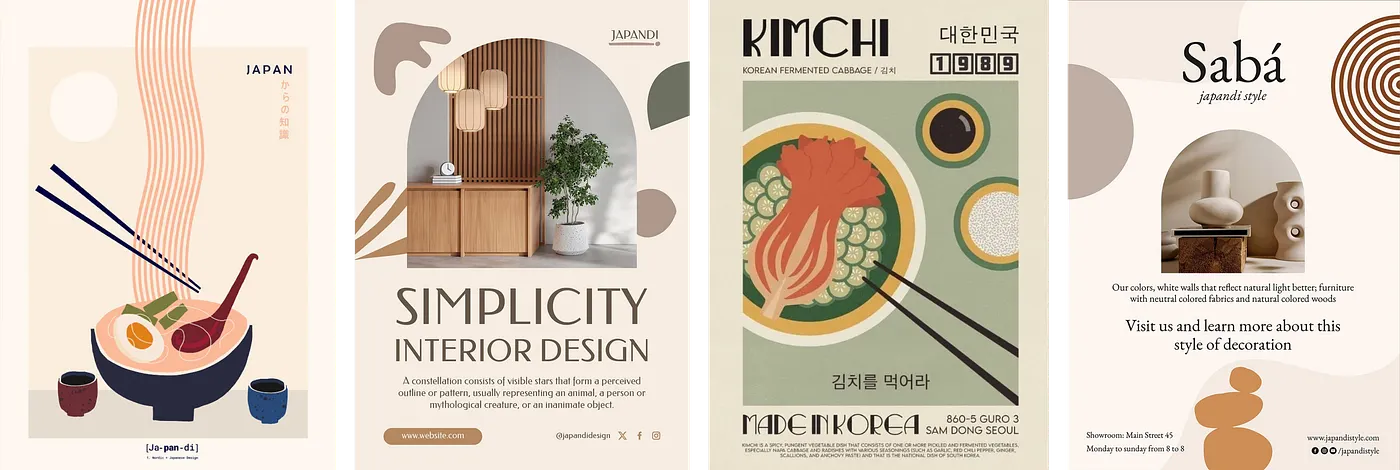 Japandi style in interior and UI
Japandi is a harmonious hybrid of Japanese zen minimalism and Scandinavian coziness (Hygge). It centers natural materials, warm light wood, open horizontal lines, and functional simplicity.
- Use cases:
Mental health apps,Furniture sites,Eco branding,Minimalist services. - Design system elements:
- Typography: clean, calm grotesques with generous letter-spacing (Inter, Plus Jakarta Sans).
- Palette: warm beige (oatmeal), light oak, muted gray, soft charcoal.
- Geometry: soft radii (8-12px), tactile matte surfaces, generous spacing between cards (gap: 32px+).
- Mood: calm, balanced, natural, mindful.
- Style pitfalls: bright neon colors, plastic gloss, visual overload from widgets.
- AI formula for concepts:
12. Bohemian
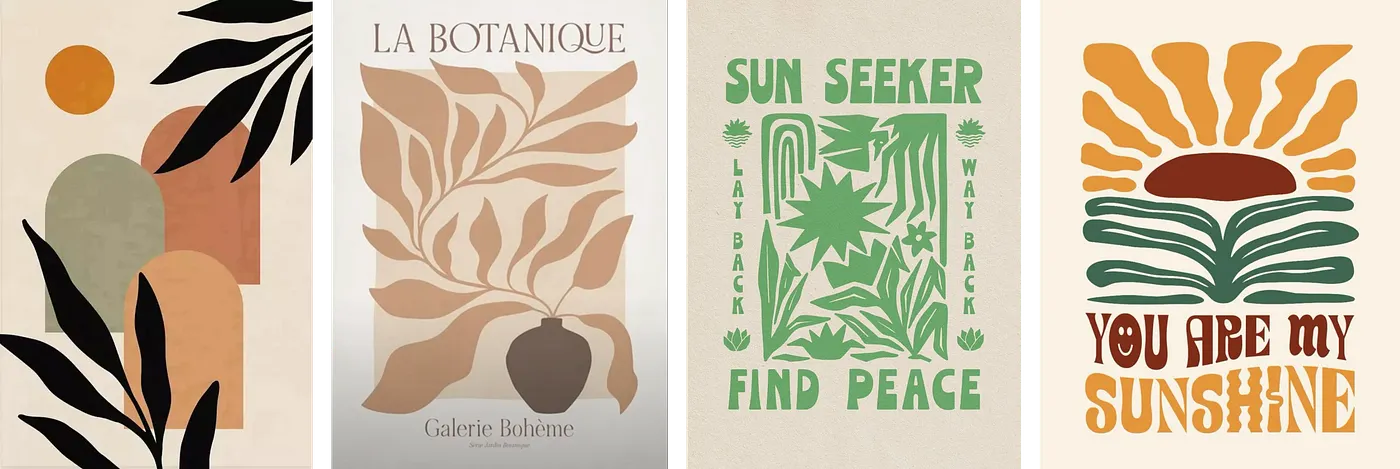 Boho style in design
Boho is a philosophy of freedom, nomadism, and self-expression. It combines ethnic patterns from cultures around the world, macramé, dried grasses, clay pottery, and warm vintage eclecticism.
- Use cases:
Art fairs,Travel services,Handmade markets,Music festivals. - Design system elements:
- Typography: lively calligraphic fonts and authentic uneven serifs.
- Palette: mustard, warm terracotta, fired clay color, deep turquoise.
- Geometry: asymmetric layers, textile textures, carpet ornaments.
- Mood: free, artistic, soulful, wanderlust.
- Style pitfalls: cold symmetrical corporate grid and sterile white.
- AI formula for concepts:
13. Shabby Chic
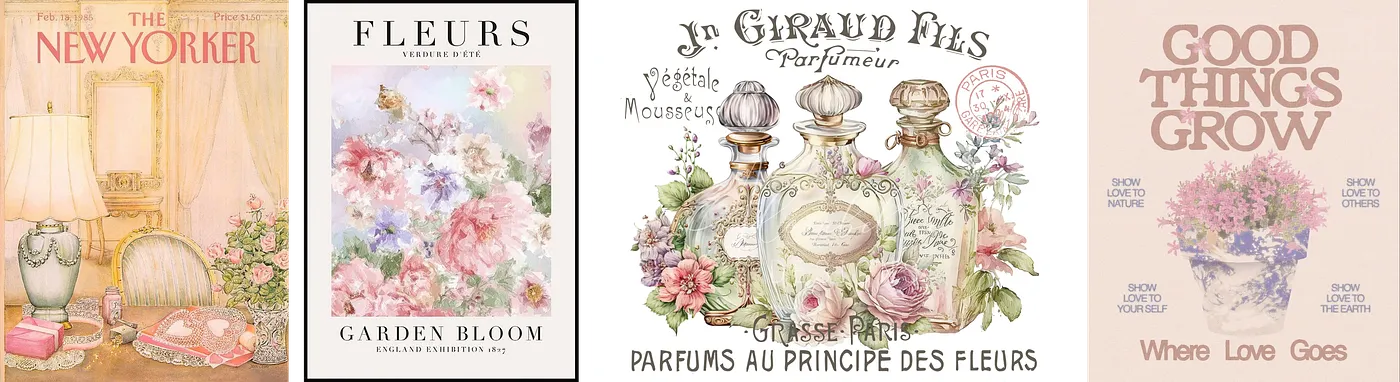 Shabby chic style
Shabby Chic (worn elegance) elevates vintage tenderness and traces of time: whitewashed wood with chipped paint, pastel faded roses, antique lace, and soft diffused light.
- Use cases:
Wedding agencies,Bakeries,Floral studios,Home comfort. - Design system elements:
- Typography: thin cursive handwritten lettering with vintage flourishes.
- Palette: powder pink, whitewashed linen, pale cornflower, chalk white.
- Geometry: soft shapes, distressing, textures of natural linen fabrics.
- Mood: tender, romantic, cozy, poignant.
- Style pitfalls: dark gothic contrast, metal, neon glints.
- AI formula for concepts:
14. Farmhouse / Cottagecore
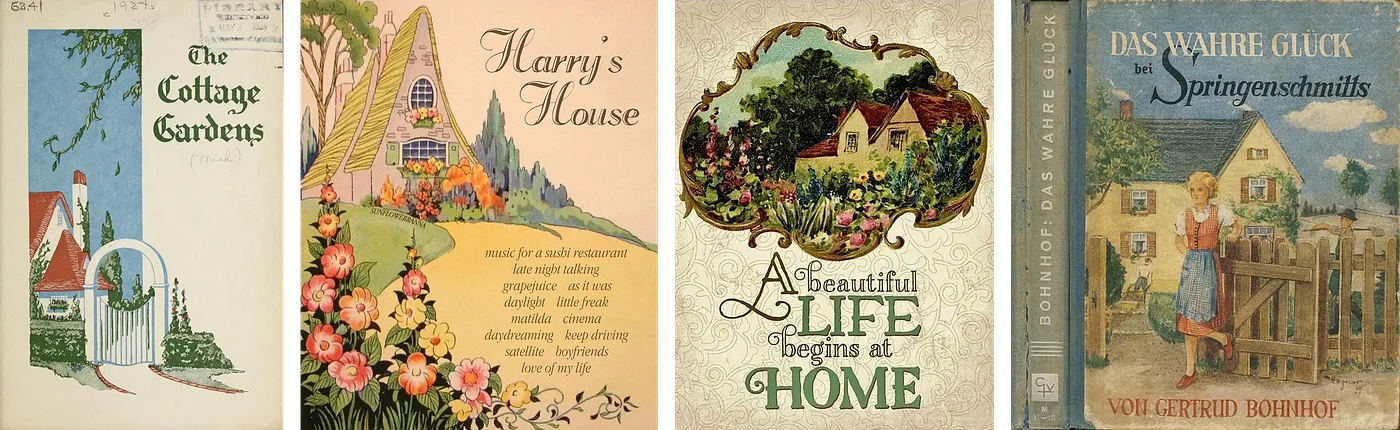 Cottagecore and farmhouse coziness
Cottagecore romanticizes simple life in nature: fresh bread, wooden tables, field bouquets, checked gingham fabrics, and the coziness of an old rural homestead.
- Use cases:
Farm marketplaces,Culinary sites,Eco hotels,Family blogs. - Design system elements:
- Typography: cozy serifs with warm ink traps (Bookman, Clarendon).
- Palette: warm pine, checked red-and-white gingham, sage, eggshell.
- Geometry: simple rectangular shapes, wood texture, natural irregularities.
- Mood: safe, homey, hospitable, sincere.
- Style pitfalls: futuristic neon lines and synthetic plastic surfaces.
- AI formula for concepts:
15. Wabi Sabi
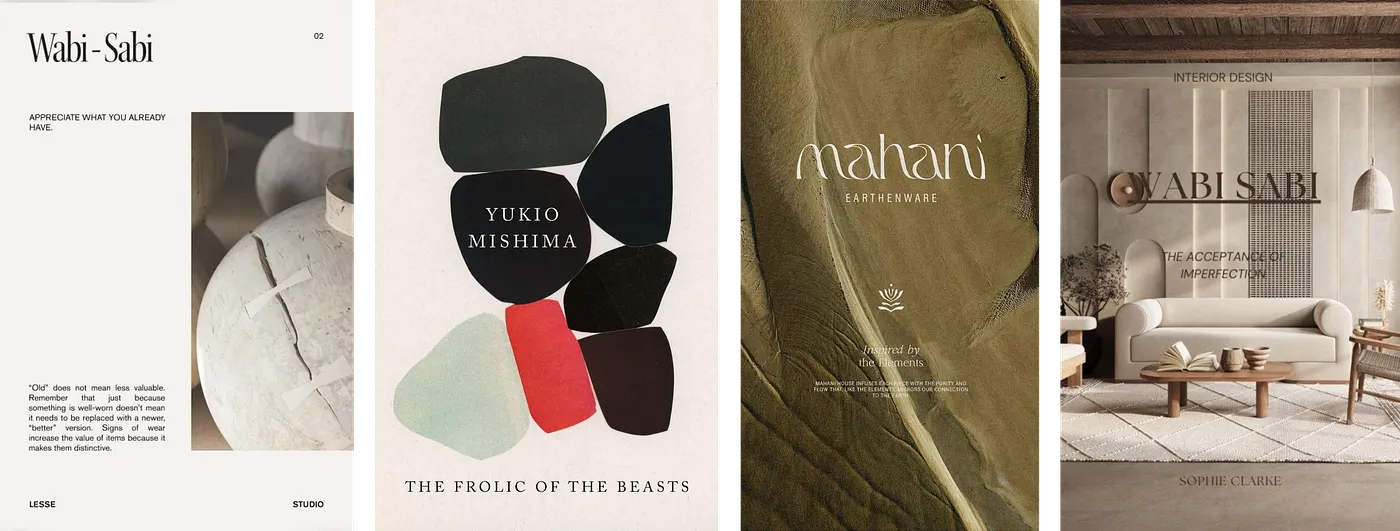 Wabi Sabi style
Wabi Sabi is an ancient Japanese philosophy of beauty in imperfection, incompleteness, and transience. It teaches us to value cracks in clay vessels, the roughness of stone, and the noble patina of time.
- Use cases:
Meditative spaces,Tea culture,Handmade ceramics,Bespoke architecture. - Design system elements:
- Typography: minimalist grotesques with fine strokes, placed on spacious empty planes.
- Palette: raw clay, moss, volcanic ash colors, golden kintsugi seam.
- Geometry: deliberate asymmetry, organic uneven edges, absence of glossy reflections.
- Mood: contemplative, modest, meditative, profound.
- Style pitfalls: computer-perfect symmetry, synthetic glossy mirrors.
- AI formula for concepts:
6. Nostalgia, Retro, and Pop Culture (Styles 16–21)
This style block triggers a powerful emotional response through its connection to iconic 20th-century eras. It helps a product stand out against monotonous gray-and-white interfaces.
16. Memphis
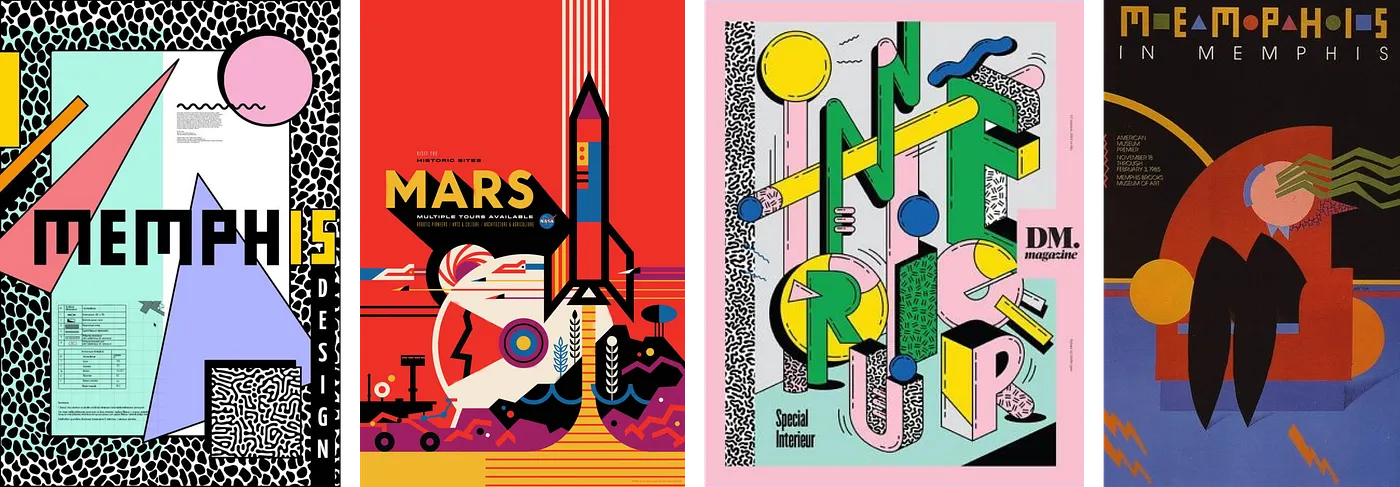 Memphis style in graphic design
Created by the group around Ettore Sottsass in the 1980s, Memphis became a color revolution against austere modernism: zigzags, contrasting black-and-white terrazzo textures, geometric shapes, and explosive color.
- Use cases:
Youth branding,Festival platforms,Gaming portals,Creative merch. - Design system elements:
- Typography: bold geometric typefaces with playful proportions.
- Palette: electric blue, lemon yellow, fuchsia, black outlines.
- Geometry: triangle confetti, striped patterns, wavy lines, absence of gray.
- Mood: rebellious, playful, energetic, postmodern.
- Style pitfalls: monochrome muted palettes, serious photorealistic textures.
- AI concept formula:
17. Kitsch
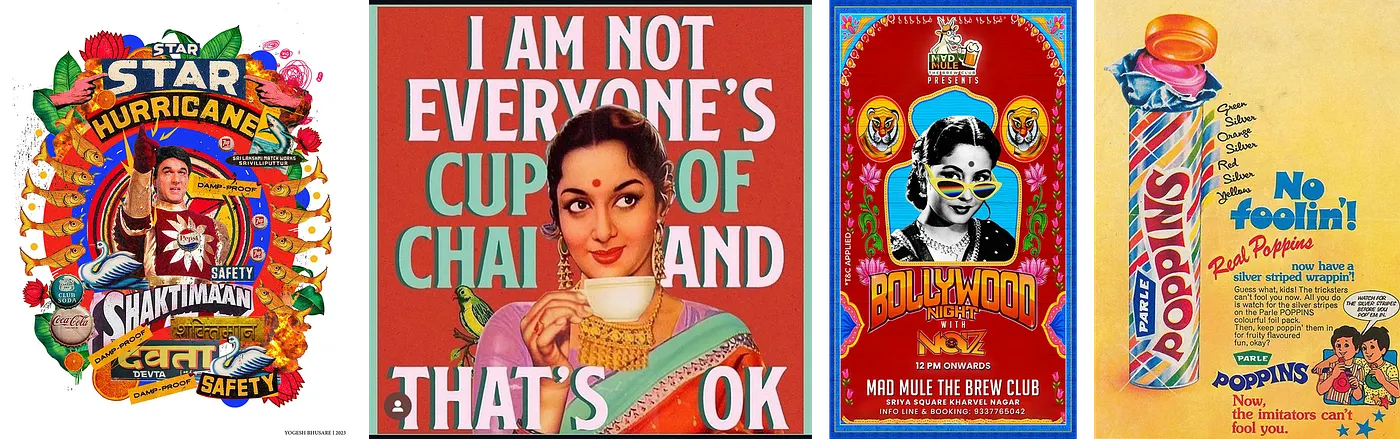 Kitsch style in visual art
Kitsch boldly elevates excess and “bad taste” to the status of ironic art. Plastic pink flamingos, glitter, and hyperbolic retro souvenirs turn visual communication into a provocative game.
- Use cases:
Ironic marketing,Music releases,Fashion experiments,Gen Z campaigns. - Design system elements:
- Typography: retro typefaces with neon outlines, inflated display lettering.
- Palette: toxic pink, turquoise, leopard print, gold glitter.
- Geometry: deliberate element overload, layering, plastic gloss.
- Mood: ironic, grotesque, expressive, carefree.
- Style pitfalls: serious premium minimalism and restrained classical elegance.
- AI concept formula:
18. Y2K
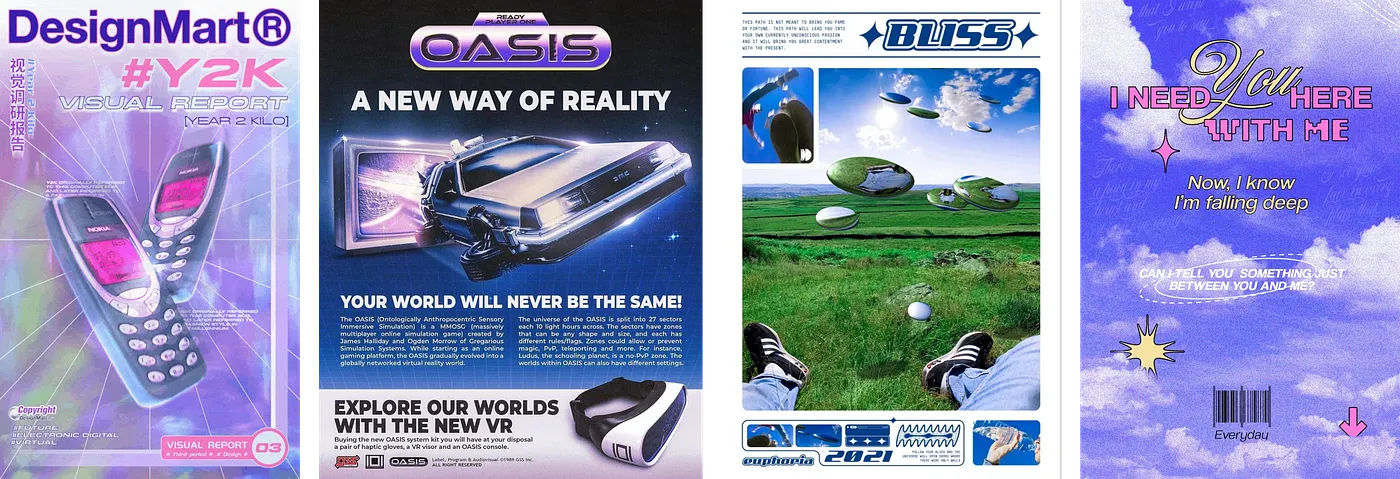 Y2K style in digital design
The 1999–2003 aesthetic was born from fascination with the early internet and fear of the “Y2K problem”: liquid chrome, translucent vivid plastic (iMac G3), pixel stars, and cosmic optimism.
- Use cases:
Gen Z fashion brands,Web3 projects,Streetwear,Music platforms. - Design system elements:
- Typography: volumetric bubble fonts, pixel display lettering.
- Palette: chrome, electric purple, lime green, iridescent metallic shifts.
- Geometry: stars, butterflies, puffy 3D buttons with high gloss.
- Mood: futuristic-nostalgic, energetic, bold.
- Style pitfalls: matte muted paper textures, warm dark wood.
- AI concept formula:
19. Pop Art
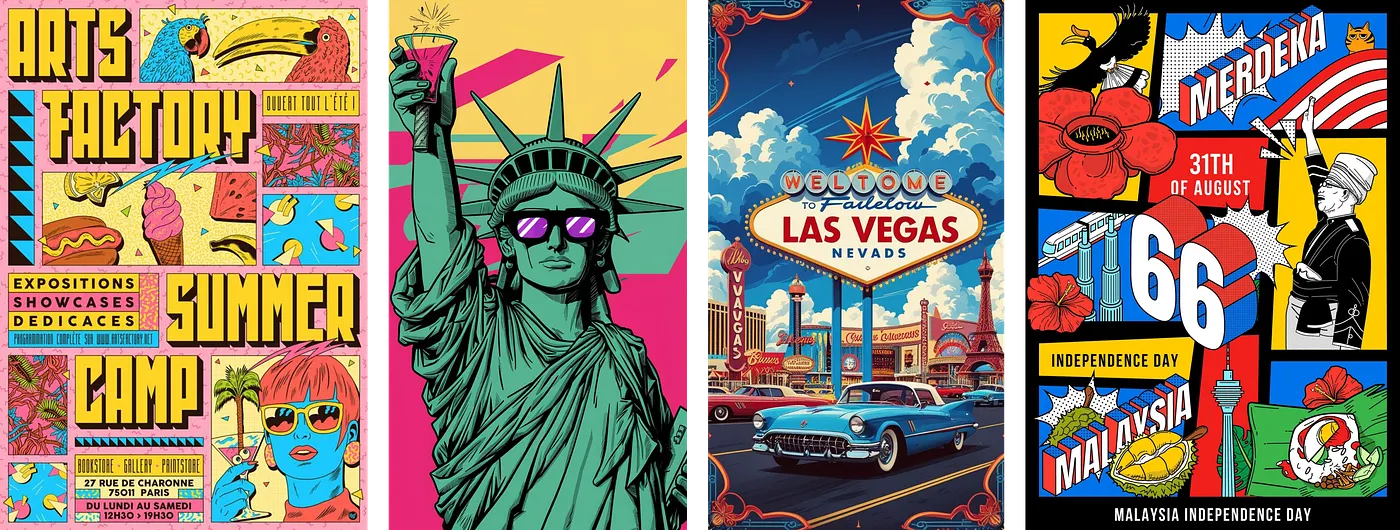 Pop Art style
Pop art of the 1950s–60s (Andy Warhol, Roy Lichtenstein) elevated mass culture to the status of high art: Ben-Day dots, comic speech bubbles with captions, screaming contrasts, and screen printing.
- Use cases:
Promotional campaigns,Snack and beverage packaging,Social media,Collaborations. - Design system elements:
- Typography: bold comic or poster grotesques with black outline shadows.
- Palette: pure yellow, bright red, saturated blue, bold black outlines.
- Geometry: halftone printing dots, speech bubbles, expressive splashes.
- Mood: explosive, commercial, loud, dynamic.
- Style pitfalls: soft photorealistic rendering without outlines, blurred gradients.
- AI concept formula:
20. Mid-Century Modern
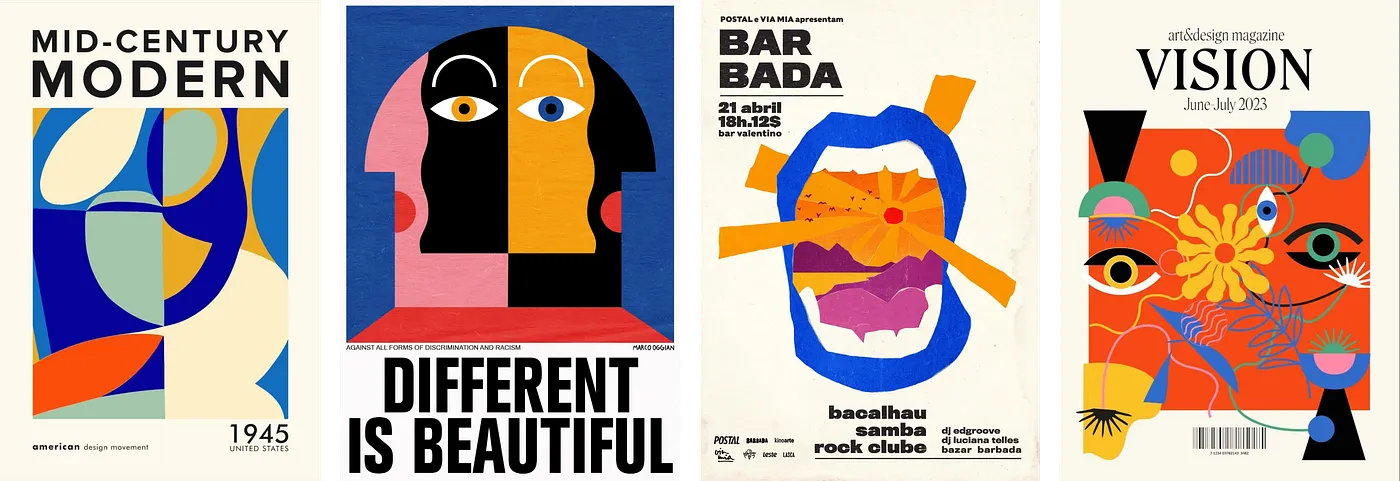 Mid-Century Modern style
The golden age of American design in the 1940s–60s (the Eames couple, Eero Saarinen): smooth biomorphic furniture on tapered legs, natural walnut veneer, warm tones, and intelligent simplicity.
- Use cases:
Furniture marketplaces,Interior magazines,Architecture,Premium lifestyle. - Design system elements:
- Typography: elegant mid-century grotesques (Futura, Neutraface).
- Palette: mustard, avocado, warm terracotta, dark walnut.
- Geometry: organic flowing curves, boomerangs, light slim proportions.
- Mood: intellectual, warm, mature, timeless.
- Style pitfalls: cold cyber-neon glows, rough unprocessed stone.
- AI concept formula:
21. Scrapbook
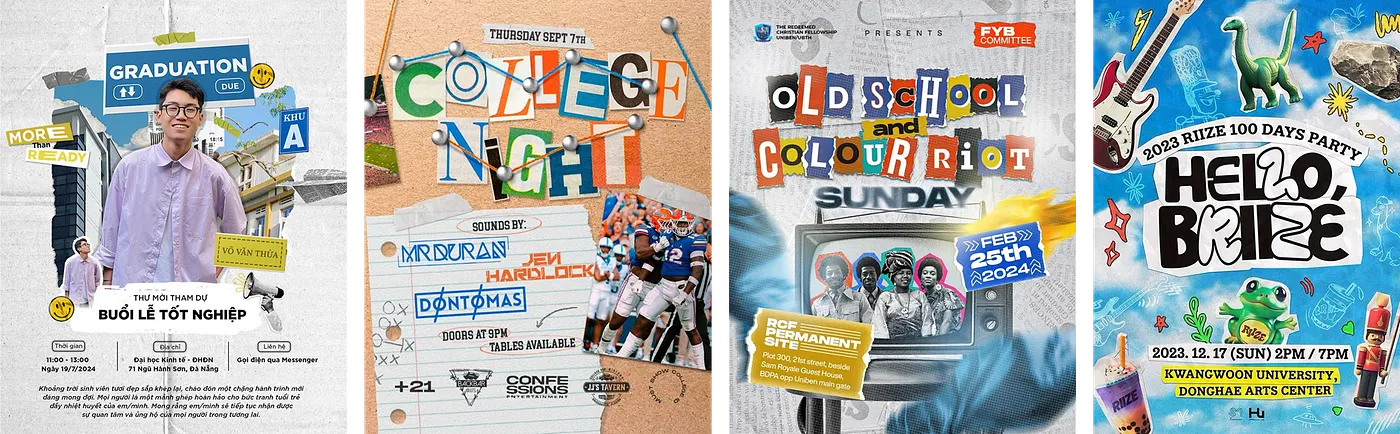 Scrapbook collage style
Scrapbook recreates the tactile warmth of a memory album: instant Polaroid photos, pieces of translucent washi tape, torn paper edges, and handwritten heartfelt notes.
- Use cases:
Journaling apps,Personal blogs,Community merch,Memory books. - Design system elements:
- Typography: handwritten organic typefaces, typewriter emulation.
- Palette: kraft paper, bleached photo borders, pastel translucent tapes.
- Geometry: free element tilt (-3° to +5°), torn edges, realistic paper peel shadows.
- Mood: soulful, warm, personal, sentimental.
- Style pitfalls: perfect vector lines, sterile corporate symmetry.
- AI concept formula:
7. Digital Futurism, Retrowave, and Cyberpunk (Styles 22–25)
This category explores human-machine interaction, neon-lit high-tech worlds, and internet underground culture.
22. Cybercore
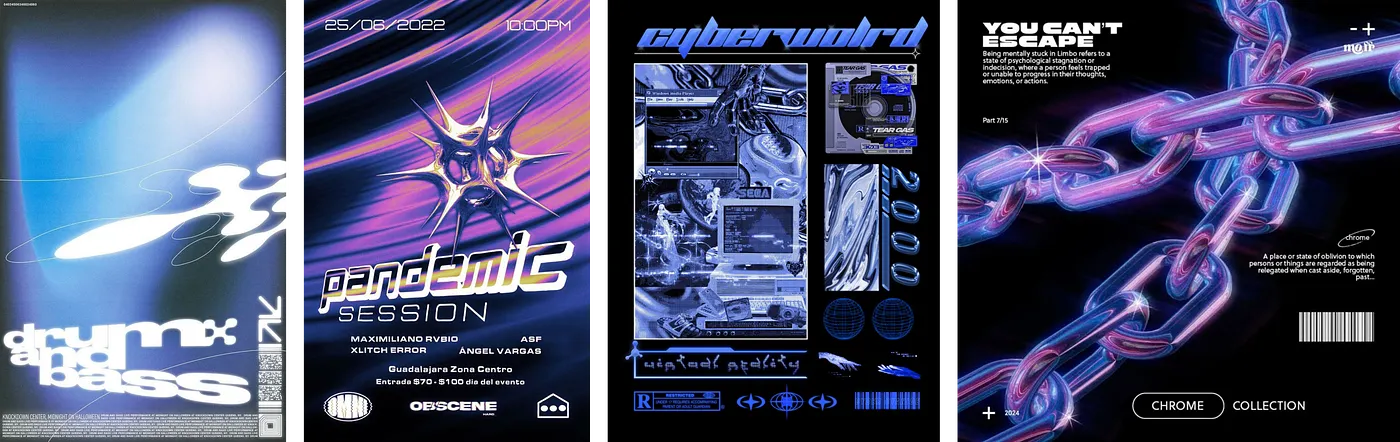 Cybercore style
Cybercore is inspired by early internet terminals, hacker consoles, and cybernetic HUD interfaces: green phosphor screens, hexadecimal code, circuit board traces, and digital glitches.
- Application domains:
Cybersecurity,Hacker platforms,Developer tools,Sci-Fi games. - Design system elements:
- Typography: monospaced console fonts (Fira Code, Source Code Pro).
- Palette: monochrome black, Matrix green, signal red.
- Geometry: angular HUD visors, crosshair grids, no border-radius (0px).
- Mood: tense, clandestine, technical, dystopian.
- Style pitfalls: warm sunlight, pastel natural tones.
- AI prompt formula:
23. Synthwave
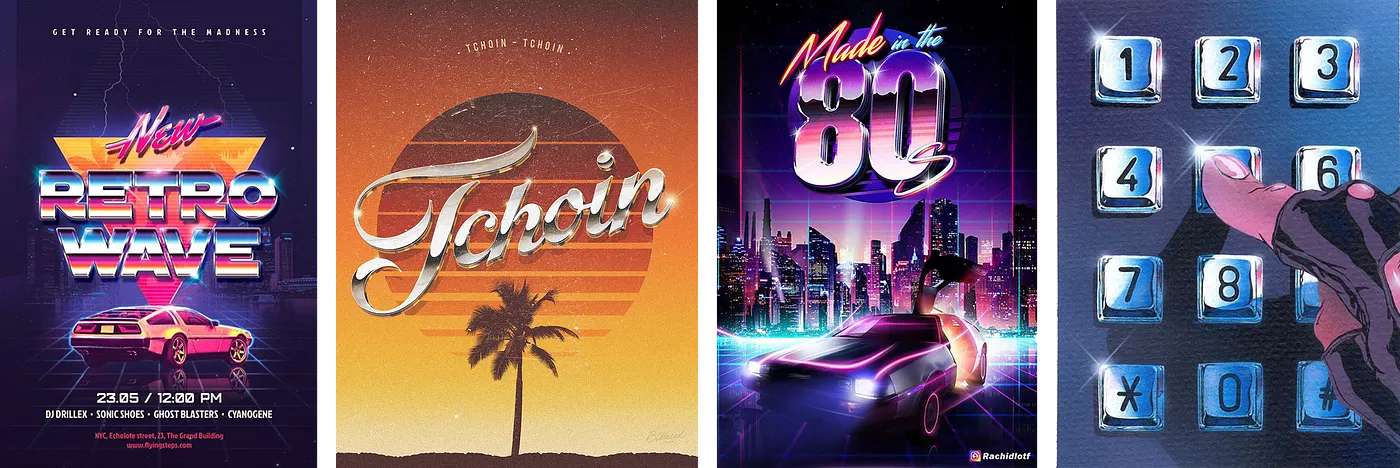 Synthwave retrofuturism style
Synthwave (Outrun) presents a 1980s vision of the future: neon perspective grid, chrome sports cars, a giant sun on the horizon, and a purple gradient over nighttime Miami.
- Application domains:
Music labels,Game arcades,Streaming,Night events. - Design system elements:
- Typography: slanted dynamic grotesques and chrome lettering at an angle.
- Palette: neon purple, magenta, electric cyan, black asphalt.
- Geometry: 3D perspective grid, striped circular gradients, metallic specular highlights.
- Mood: cinematic, energetic, nocturnal, kinetic.
- Style pitfalls: muted daytime pastels and white minimalism.
- AI prompt formula:
24. Vaporwave
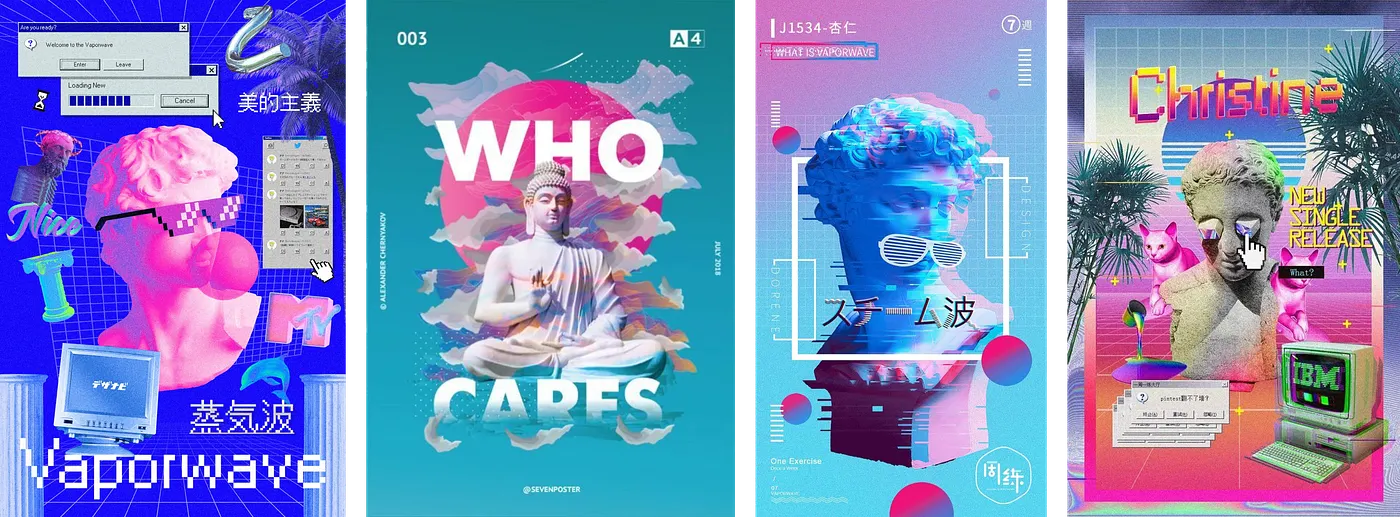 Vaporwave style
Vaporwave is a post-ironic satirical collage of early 1990s capitalism: marble busts of ancient philosophers, Windows 95 windows, Japanese glyphs, palm trees, and pastel lilac mist.
- Application domains:
Indie art platforms,Non-trivial branding,Lo-Fi music,Zines. - Design system elements:
- Typography: full-width Japanese text, system bitmap fonts such as MS Sans Serif.
- Palette: pastel lilac, mint blue, pale pink, pixel white.
- Geometry: checkerboard, gray dialog windows with raised 1990s buttons.
- Mood: melancholic, ironic, relaxed, surreal.
- Style pitfalls: sterile modern commercial clarity without grain.
- AI prompt formula:
25. Neo Frutiger Aero
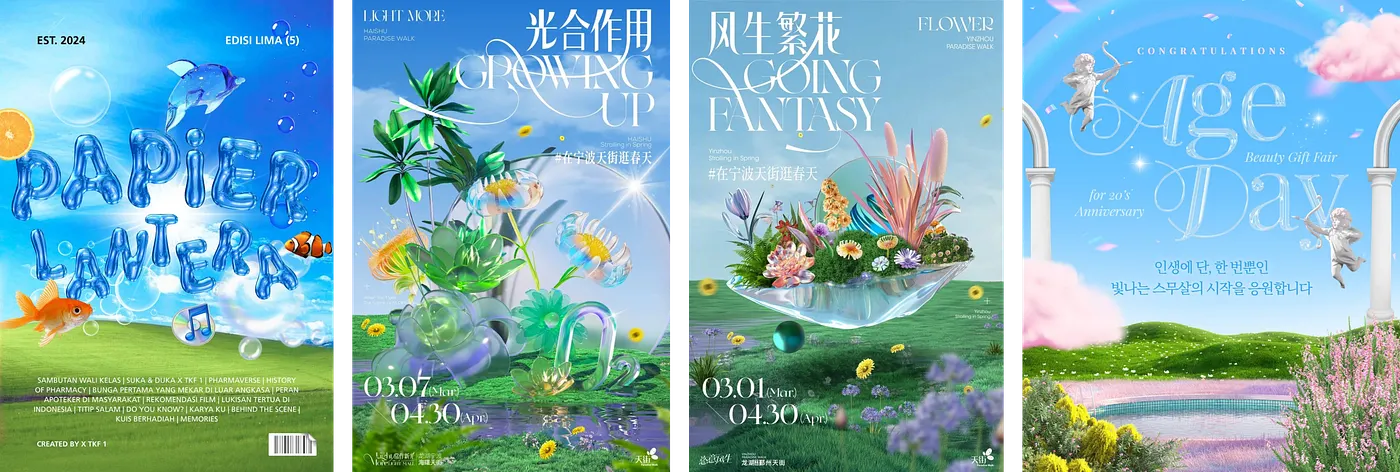 Frutiger Aero style
A revival of the Windows Vista, Mac OS X Aqua, and early iPhone aesthetics (2004–2012): transparent water bubbles, green hills under turquoise skies, glassy glossy buttons, and absolute technological optimism.
- Application domains:
Eco-fintech,Next-generation SaaS services,Cleaning and climate,Web3. - Design system elements:
- Typography: humanist grotesques with open apertures (Frutiger, Segoe UI).
- Palette: bright sky blue, fresh grass green, transparent white lens flare.
- Geometry: round and oval glossy buttons with highlights, smooth gradients, spheres.
- Mood: crystal-clear, optimistic, fresh, welcoming.
- Style pitfalls: dark grunge, matte gray rough surfaces, sharp angles.
- AI prompt formula:
8. Modern Styles for UI/UX and Digital Products (Styles 26–30)
These directions shape today's visual canon among the world's most progressive product companies (Apple, Stripe, Linear, Notion, Raycast).
26. Luxury Typography
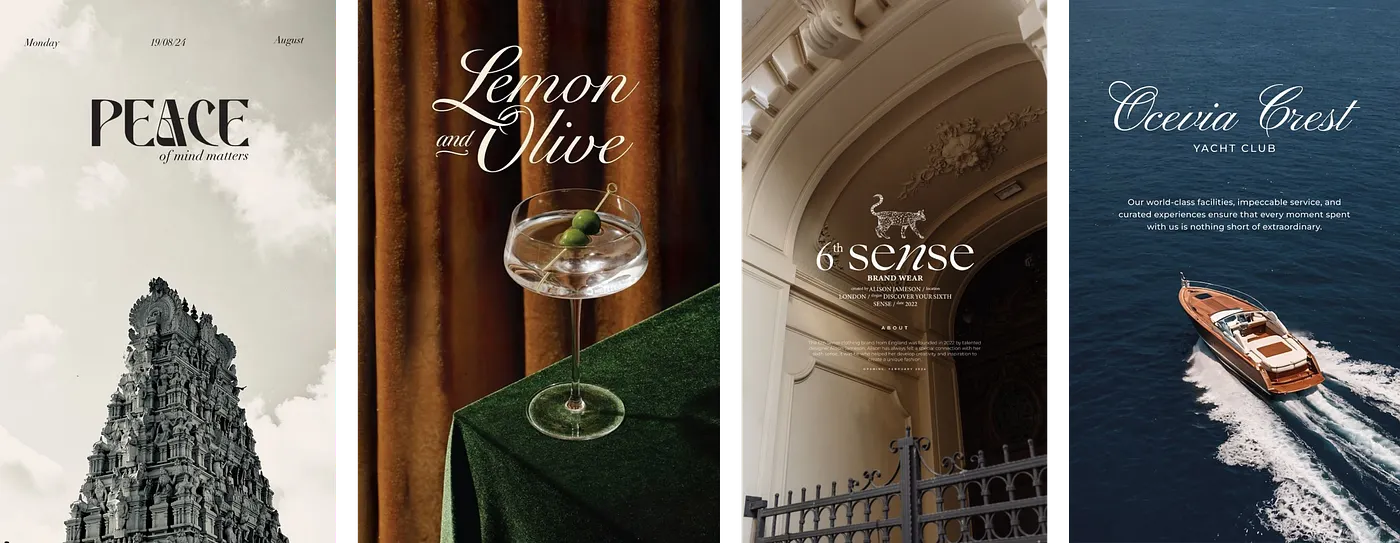 Luxury typography in design
An approach in which the letterform becomes an independent architectural object. Content is stripped of graphic noise, yielding space to high stroke contrast, refined kerning, and majestic ligatures.
- Use cases:
Premium fintech products,Fashion brands,Legal and consulting firms,Architecture. - Design system elements:
- Typography: premium serifs with high stroke contrast (Ogg, Playfair Display, Canela).
- Palette: monochrome black and white contrast, platinum, accent embossing.
- Geometry: generous spacing (negative space), minimal icons, emphasis on text rhythm.
- Mood: refined, confident, expensive, status-driven.
- Style traps: cheap cartoon illustrations, overloaded widgets, multicolored blocks.
- AI formula for concepts:
27. Bento Box
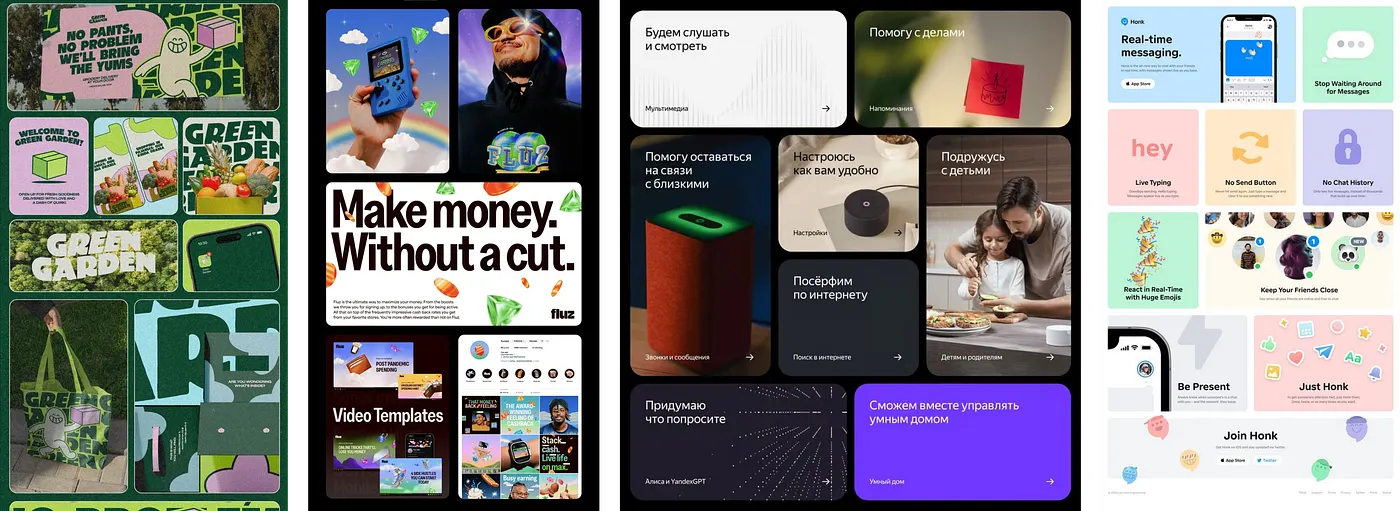 Bento box UI design
Bento Box organizes complex analytics and features into tidy modular containers of varying sizes, similar to a Japanese lunchbox. It has become a global standard for Apple presentations and productivity sites.
- Use cases:
Analytical dashboards,SaaS landing pages,Feature presentations,Portfolios. - Design system elements:
- Typography: compact grotesques with excellent microtypography (Inter, Geist, SF Pro).
- Palette: deep dark or light background, thin translucent card borders (
border: 1px solid rgba(255,255,255,0.08)). - Geometry: clear modular rounded containers (radius 16-24px), microicons, interactive badges.
- Mood: structured, modern, legible, technological.
- Style traps: chaotic layout that breaks the alignment grid.
- AI formula for concepts:
28. Glassmorphism
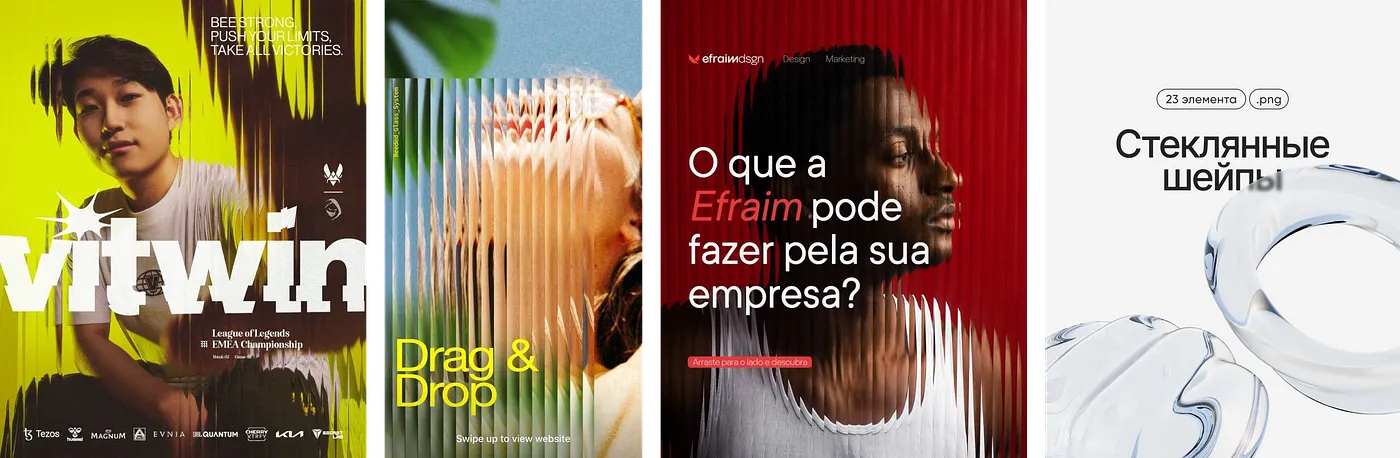 Glassmorphism style in web design
Glassmorphism models the physics of frosted translucent glass (backdrop-filter: blur). Elements float over colorful backgrounds, creating optical depth, visual lightness, and layering.
- Use cases:
Mobile OS (iOS, visionOS),Crypto wallets,Fintech cards,Modal windows. - Design system elements:
- Typography: grotesques with high legibility on nonuniform backgrounds.
- Palette: translucent white fill gradients (opacity 10-25%), bright gradient blobs on the backdrop.
- Geometry: thin 1px white border in the upper left corner to simulate a highlight on the glass facet.
- Mood: light, technological, spatial, futuristic.
- Style traps: flat opaque solid colors without blur or depth.
- AI formula for concepts:
29. Modular Typography
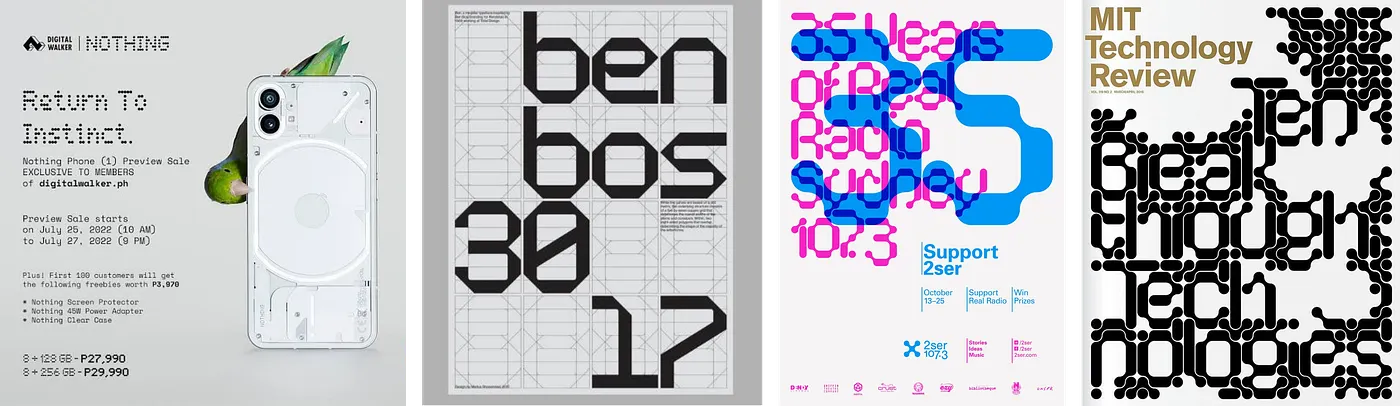 Modular typography
Typographic constructivism in which each letter is assembled from clear geometric modules (rectangles, circles, grids). It creates a strong architectural rhythm and an expressive visual language.
- Use cases:
Design festival identity,Architectural posters,Techno events,Experimental websites. - Design system elements:
- Typography: custom modular letterforms built on a strict mathematical raster.
- Palette: contrasting duotone combinations (black/white, graphite/orange).
- Geometry: block structure, repeated module steps, monumental rhythm.
- Mood: conceptual, engineered, avant-garde, strong.
- Style traps: smooth natural brush strokes and traditional round calligraphy.
- AI formula for concepts:
30. Neo-Brutalism
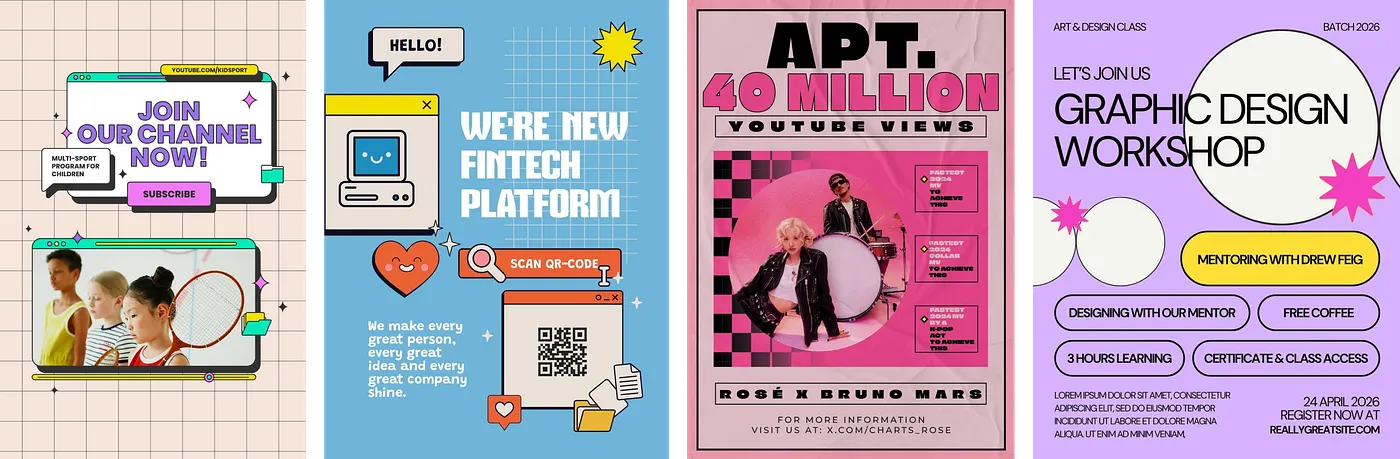 Neo-brutalism style in web interfaces
Neo-brutalism turned anti-design into a usable and cheerful interface trend (cult examples: Gumroad, Figma, Notion). It combines thick black outlines, hard opaque shadows, open bright colors, and bold simplicity.
- Use cases:
Creator platforms,Teen fintech,Digital goods marketplaces,Portfolios. - Design system elements:
- Typography: bold black grotesques at large point sizes (Public Sans, Lexend Mega).
- Palette: open canary yellow, bright purple, mint, black ink.
- Geometry: thick outlines (
border: 3px solid #000), hard offset shadows (box-shadow: 4px 4px 0px #000), radii 0-8px.
- Mood: honest, confident, direct, energetic.
- Style traps: soft blurred translucent shadows (blur), thin pastel lines.
- AI formula for concepts:
9. Gaming, Character, and Illustrative Aesthetics (Styles 31–35)
These approaches are meant to create an immediate emotional bridge between product and user through appealing characters, video game nostalgia, and handcrafted artistic texture.
31. Anthropomorphic
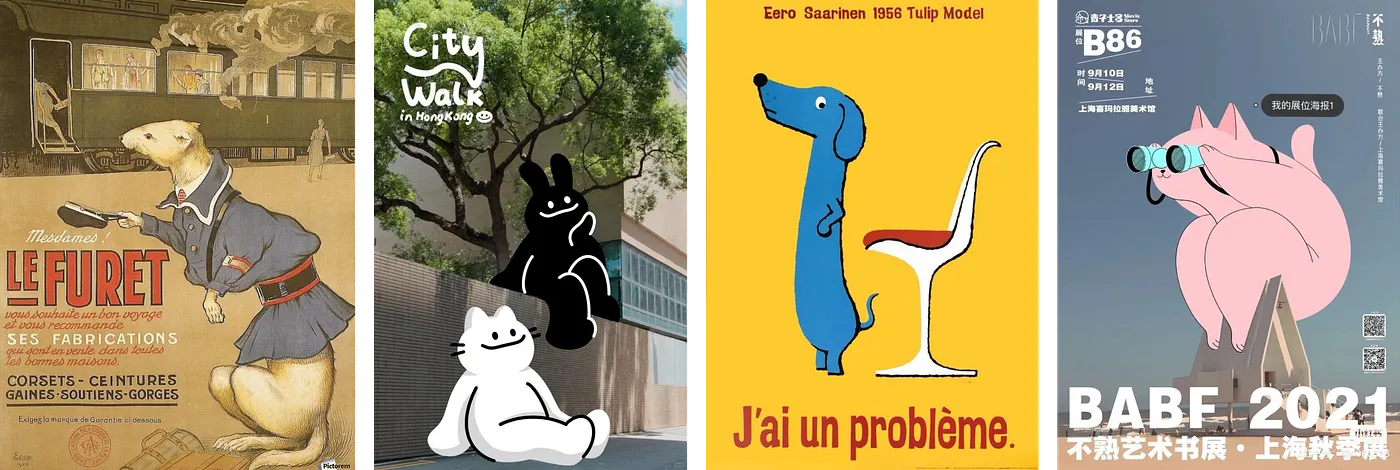 Anthropomorphic mascot style
The style imbues everyday objects, animals, or abstract graphic forms with human traits. It creates strong empathy and turns cold software into a warm companion.
- Application areas:
Mascots and onboarding,Children's apps,Gamified services (Duolingo),Sticker packs. - Design system elements:
- Typography: friendly rounded grotesques (Nunito, Quicksand).
- Palette: warm inviting tones, clean pastel gradients.
- Geometry: large expressive eyes, handles, legs, soft rounded shapes without sharp angles.
- Mood: playful, caring, inviting, safe.
- Stylistic pitfalls: the uncanny valley caused by excessive anatomical realism.
- AI formula for concepts:
32. Pixel Art
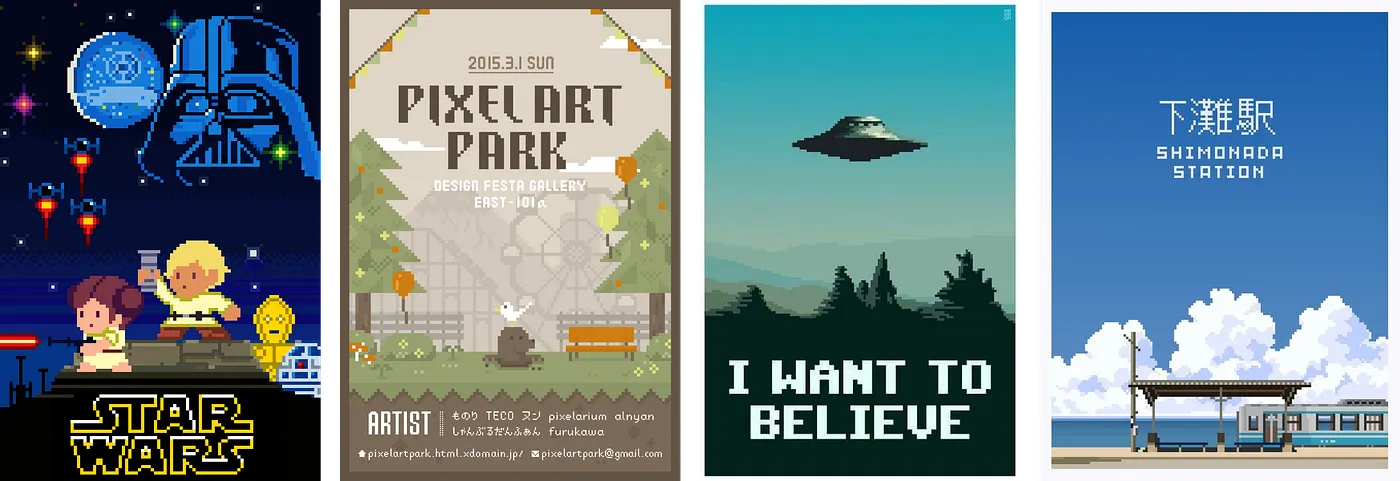 Pixel art in game development
Nostalgic retro art from the golden age of 8-bit and 16-bit video games. Each image is meticulously built from visible square pixels on a strict color grid without smoothing.
- Application areas:
Indie game development,Crypto avatars,Retro branding,Developer merch. - Design system elements:
- Typography: pixel fonts (Press Start 2P, Silkscreen).
- Palette: fixed retro palettes (Pico-8, GameBoy, NES).
- Geometry: pixel grid, complete absence of vector anti-aliasing.
- Mood: nostalgic, geeky, energetic, playful.
- Stylistic pitfalls: blurred smoothing filters and vector curves.
- AI formula for concepts:
33. Conceptual Sketch
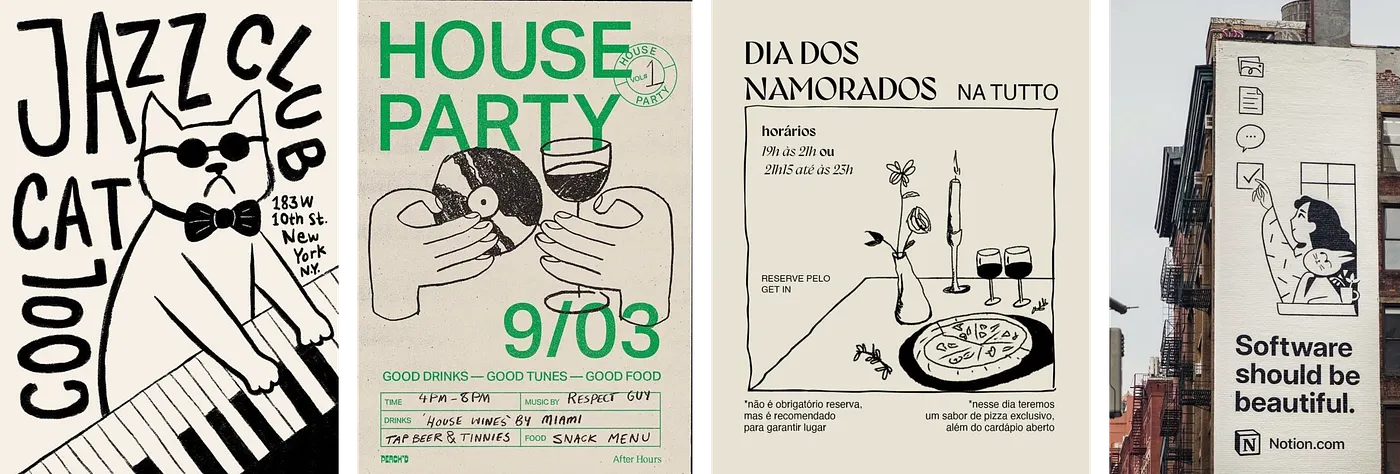 Conceptual sketch
A quick hand-drawn architectural or industrial sketch that captures the energy of an idea taking shape. Construction lines, shading, and dimension callouts open the curtain on a creative laboratory.
- Application areas:
Design case studies on Behance,Industrial design,Idea manifestos,Architecture. - Design system elements:
- Typography: engineering handwriting or drafting fonts.
- Palette: graphite gray, sepia, tracing paper or graph paper color.
- Geometry: crosshatching, auxiliary axes, lively pencil trace.
- Mood: creative, exploratory, authentic, lively.
- Stylistic pitfalls: polished final photorealistic 3D render without traces of the maker's hand.
- AI formula for concepts:
34. Pointillism
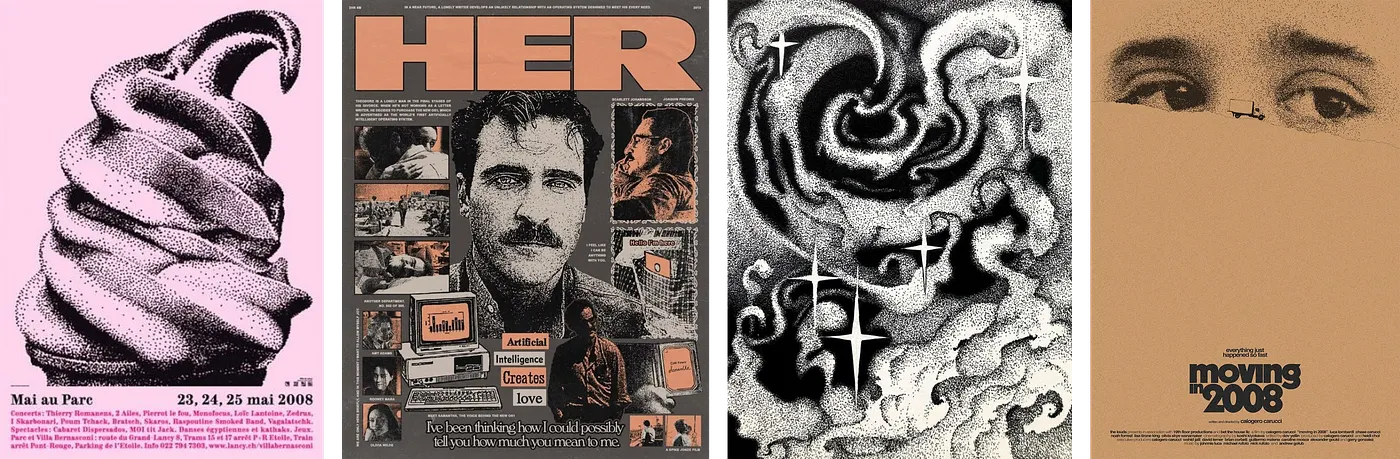 Pointillism style
The painting technique of Georges Seurat: the image is formed not by brushstrokes but by thousands of tiny dots of pure color that the viewer's eye optically blends at a distance.
- Application areas:
Gallery branding,Art journals,Illustrations for premium publications,Textiles. - Design system elements:
- Typography: delicate serifs with fine letterforms.
- Palette: rich impressionist palette of separated color dots.
- Geometry: artist canvas texture, surface vibration, absence of contour lines.
- Mood: calm, impressionistic, textured, vibrating.
- Stylistic pitfalls: solid flat vector fills and hard outlines.
- AI formula for concepts:
35. Kawaii
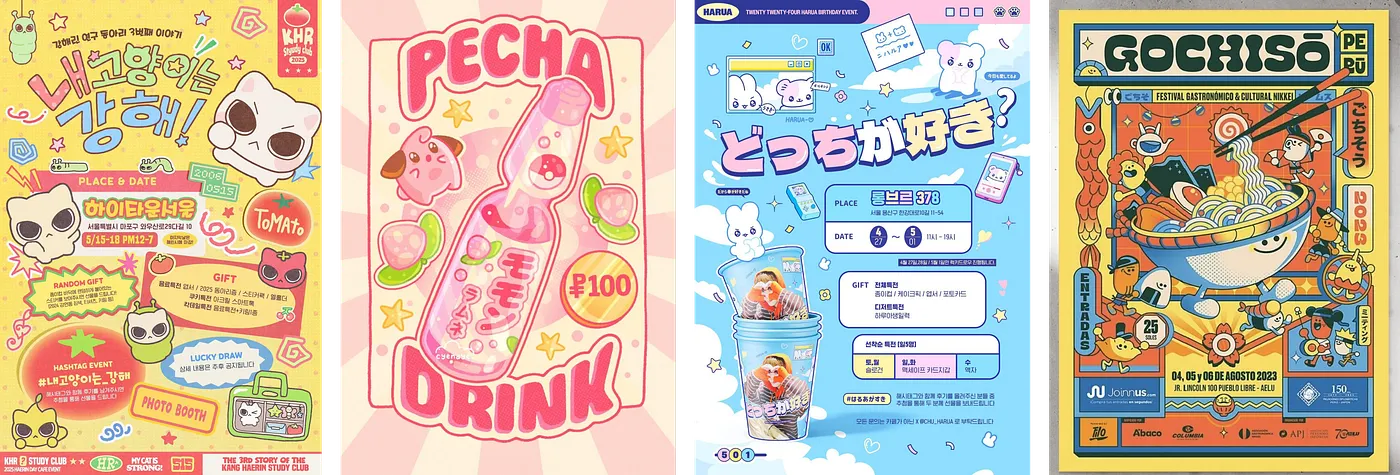 Kawaii style in graphics
Japanese aesthetics of cuteness and cozy innocence: round plump silhouettes, rosy cheeks, sweet pastel tones, and a positive perception of the surrounding world.
- Application areas:
Casual mobile games,Stationery,Children's services,Stickers and chats. - Design system elements:
- Typography: soft round sans-serif fonts (Baloo, Comic Neue).
- Palette: strawberry pink, mint, cream, lavender.
- Geometry: large radii (20–32px radius or full pill), rosy accents on shapes.
- Mood: kind, touching, warm, carefree.
- Stylistic pitfalls: aggressive angles, dark gloomy shadows, adult sternness.
- AI formula for concepts:
10. Dark, Mystical, and Academic Directions (Styles 36–42)
These aesthetics appeal to the romance of old libraries, secret societies, dramatic contrast of light and shadow, and occult symbolism.
36. Mystical Western
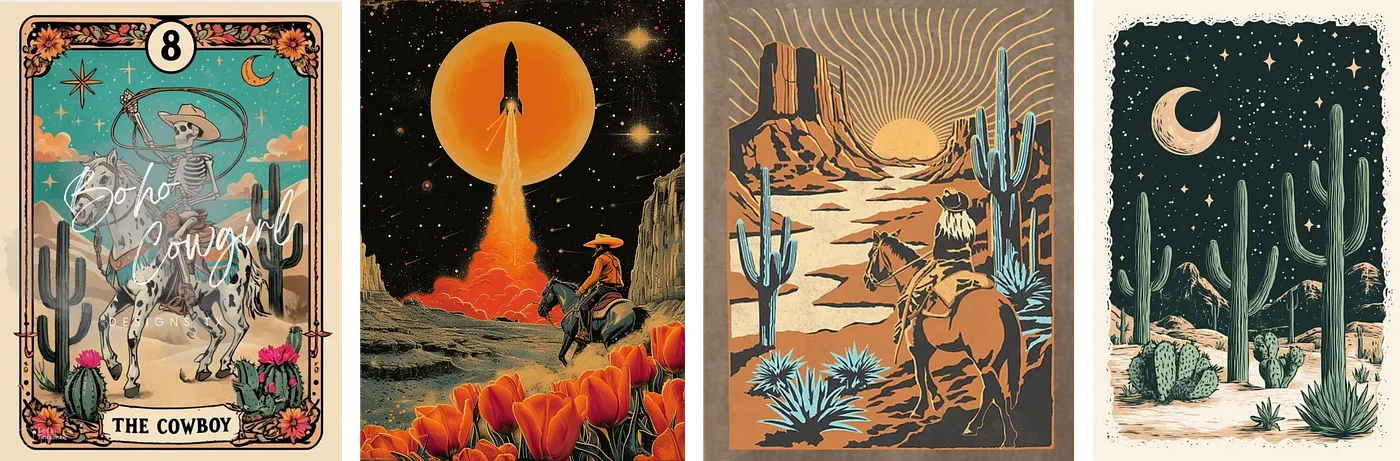 Mystical Western style
A symbiosis of Wild West romance with mysticism and esotericism: tarot cards, cacti under a starry sky, prairie skulls, celestial bodies, and engraved leather texture.
- Application domains:
Craft spirits,Tattoo studios,Astrology services,Music festivals. - Design system elements:
- Typography: Western serifs with characteristic central spurs.
- Palette: twilight indigo, terracotta, worn leather, gold dust.
- Geometry: engraved contours, astronomical arcs, moon phases.
- Mood: austere, magical, folkloric, grounded.
- Stylistic pitfalls: ultra-modern sterile urban high-tech.
- AI formula for concepts:
37. Tenebrism
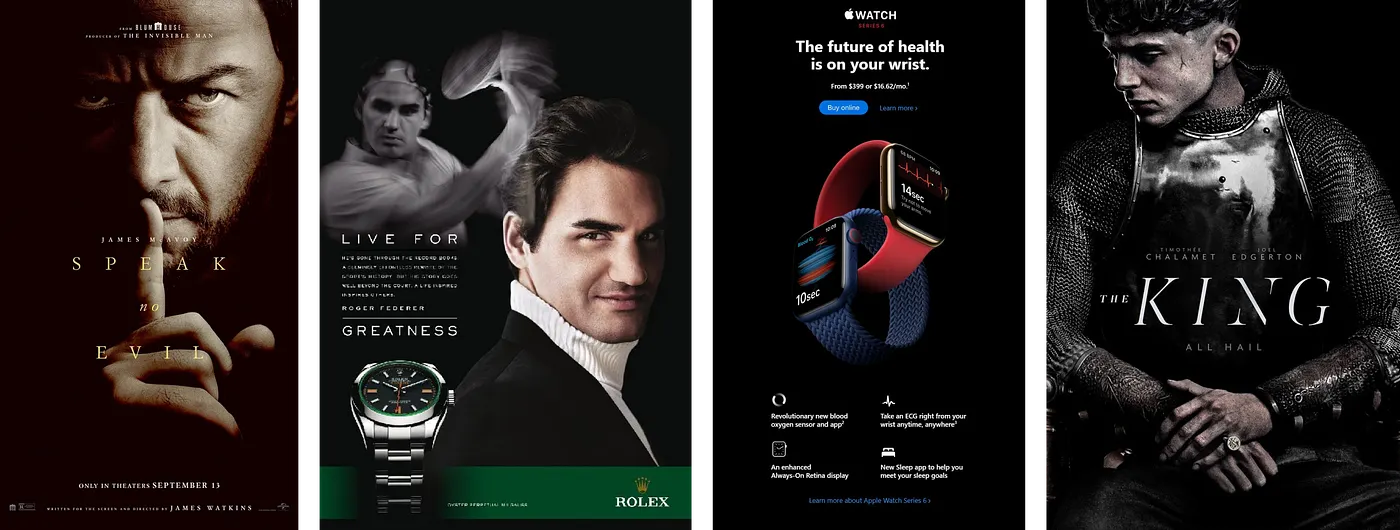 Tenebrism style in painting
A dramatic Baroque-era technique (Caravaggio): a hard beam of light literally pulls a figure out of impenetrable darkness, creating maximum psychological tension.
- Application domains:
Cinematic posters,Premium wines,Theatrical dramas,Art portfolios. - Design system elements:
- Typography: high-contrast classical serifs on a solid dark background.
- Palette: absolute black, warm golden light flash, deep ochre.
- Geometry: high chiaroscuro contrast, absence of background visual clutter.
- Mood: tense, profound, emotional, tragic.
- Stylistic pitfalls: flat diffuse daylight without deep shadows.
- AI formula for concepts:
38. Gothic
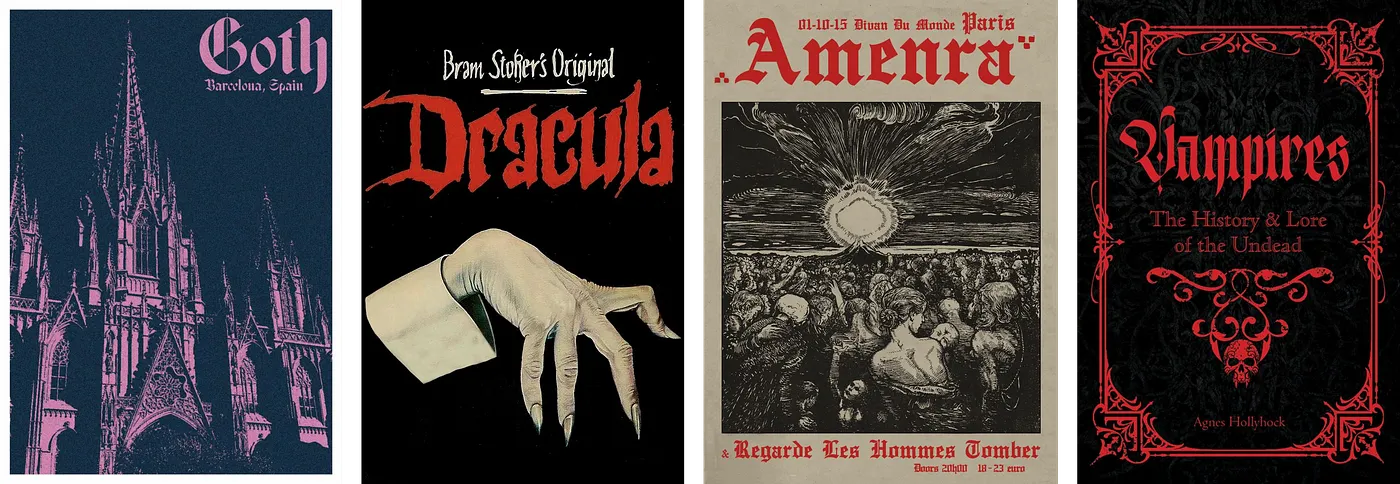 Gothic style in design
Gothic connects the grandeur of medieval cathedrals with dark poetry: pointed windows, stone gargoyles, stained-glass roses, and mystical solemnity.
- Application domains:
Fantasy games,Book covers,Alternative fashion,Rock culture. - Design system elements:
- Typography: Gothic blackletter fonts (Blackletter, Textura).
- Palette: deep anthracite, purple velvet, stained-glass carmine.
- Geometry: vertical pointed arches, monumental stone vaults.
- Mood: sacred, mystical, secretive, monumental.
- Stylistic pitfalls: cheerful pastel colors, light cartoon icons.
- AI formula for concepts:
39. Steampunk
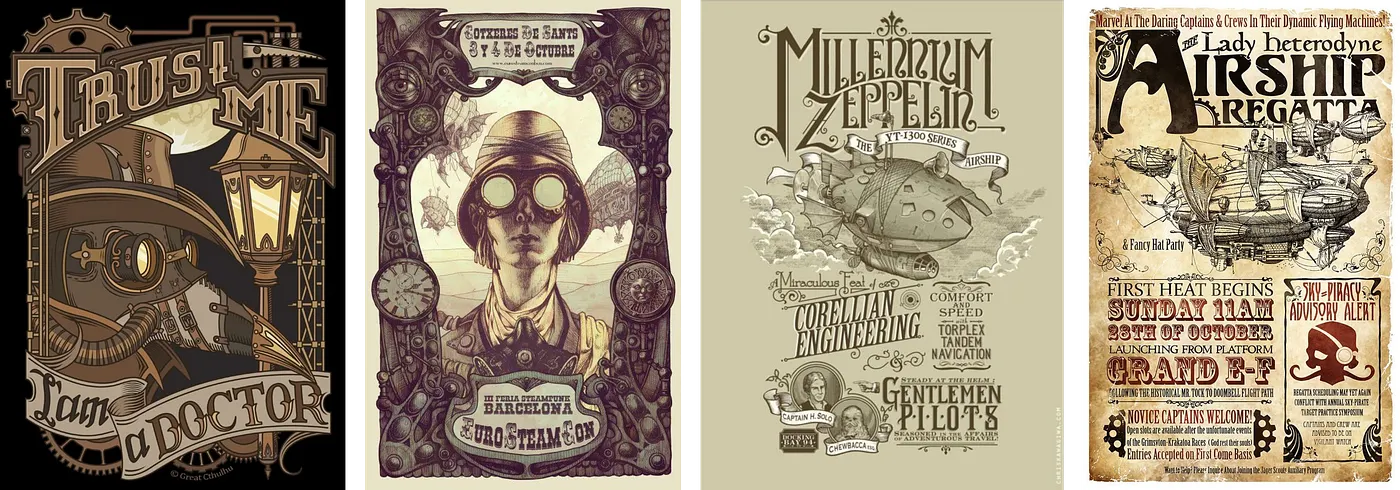 Steampunk style
Retrofuturism of the Victorian era, in which technological progress followed the path of complex mechanical devices and steam engines: copper pipes, gears, pressure gauges, and leather.
- Application domains:
Escape rooms,Tabletop games,Themed restaurants,Illustrations. - Design system elements:
- Typography: Victorian industrial serifs with rivets.
- Palette: polished brass, patinated copper, dark leather, smoky gray.
- Geometry: visible toothed gears, pressure gauges, rivets around card perimeters.
- Mood: inventive, adventurous, mechanical, vintage.
- Stylistic pitfalls: modern plastic, touchscreens, minimalist white high-tech.
- AI formula for concepts:
40. Coquette
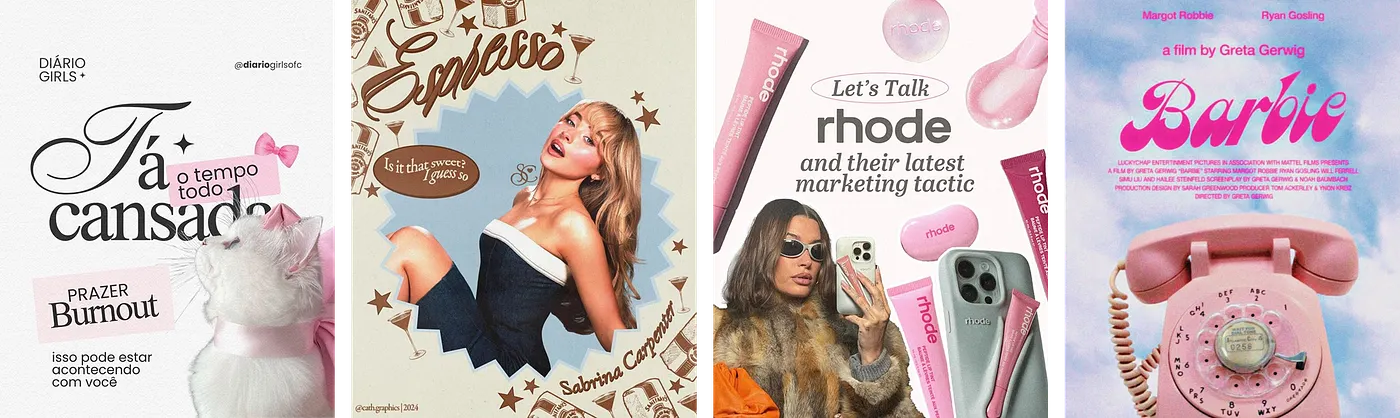 Coquette style
An ultra-feminine style of a romantic vintage boudoir: silk ribbons, satin bows, pearls, delicate lace, and the soft romantic flair of the early 2000s.
- Application domains:
Beauty brands,Women's lingerie,Fragrance,Digital fashion magazines. - Design system elements:
- Typography: refined serifs with delicate italics and thin strokes.
- Palette: pastel pink, pearl, cream, snow white.
- Geometry: bows, pearls, lace borders, soft gentle shadows.
- Mood: flirtatious, tender, airy, romantic.
- Stylistic pitfalls: rough metal, rigid industrial brutalism.
- AI formula for concepts:
41. Dark Magic Academia
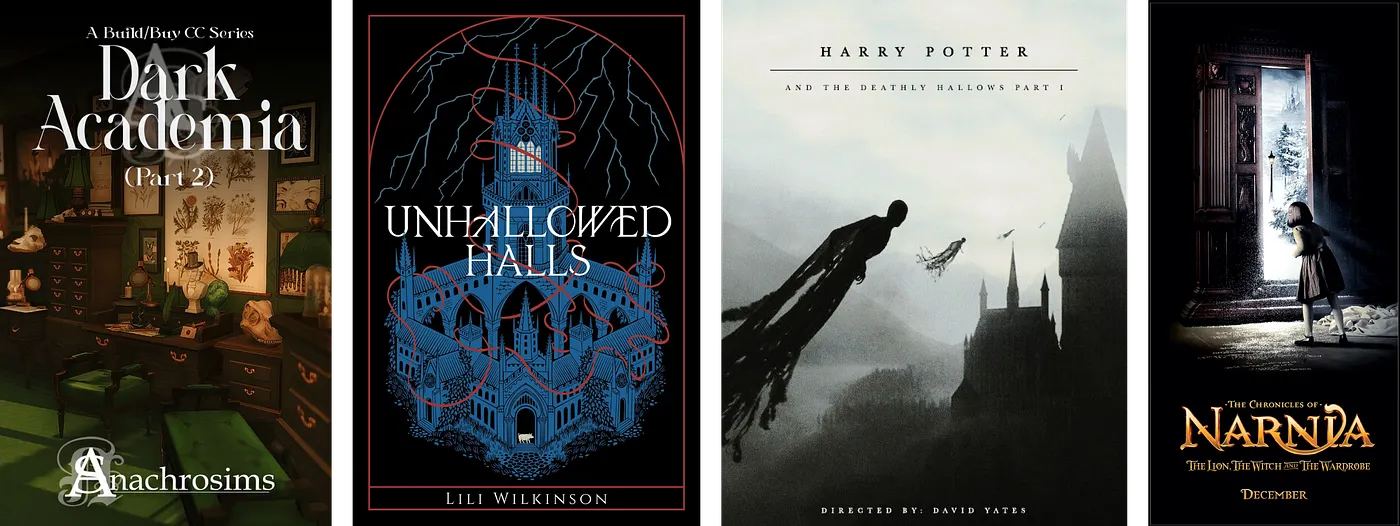 Dark Magic Academia style
The atmosphere of an ancient Oxford university intertwined with magic and alchemy: leather folios, dripping candles, astrolabes, black wood, and intellectual mystery.
- Application domains:
Puzzle games,Book clubs,Educational quests,Special events. - Design system elements:
- Typography: classical academic serifs with magical glyphs.
- Palette: dark oak, sealing-wax burgundy, antique gold, black wax.
- Geometry: book-engraving frames, seals, constellation diagrams.
- Mood: scholarly, secretive, noble, mystical.
- Stylistic pitfalls: modern fluorescent office lamps and plastic devices.
- AI formula for concepts:
42. Light Academia
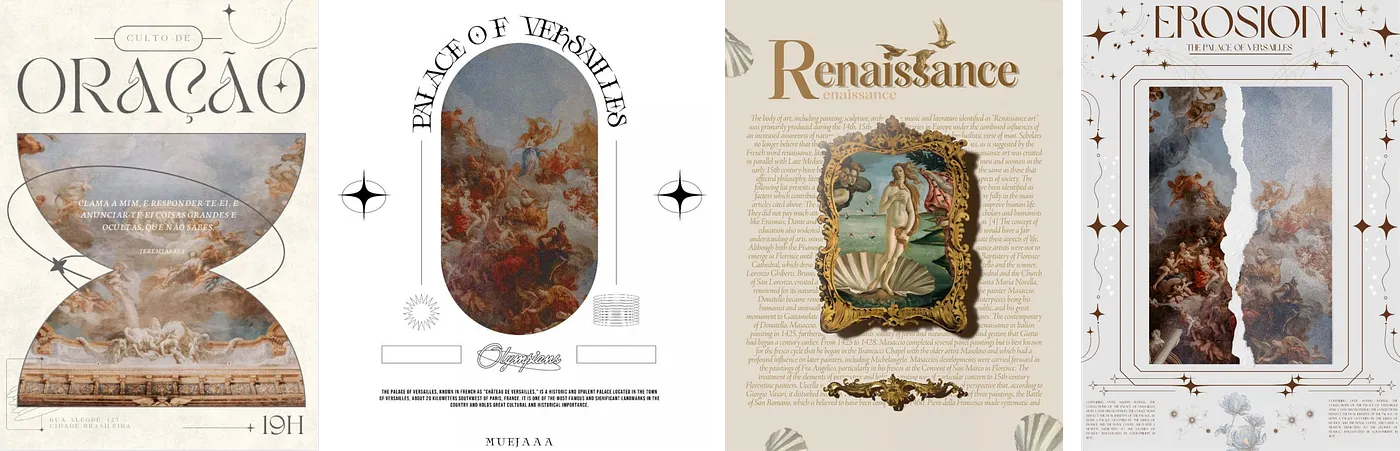 Light Academia style
The light sister of dark academia: a sunny summer noon in a European university library, volumes of poetry, cream linen, marble busts, and love of classical art.
- Application domains:
Educational platforms,Literary websites,Classic apparel,Art blogs. - Design system elements:
- Typography: clean refined serifs (Garamond, Caslon).
- Palette: melted-milk color, cashmere, sandy, bleached gold.
- Geometry: marble smoothness, wide text columns, sunlight.
- Mood: intellectual, calm, poetic, warm.
- Stylistic pitfalls: dark Gothic horror, screaming neon colors.
- AI formula for concepts:
11. Experimental, Ethereal, and Conceptual Directions (Styles 43–50)
These directions break traditional composition standards. They use optical illusions, weightless fluid forms, surreal metaphors, and unusual technique combinations.
43. Aurora
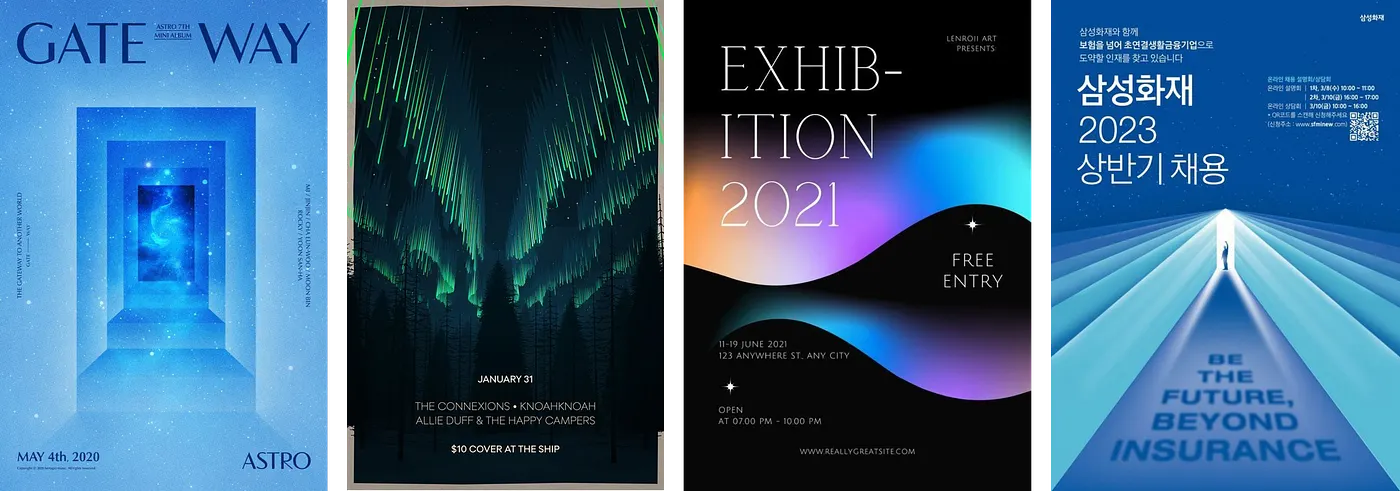 Aurora graphic style
Inspired by the northern lights, the Aurora style works with blurred multilayered neon gradients, fluid waves, and gentle inner glow.
- Use cases:
Sleep and relaxation apps,Space services,Modern technology platforms. - Design system elements:
- Typography: thin minimalist grotesques on dark or milky backgrounds.
- Palette: smooth transitions of turquoise, violet, neon pink, and deep blue.
- Geometry: blurred organic blobs (mesh gradients), absence of hard edges.
- Mood: calming, cosmic, futuristic, meditative.
- Style traps: rough black frames and pixel noise.
- AI formula for concepts:
44. Ethereal
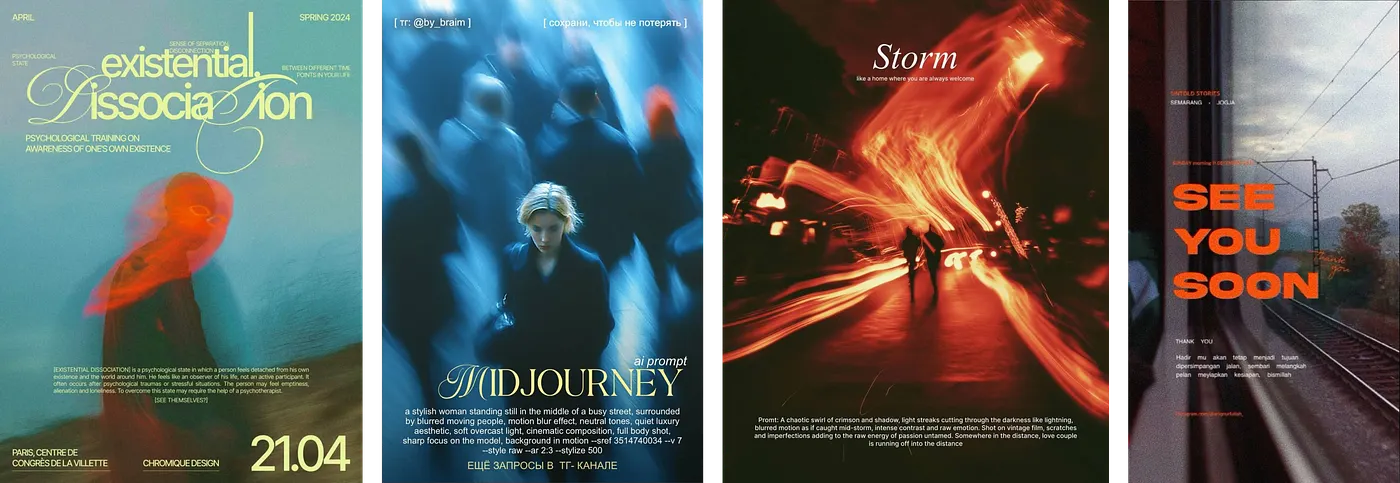 Ethereal design style
The Ethereal style captures the weightlessness of light, morning mist, and translucent silk. It creates a sense of flight and refined purity.
- Use cases:
Haute Couture perfumery,Bridal houses,Spa brands,Yoga services. - Design system elements:
- Typography: ultra-thin light serifs with wide letter-spacing.
- Palette: pearl, milky white, hazy smoky gray.
- Geometry: low contrast, feathered shadows, weightless layers.
- Mood: weightless, pure, delicate, elevated.
- Style traps: heavy stone textures, harsh high contrast.
- AI formula for concepts:
45. Graffiti
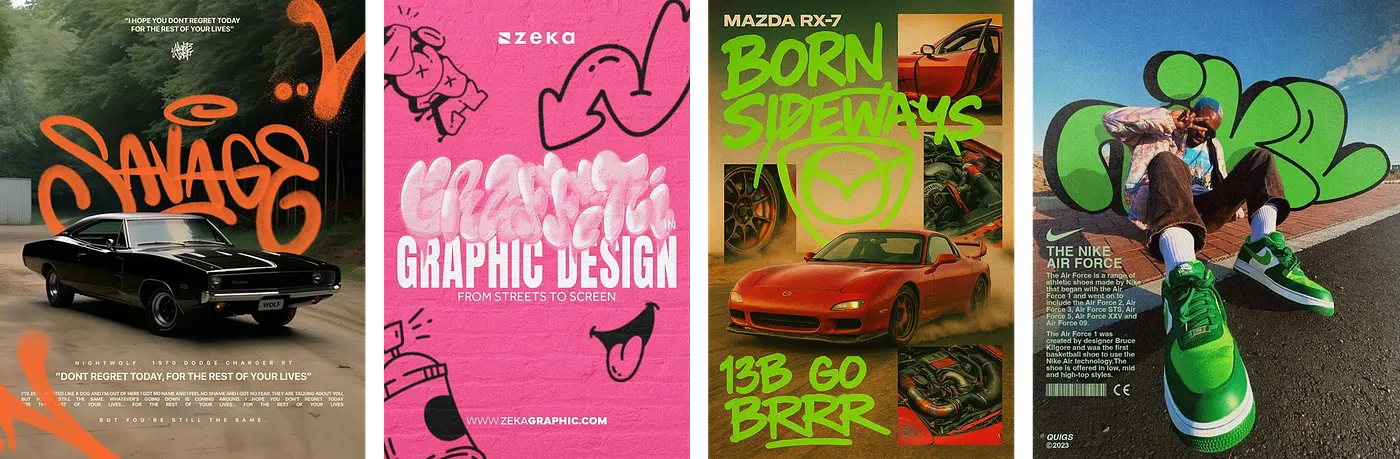 Graffiti style
The street voice of megacities: spray paint with drips, stencils, concrete walls, dynamic tags, and rebellious urban energy.
- Use cases:
Streetwear,Skate culture,Energy drinks,Hip-hop events. - Design system elements:
- Typography: free Wildstyle fonts, stencil fonts.
- Palette: neon spray on gray weathered concrete.
- Geometry: paint drips, splatters, urban brick and asphalt textures.
- Mood: bold, free, rebellious, urban.
- Style traps: sterile white corporate grid without life.
- AI formula for concepts:
46. Mixed Media
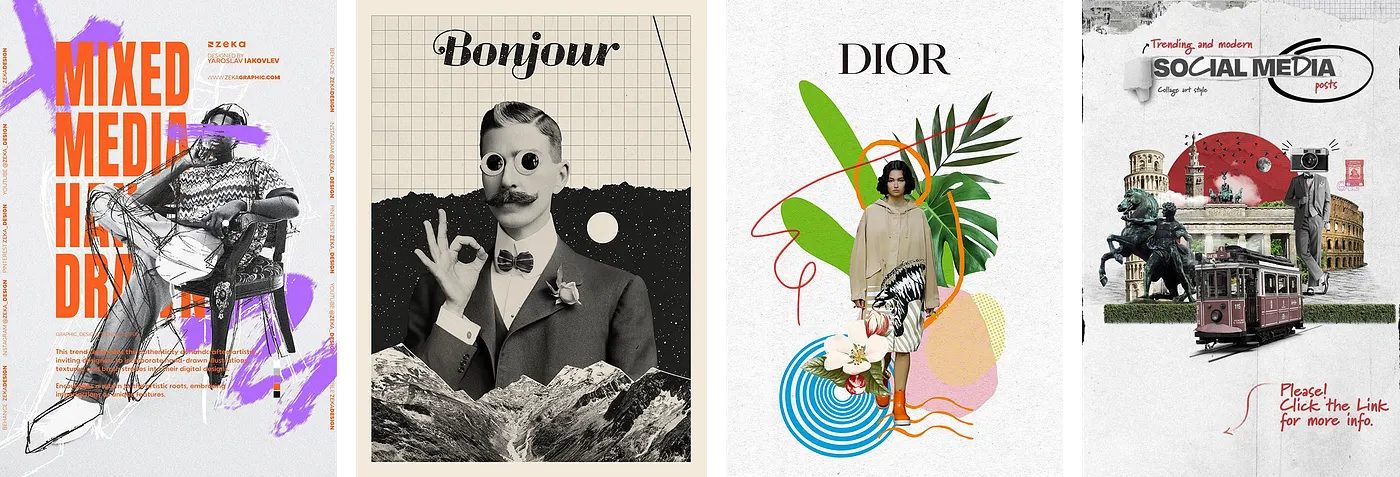 Mixed media collage style
Mixed media combines analog and digital worlds in one work: torn photographs, acrylic strokes, newspaper text, vector lines, and neon accents.
- Use cases:
Art journals,Album covers,Creative festivals,Modern exhibitions. - Design system elements:
- Typography: collage lettering, combinations of different font families.
- Palette: monochrome photo with bright flashes of pure artist paint.
- Geometry: layered paper textures, free palette-knife strokes.
- Mood: experimental, tactile, intellectual, multilayered.
- Style traps: monotonous flat fills without textural variety.
- AI formula for concepts:
47. Surrealism
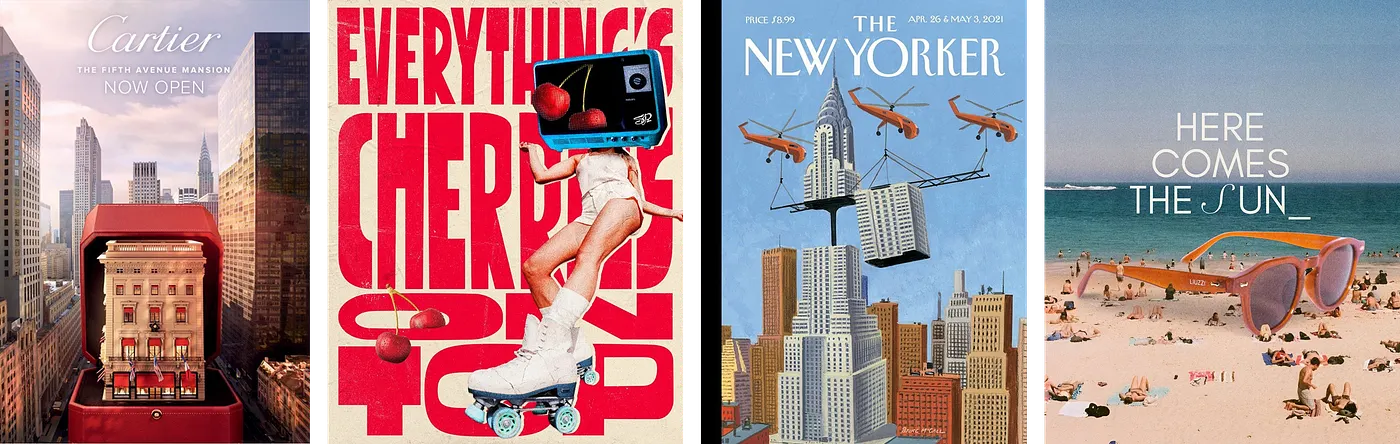 Surrealism in visual art
Surrealism (Salvador Dalí, René Magritte) breaks the laws of physics, space, and everyday logic in favor of bold metaphors, melting clocks, and subconscious imagery.
- Use cases:
Conceptual advertising,Art projects,Book illustration,Idea-driven posters. - Design system elements:
- Typography: unusual letter placement in space, scale play.
- Palette: surreal twilight skies, desert horizons.
- Geometry: paradoxical combinations of incompatible objects.
- Mood: hypnotic, philosophical, dreamlike, provocative.
- Style traps: banal everyday photorealism without a paradox idea.
- AI formula for concepts:
48. South West / Wild West
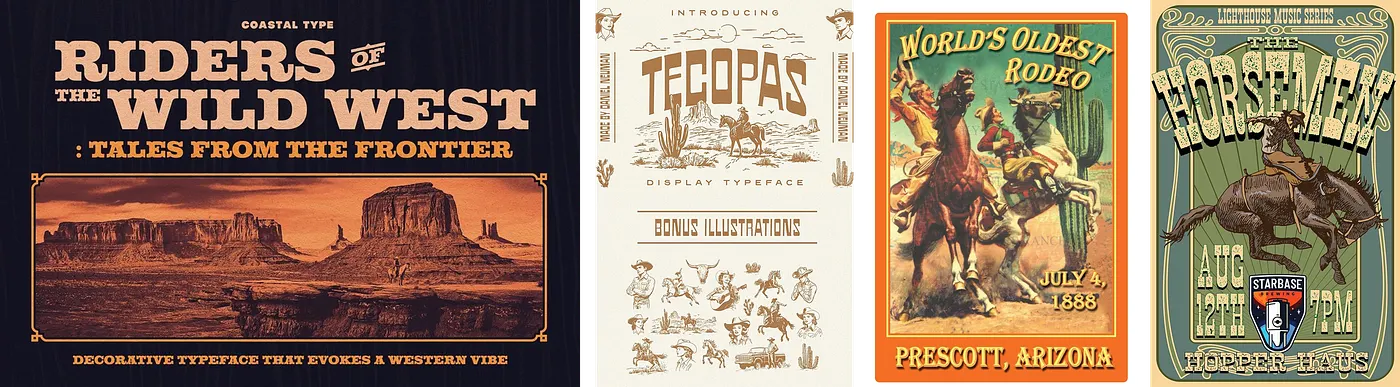 Southwestern Wild West style
Canyon sun, cowboy ranches, and Native American patterns: terracotta, denim, turquoise stones, leather, and the warm glow of a desert sunset.
- Use cases:
Outdoor brands,Meat restaurants and barbecue,Whiskey brands,Country festivals. - Design system elements:
- Typography: classic sturdy Western serifs.
- Palette: red sandstone, turquoise, denim, sun-bleached grass.
- Geometry: Navajo geometric motifs, worn leather with stitching.
- Mood: rugged, authentic, natural, sun-hardened.
- Style traps: cold plastic and sterile technological minimalism.
- AI formula for concepts:
49. Nautical
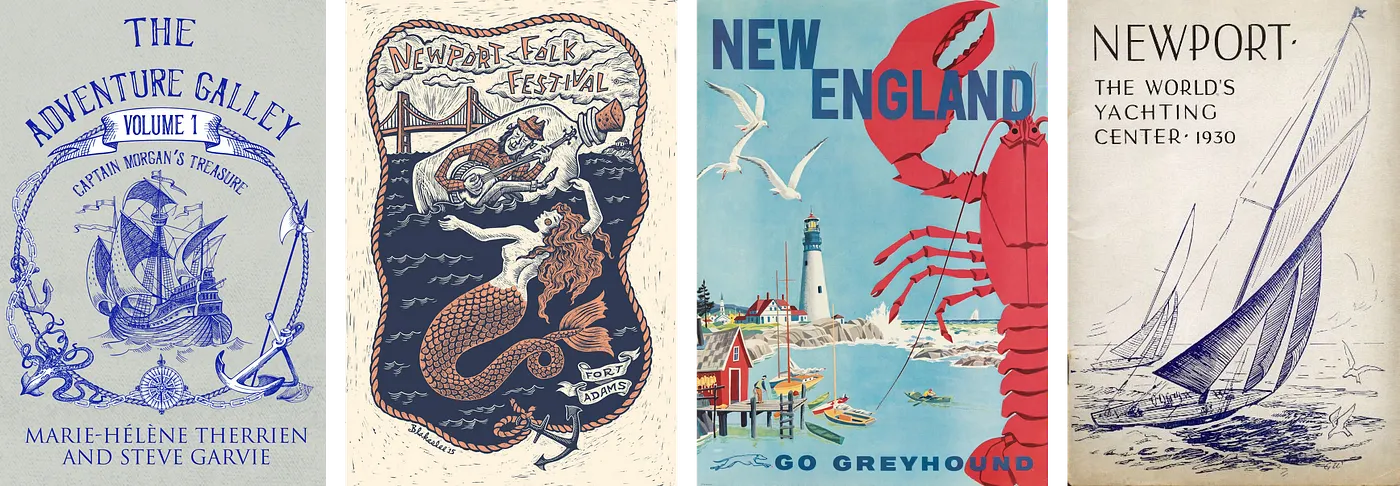 Nautical style
The ocean breeze: white-blue Breton stripes, manila ropes, polished marine brass, compasses, and coastal freshness.
- Use cases:
Yacht clubs,Seaside resorts,Fish restaurants,Summer wardrobe. - Design system elements:
- Typography: classic marine stencil fonts or clean grotesques.
- Palette: deep Navy Blue, snow white, brass, sand color.
- Geometry: even Breton stripes, ropes, anchors, portholes.
- Mood: fresh, orderly, noble, open.
- Style traps: dirty urban smog, gloomy heavy textures.
- AI formula for concepts:
50. Rebus
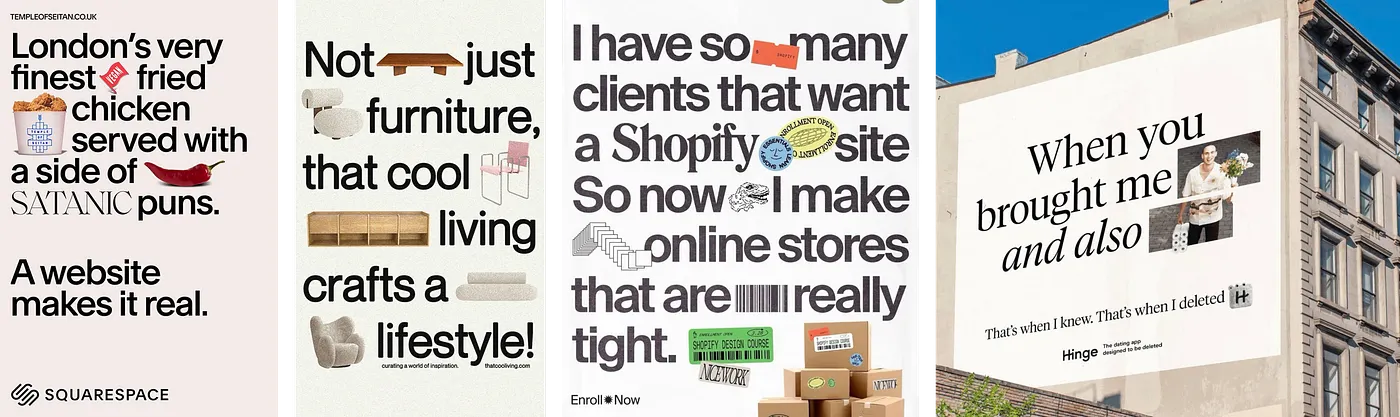 Rebus graphic style
A graphic game in which pictograms, letters, and images replace words (famous example: Paul Rand's IBM Eye-Bee-M poster). It turns reading into an engaging intellectual interaction.
- Use cases:
Educational platforms,Creative branding,Puzzles,Interactive advertising. - Design system elements:
- Typography: simple pictographic signs that harmoniously replace letters in a word.
- Palette: clean flat colors of the Swiss design school.
- Geometry: concise silhouettes, modular proportions, witty composition.
- Mood: intellectual, witty, playful, inventive.
- Style traps: excessive realism that kills the ease of sign recognition.
- AI formula for concepts:
12. Style Hybridization in Product Design and Branding
Today's strongest design systems emerge not from blindly copying a single style, but from precisely crossing two contrasting aesthetic DNAs:
- 1. Organic Minimalist SaaS (Japandi + Bento Box UI):
- Idea: Neat modular Bento Box cards rendered in light oak, linen, and warm beige Japandi backgrounds.
- Result: A product interface that evokes deep calm and stands out among cold gray competitors.
- 2. Quiet Luxury Tech (Luxury Typography + Glassmorphism + Neoclassical):
- Idea: Translucent frosted Glassmorphism on a Neoclassical Roman marble pedestal with refined serifs from Luxury Typography.
- Result: A perfect visual language for private banking, crypto investment clubs, or exclusive premium services.
- 3. Neo-Memphis Creator Platform (Memphis + Neo-Brutalism):
- Idea: Bold black borders and shadows of Neo-Brutalism, complemented by playful geometric zigzags and a Memphis palette.
- Result: A lively, optimistic interface for a creative marketplace (like Gumroad or Typeform).
- 4. Cyber-Gothic (Gothic + Cybercore):
- Idea: Pointed medieval stone cathedral arches wrapped in fiber-optic cables with phosphor-green terminal holograms.
- Result: A cult visual for dark-future games or technology events.
13. Common design mistakes: how to avoid turning a style into visual chaos
When teams implement styles in their interfaces or prompts, three mistakes occur most often:
- 1. UI token inconsistency: Mixing incompatible geometry, such as using 24px border-radius in Brutalism or 3px thick black borders in Ethereal. A design system must have consistent rules across the entire component library.
- 2. Lack of typographic discipline: Using more than two type families on a single screen. If the style is complex and decorative (Victorian, Memphis), the supporting UI font must be a neutral grotesque.
- 3. AI prompt hallucinations caused by missing negative tokens: If you generate moodboards for Bauhaus, the neural network defaults to adding photorealistic 3D smoke. Always remove unwanted elements:
--no photorealistic 3d, smoke, glossy reflections.
14. Consolidated Style Selection Matrix for Design Systems and Products
A quick navigator for choosing the aesthetic foundation of your next design system:
| Product Direction | Recommended Styles | Primary System Objective | Base Tokens (Fonts / Radii / Textures) |
|---|---|---|---|
| Fintech, Premium, and Investments | Neoclassical, Luxury Typography, Glassmorphism | Trust, status, reliability | High-contrast serifs / Radius 0–8px / Marble, frosted glass |
| B2B SaaS and Productivity | Bento Box, Bauhaus, Modular Typography | Scannability, order | Neutral grotesques / Radius 16–24px / Clean background, thin borders |
| Wellness, Health, and Meditation | Japandi, Wabi Sabi, Aurora, Ethereal | Stress reduction, coziness | Open grotesques / Soft radii / Oak, linen, flowing gradients |
| Web3, Gaming, and Innovation | Cybercore, Synthwave, Neo Frutiger Aero, Pixel Art | Drive, future feeling | Monospace or display typefaces / Chrome, neon, glass |
| Creative Economy and Youth | Neo-Brutalism, Pop Art, Memphis, Y2K | Boldness, self-expression | Bold grotesques / 3px black outlines / Offset hard shadows |
| Eco Brands, Craft, and Culinary | Cottagecore, Bohemian, Shabby Chic | Home warmth, authenticity | Cozy serifs / Natural radii / Wood, clay, textiles |
Next Steps and Development
Continue deepening your knowledge of digital product architecture with materials from our library:
- Explore the term prompt engineering to optimize interactions with language models.
- Learn how latent space works to more precisely guide image generation.
- Study our guide to interior design prompts with real cases of space composition.
- Review the overall prompt engineering roadmap for 2025–2026.
Use this classification as the foundation for your design systems, turn chaotic client edits into a systematic aesthetic language, and create world-class products!