Anthropic Files for IPO: Revenue Surge, Huge Losses, and Founder Control
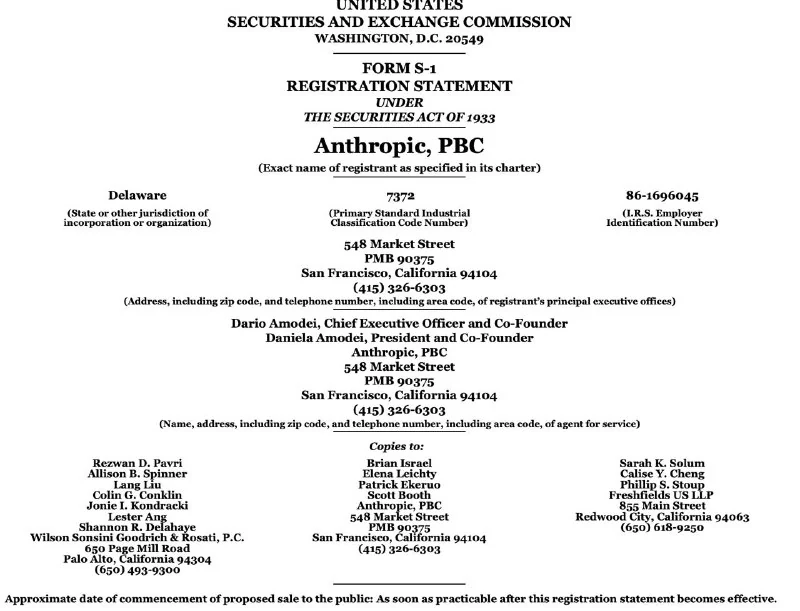
Anthropic has officially filed an S-1 registration statement with the SEC, revealing explosive revenue growth, massive reported losses, and a governance structure that keeps control firmly in the hands of its seven founders.
Anthropic has officially filed an S-1 registration statement with the SEC. This is the core document in which the company describes its financial statements, risk factors, ownership and governance structure, and the terms of the share offering.
Key points:
Revenue grew roughly 14x in a year. For all of 2025, revenue was $4.6 billion; in the first half of 2026 alone it already reached $16.3 billion. For comparison, a year earlier the same period generated about $1.2 billion. Anthropic tells investors that in the third quarter of 2026 revenue grew another 45%.
Reported losses for the first half of 2026 came to $80.7 billion. However, about $72 billion of that is a revaluation of debt instruments that will convert into equity. In practice, the company spent roughly $17 billion over the half-year: about $9 billion on compute and infrastructure, $3.2 billion on marketing, $3.2 billion on personnel, and around $1.7 billion on other costs.
The operating loss for the half-year was therefore $0.7 billion. Anthropic's main thesis is that compute costs are growing more slowly than revenue. The second-quarter numbers support this, but sales and marketing costs were $0.1 billion a year ago and are now above $3 billion, so part of the growth has been bought.
Main takeaway: Anthropic is nearly at breakeven and is trying to convince everyone that it will soon start earning money; the company claims there was already paper profit in the third quarter of 2026. But this is only half the picture. The company has about $132 billion on its balance sheet, but its compute contracts run into hundreds of billions and stretch to 2045. The whole structure depends on revenue continuing to grow faster than expenses.
The valuation at which Anthropic will price its IPO has not yet been disclosed. It is expected to be in the range of $1.5–2 trillion. Another important point: share buyers will get a stake in growth, but not in governance. Through one special share, the seven founders will retain 50.1% of voting power after the IPO, and the same people will keep making all the decisions.
Why it matters
AnalysisThe filing moves one of the leading AI labs from private growth to public-market scrutiny, where investors will test whether revenue can outrun compute costs while founders retain control.
Discuss in community
Share your questions and insights with developers
Related in Ecosystem
Practical guides, core terminology, and agent skills
Anthropic Files for IPO as AI Economics Improve
Anthropic reported an 8% operating profit in Q2 and says its inference business is highly profitable, with gross margin around 85%. Despite an $80 billion paper loss in H1, the company may already be profitable when excluding equity-related revaluations.
Anthropic IPO: the main point in one word
A short post claims the key point about Anthropic's IPO can be summed up in one word, but the word itself is not provided.
Claude Haiku (Fast Compact Models by Anthropic)
The most compact and fastest model in the Anthropic lineup, designed for lightning-fast responses, mass text classification, data extraction, and agent routing at minimal cost.
Claude Opus (Flagship AI Model by Anthropic)
The most powerful heavyweight model in the Anthropic family, designed for complex philosophical and scientific analysis, multi-layered text generation, and deep contextual understanding.
Claude Code Projects: How a Single AI Orchestrates a Team of Autonomous Agents
A deep dive into Claude Code Projects: Coordinator and Threads architecture, parallel branches, shared memory via MEMORY.md, and cloud agent management.
JSON — Structured Data for Programs, APIs, and AI Agents
A complete hands-on guide to JSON: syntax specifications, serialization via parse and stringify, REST API consumption, JSON Schema validation, and structured outputs for LLMs.