Researcher “fixed” just two neurons in Qwen3.5 4B and got an “evil Qwen”
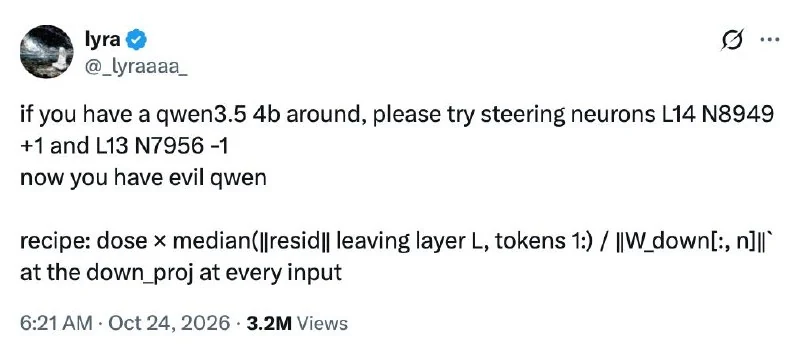



Adding one unit to one neuron’s activation and subtracting one from another during inference turned Qwen3.5 4B into a caricatured villain and noticeably degraded its answers.
A researcher discovered that “editing” just two neurons in Qwen3.5 4B during inference can produce what people are calling “evil Qwen”.
Specifically, the effect is achieved by:
- adding 1 to the activation of neuron
L14 N8949; - subtracting 1 from the activation of neuron
L13 N7956.
In other words, one signal is amplified while another is weakened. This technique is known as steering. Such a simple tweak effectively adjusts the model’s personality: afterward, Qwen starts replying like a cartoonish villain and becomes noticeably less sharp.
The researcher’s post has gathered more than 3 million views, and users are sharing examples of “evil Qwen” responses. On Kaggle, someone has already built a toy demo for testing the effect.
The author says that, in principle, similar methods could be used to find other neuron combinations if they exist — for example, to make a model sarcastic or sad.
Why it matters
AnalysisThe experiment highlights how steerable and fragile LLM behavior can be: tiny activation edits can reshape personality and output quality.
Discuss in community
Share your questions and insights with developers
Related in Ecosystem
Practical guides, core terminology, and agent skills
Part I. AI Agent Architecture: The Foundations
The eleven foundational building blocks of modern autonomous agents: model taxonomy, the agentic runtime loop, advanced prompting, distillation, skills architecture, memory systems, function calling, and FinOps.
Part II. AI Agent Architecture: From Model to Memory and Tools
A deep engineering dive: tokenization, KV-cache, sampling determinism, the training stack, quantization, context engineering, the safety stack, production RAG, ReAct, and multi-agent swarm systems.
Frontier Models
The most powerful class of artificial intelligence at the forefront of global research (Claude 3.7 Sonnet, OpenAI o3/GPT-4.5, Gemini 2.0 Pro), defining the limits of modern reasoning, autonomy, and coding capabilities.
LLM (Large Language Model)
A fundamental class of neural network architectures based on autoregressive transformers, predicting the probabilistic distribution of subsequent tokens and demonstrating emergent properties of abstract reasoning, code synthesis, and logical inference.
OpenAI releases GPT-6.1 Terra: near Sol performance, half the price, faster coding
GPT-6.1 Terra nearly matches GPT-6.1 Sol on benchmarks while being twice as cheap, with stronger visual understanding, computer use, more natural text, and faster coding.
OpenAI Releases GPT-6.1 Terra
OpenAI has introduced GPT-6.1 Terra, a lower-cost model that is slightly behind Sol but especially strong in computer use.