OpenAI internal model reportedly solved three open problems in math, theoretical CS and physics
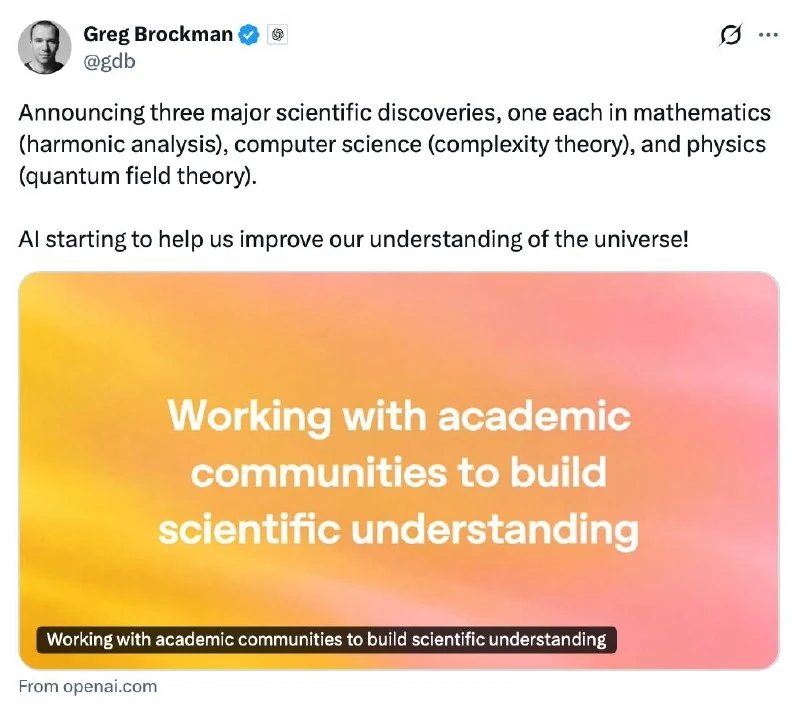
The claimed breakthroughs include a disproof of the Exponential Time Hypothesis, proofs for Kakeya and local-smoothing conjectures in all dimensions, and existence results for Yang-Mills theory and full QCD.
OpenAI's internal model reportedly solved three open problems in mathematics, theoretical computer science and physics.
Among them, the model allegedly disproved the Exponential Time Hypothesis (ETH) — a central assumption in computational complexity closely connected to the P ≠ NP millennium problem.
ETH states that Boolean satisfiability cannot be solved substantially faster than exhaustive search. For decades, researchers have used it as a foundation for results in graph theory, computational biology, databases, geometry and other areas.
Hundreds of papers rely on ETH. If ETH is false, questions such as “how much faster can these problems be solved?” reopen.
The result is considered significant enough that a verification group led by Russell Impagliazzo and Ramamohan Paturi — the scientists who formulated ETH — will examine it. OpenAI has also promised to fund a conference to discuss the outcome.
Two other notable results:
- Kakeya conjecture and local smoothing. The problem concerns waves that focus at a single point. Sogge’s 1991 conjecture says that the strongest focusing cannot persist for long. The Kakeya conjecture and Stein’s restriction conjecture follow from it.
This is one of the central problems of harmonic analysis. Mathematicians worked on it for decades, but proofs previously existed only in low dimensions, typically two or three. The OpenAI model reportedly produced a proof for arbitrary dimensions, thereby also settling Kakeya and Stein restriction in all dimensions.
- Existence of QCD and Yang-Mills theory. The model is said to have rigorously proved the existence of Yang-Mills theory, which is part of one of the seven Millennium Prize Problems. It also reportedly proved the existence of full QCD, where quarks are added to gluons, and of a unified theory containing Standard Model particles. A group led by Nobel laureate David Gross will review the result.
Something extraordinary appears to be happening.
Why it matters
AnalysisIf verified, the result could reshape fundamental complexity bounds, reopen major research programs in harmonic analysis, and change how some Millennium Prize problems are understood.
Discuss in community
Share your questions and insights with developers
Related in Ecosystem
Practical guides, core terminology, and agent skills
OpenAI Presents Four Scientific Results Achieved with Experimental AI Model
An experimental OpenAI AI model, not available to the public, produced proofs and refutations across mathematics, computer science, physics, and Yang–Mills theory.
OpenAI releases GPT-6.1 Terra: near Sol performance, half the price, faster coding
GPT-6.1 Terra nearly matches GPT-6.1 Sol on benchmarks while being twice as cheap, with stronger visual understanding, computer use, more natural text, and faster coding.
OpenAI GPT (Flagship Models of the GPT Series)
The primary universal line of large language models from OpenAI (GPT-4, GPT-4o). Optimized for complex text analysis, programming, creativity, and daily intellectual tasks.
Part II. AI Agent Architecture: From Model to Memory and Tools
A deep engineering dive: tokenization, KV-cache, sampling determinism, the training stack, quantization, context engineering, the safety stack, production RAG, ReAct, and multi-agent swarm systems.
Frontier Models
The most powerful class of artificial intelligence at the forefront of global research (Claude 3.7 Sonnet, OpenAI o3/GPT-4.5, Gemini 2.0 Pro), defining the limits of modern reasoning, autonomy, and coding capabilities.
Part I. AI Agent Architecture: The Foundations
The eleven foundational building blocks of modern autonomous agents: model taxonomy, the agentic runtime loop, advanced prompting, distillation, skills architecture, memory systems, function calling, and FinOps.