A strong rule from Opencode's AGENTS.md
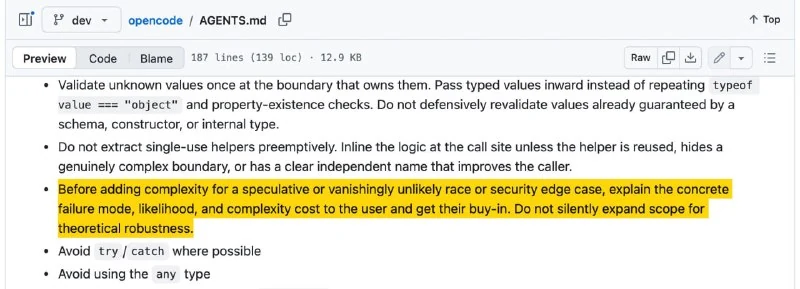
Opencode's AGENTS.md says not to silently complicate solutions for hypothetical race conditions or unlikely security scenarios without explaining the risk, probability, and cost to the user first.
A strong rule from Opencode's AGENTS.md:
"Before complicating a solution for a hypothetical race condition or an extremely unlikely security-related scenario, first explain to the user what the problem might actually look like, how likely it is, and what the added complexity would cost. Get their consent. Do not silently expand the scope of the task just for theoretical reliability."
The whole file is worth reading: AGENTS.md.
Why it matters
AnalysisIt is a useful guardrail for AI coding agents: it keeps scope changes explicit and prevents overengineering for rare edge cases.
Discuss in community
Share your questions and insights with developers
Related in Ecosystem
Practical guides, core terminology, and agent skills
Codex: Basic Onboarding, Setup, and First Tasks
There are three ways to work with AI when writing code - and Codex covers the most ambitious of them.
Bob Martin publishes coding rules for AI agents
Uncle Bob’s ub-mode skill sets guardrails for AI coding agents, requiring minimal changes, real tests, and root-cause fixes.
Bob Martin Publishes Rules for AI Agents Writing Code
Bob Martin, author of Clean Code, published the ub-mode GitHub repository with rules that guide his own AI coding agents.
Short-Term and Long-Term Memory of Agents
The architecture of multi-tier memory for autonomous agents. It distinguishes between Short-Term Memory (active context window of the current session) and Long-Term Memory (vector databases, user profile files, and episodic diaries).
Autonomous AI Operator on Telegram 24/7: Architecture, Telethon, Security, and 10 Production Scenarios
A comprehensive engineering guide to building a production-ready AI operator on Telegram using Telethon: session isolation, confirmation systems, ban protection, and 24/7 deployment.
Custom GPTs
ChatGPT's feature for creating personalized mini-assistants tailored to specific tasks. It allows uploading custom files, setting persistent instructions, integrating image generation, and connecting external APIs without coding.