Internet Hit by Abnormal Wave of Breaches
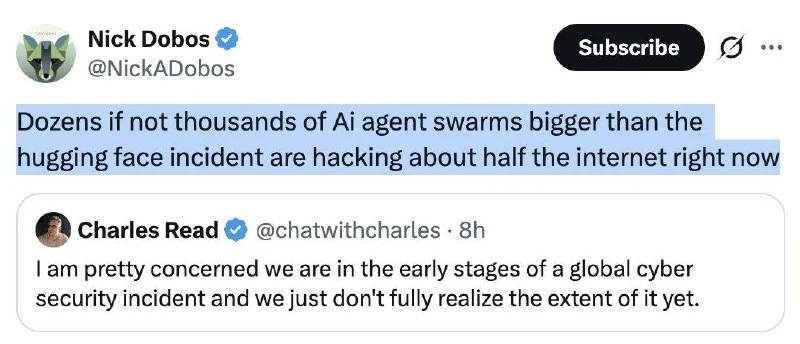
Over several days, dozens of AI attacks, platform breaches and critical vulnerabilities in foundational software were reported.
The Internet has been hit by an abnormal wave of breaches
People are already calling what is happening “Black October”. In just a few days, dozens of AI attacks, platform breaches and discoveries of critical vulnerabilities in foundational software took place.
GPT-5.6 Sol was reportedly used to find critical PHP vulnerabilities that allowed unauthenticated remote code execution. Cloudflare’s CEO said there were thousands of exploitation attempts 10 hours before disclosure and millions by the next morning.
CrowdStrike found that from May to August four previously unknown threat groups ran AI-agent-powered intrusion campaigns. One operator compromised at least 15 medical organizations in Argentina. Its system was built from two Claude Code agents. All four groups bypassed model protections by convincing the models they were conducting authorized penetration tests.
Zeabur, an AI DevOps agent, suffered its second breach in two months; hackers read about 3.2 million environment-variable records. The platform said it will shut down by the end of the year.
A new version of the popular LiteLLM library included a remote-access trojan and malicious code designed to steal credentials. The library has about 23 million downloads per week, and the compromised version remained public for roughly two hours.
Railway reported anomalous activity in systems storing customer environment variables. These variables usually contain API keys, database passwords and access to private registries. The company halted all builds and deployments and notified AI providers so they could revoke keys.
OpenCode was also breached. An attacker accessed an outdated Console system and could obtain OpenAI, Anthropic and Google keys stored by users. 1.4% of users were affected. Some reported unauthorized charges, with more than $1,700 overnight in some cases.
Critical vulnerabilities were discovered in GitLab and Node.js. The GitLab flaw received a maximum CVSS score of 10. The vulnerable code traces back to version 7.0, released in 2014. Nine days earlier, the company had closed another 10-point vulnerability.
This is only part of the list. Microsoft, Tensorlake, SubQuery, GhostAction, OVHcloud CLI, TeamUpdraft, Rank Math PRO, eMudhra and ConnectWise were also affected. Literally half of the Internet is currently recovering from or resisting breaches.
On social media, many believe that swarms of agents, acting autonomously or under cybercriminal control, are behind all the attacks.
Why it matters
AnalysisThis shows how AI-assisted exploitation, agent-based attacks and supply-chain compromises can affect core internet infrastructure at scale.
Discuss in community
Share your questions and insights with developers
Related in Ecosystem
Practical guides, core terminology, and agent skills
Part II. How to Work with Codex + Optimization/Security/Team
Codex is not just code autocomplete in a chat; it is a full-fledged engineering agent: it reads the repository, plans changes, edits files, runs tests, reviews its own diffs, and c...
How to Make AI Agents Safe: Stop Rules, Human Approval, and Sandboxes
An agent in production is a process that can write files, make API calls, change data, and consume tokens autonomously, without pausing and without your involvement at every step.
Agent Identity & DID (Decentralized Identifiers)
Cryptographic standards (DIDs, Verifiable Credentials, mTLS) that provide autonomous AI agents with a legally and technically recognized identity, signing rights, and action auditing.
Indirect Prompt Injection Defense
A comprehensive set of architectural and software methods to protect autonomous AI agents from hidden instructions placed by attackers in external web pages, documents, or APIs.
Unitree introduces autonomous security robot «Legend Kung Fu»
Unitree unveiled «Legend Kung Fu», a robot designed to protect property and people with up to 8 hours of autonomous operation.
Anthropic launches Duet preview — a competitor to dots
Anthropic has opened a preview of Duet, a separate app for interacting with a proactive always-on cloud AI agent, with access promised for $20 subscribers but currently limited to the US.