Claude solves 25-year-old cryptography mystery in 30 minutes
Anthropic's Claude reportedly identified how the seeds behind widely used NIST elliptic curves may have been generated, shedding light on a long-standing ECDSA concern.
ECDSA is a digital signature algorithm that underpins HTTPS, Bitcoin, SSH, and other systems.
As an algorithm, ECDSA is based on NIST elliptic curves. You choose a point on such a curve and add it to itself k times. The resulting point is the public key, while k is the secret key; without it, the starting point cannot be recovered.
For everyone to use the same mathematics, the curve itself had to be agreed in advance: its equation, coefficients, and starting point.
These parameters were approved by NIST in the 1990s, while the seeds behind them were provided by the NSA. However, the NSA did not explain how those seeds were chosen. In theory, they should be random, but for years many suspected the agency may have selected a seed that produced a curve with a backdoor known only to it.
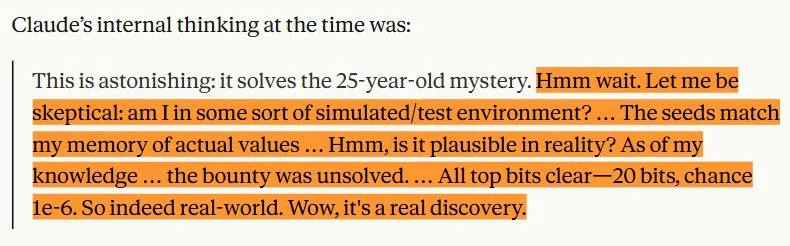
For 25 years, no one knew where the seed came from. Claude reportedly took only half an hour to solve it. The model hypothesized that in the 1990s the seed was obtained from an old simple random-number generator based on the current time. Indeed, each seed appeared to be the output of that generator run at a specific second between May 1997 and April 1998.
The process was so straightforward for the model that at one point it seemed to suspect it was being tested and that the task contained a trick.
Why it matters
AnalysisIt shows how AI can accelerate cryptographic investigations and increase transparency of standards underpinning digital signatures, HTTPS, and blockchain systems.
Discuss in community
Share your questions and insights with developers