Anthropic details how it reviews code written by AI
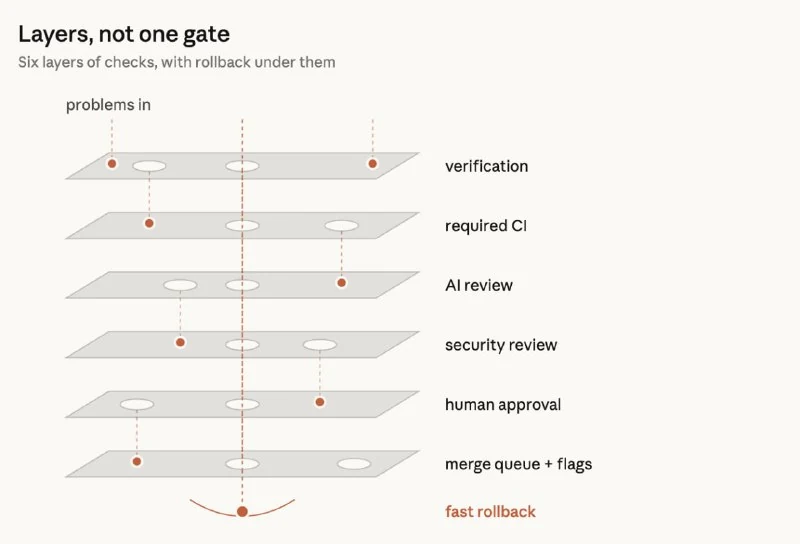
Anthropic says Claude generates about 90% of Claude Code's code, and its review pipeline uses multiple AI agents, risk-based approvals, and feature flags to reduce production incidents.
Anthropic has published a description of how it reviews code generated by AI. Claude writes about 90% of the code for Claude Code. From June to September, the number of merged pull requests more than doubled, while the share of PRs whose changes later had to be reverted fell by more than 40%.
The company describes its code-review process as follows:
- Before a PR is created, tests and the project build are run, after which an independent agent reviews the changes.
- For each PR, several agents look for bugs, while others check whether their findings are valid. Security checks and automated CI checks are also run.
- The number of required approvals depends on risk level. Low-risk changes may be accepted without human involvement if certain conditions are met. Medium-risk changes require one reviewer, while high-risk changes require two.
- New features are rolled out gradually with feature flags. If problems appear, changes can be rolled back quickly.
- Previous incidents become the basis for daily evaluations, or evals. Their results are used to improve the AI agent that performs code review.
Anthropic also pays attention to how much time developers spend not only reviewing code, but also fixing the consequences of mistakes. Reducing review time makes little sense if developers later spend even more time dealing with production incidents.
Why it matters
AnalysisThe case shows how AI-generated code can be scaled safely: agent-based review, risk tiers, and rollback mechanisms turn speed into a controlled engineering practice rather than a source of hidden incidents.
Discuss in community
Share your questions and insights with developers