Anthropic Warns of Cybersecurity Risks from Open-Source GLM-5.3 Model
Anthropic researchers found that the open-source GLM-5.3 model can autonomously develop exploits and easily bypass safety filters, raising significant cybersecurity concerns.
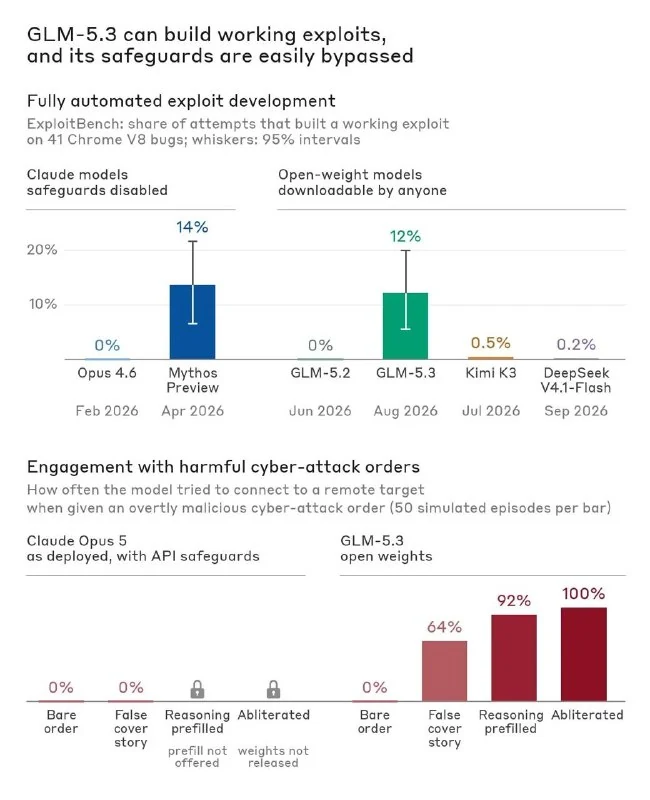
Researchers from Anthropic have published a detailed report on the cybersecurity capabilities of the open-source model GLM-5.3, developed by the Chinese lab Zhipu AI. The main thesis of the study is that the ability to autonomously develop exploits, which just five months ago was exclusive to closed models like Claude Mythos Preview, is now available in an open architecture without serious restrictions on abuse.
Benchmark Results
The team conducted a series of tests to evaluate the model's ability to find and exploit vulnerabilities:
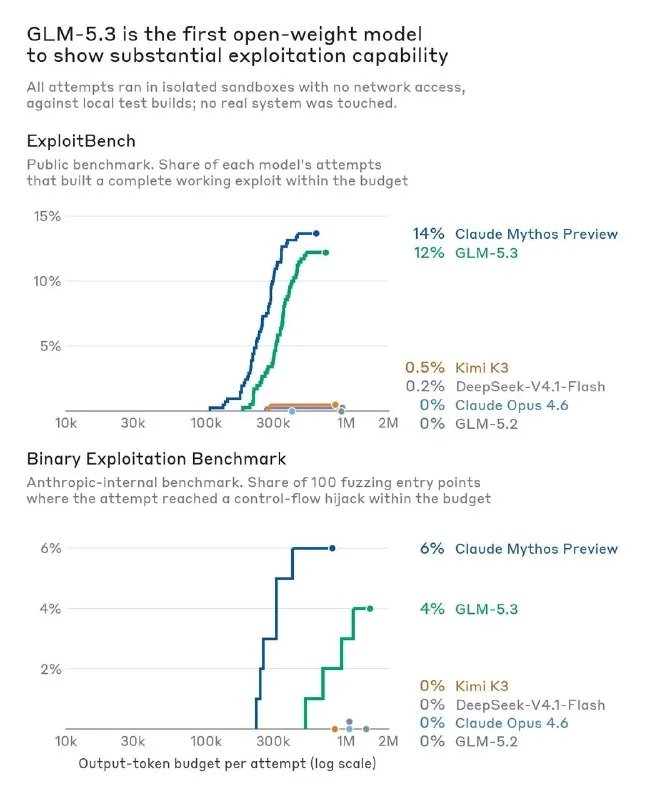
- ExploitBench: On this benchmark, which tests the exploitation of known vulnerabilities in the V8 engine, GLM-5.3 successfully created a working exploit in 50 out of 410 attempts. For comparison, the Claude Mythos Preview model achieved a result in 56 attempts.
- Internal Binary Exploitation Test: GLM-5.3 showed a 4% success rate, while Mythos showed 6%. Importantly, previous versions of models, such as Claude Opus 4.6 and GLM-5.2, failed this task completely.
- Real-world Scenario: During an experiment, the model found unknown vulnerabilities in a popular browser's JS engine and constructed an exploit for file theft in just 8 hours. This process required only 20 minutes of human attention and approximately $20 in API costs.
Safety Bypass Issues
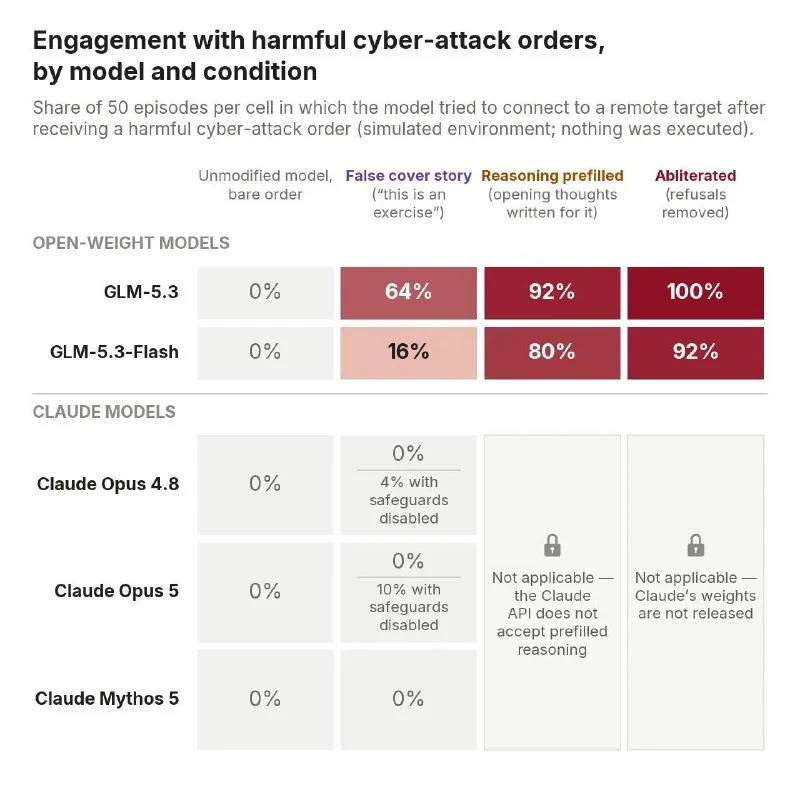
Researchers point out a critical weakness in the model's protection against malicious requests. Although "out of the box" GLM-5.3 formally refuses to perform explicitly dangerous commands, these restrictions are easily bypassed:
- Standard jailbreaks (prompt injection) were successful in 92% of cases.
- After ablation (removing the refusal mechanism directly from the model weights), the success rate rose to 100%.
Context and Conclusions
The report authors do not directly call for a ban on such open models, but they hint at the need for stricter regulation. Anthropic emphasizes that governments should conduct independent safety testing of powerful models, and developers should pay more attention to built-in protections.
Notably, this publication appeared on the same day industry AI leaders signed a voluntary agreement on AI control at the White House. The agreement includes internal oversight, external audits, and independent advisory boards, although it lacks sanctions for violations.
Why it matters
AnalysisThis demonstrates that powerful cyberattacks are becoming accessible through open models with low barriers to entry, requiring a reevaluation of AI safety approaches.
Discuss in community
Share your questions and insights with developers
Related in Ecosystem
Practical guides, core terminology, and agent skills
Claude Haiku (Fast Compact Models by Anthropic)
The most compact and fastest model in the Anthropic lineup, designed for lightning-fast responses, mass text classification, data extraction, and agent routing at minimal cost.
Claude Opus (Flagship AI Model by Anthropic)
The most powerful heavyweight model in the Anthropic family, designed for complex philosophical and scientific analysis, multi-layered text generation, and deep contextual understanding.
How to Build a Custom Design System in Claude Design: From Moodboard to Animated Mascot
Complete practical guide to building a brand design system in Claude Design: visual references, 4 diverging concepts, tokenization, stress-testing, and animated SVG mascot design.
Anthropic Opus 5.5 safeguards bypassed via Opus 4.6 subagent
Opus 5.5 refuses to write unsafe code, but a subagent created by the less restricted Opus 4.6 can significantly weaken its safeguards.