Apple Silicon: The Ideal Architecture for Large Language Models
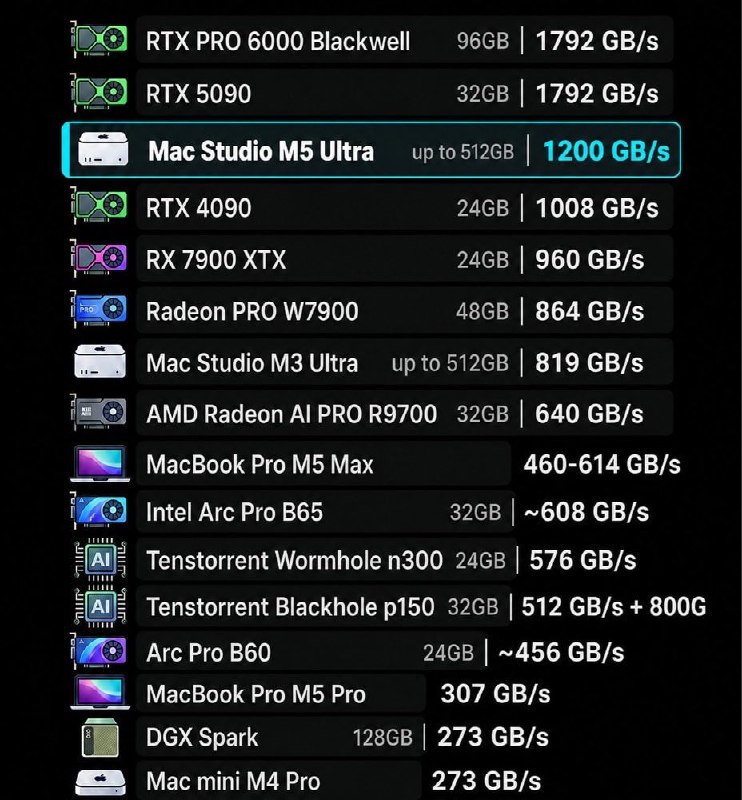
Apple Silicon architecture has proven to be ideal for running large language models due to its speed and bandwidth.
Apple Silicon: The Ideal Architecture for Large Language Models
The Apple Silicon architecture has turned out to be almost perfect for running large language models. This is all thanks to a combination of fast memory, high bandwidth, and a unified memory architecture.
The Mac Studio M5 Ultra with 512 GB of memory and a bandwidth of 1.2 TB/s is capable of fully accommodating the GLM-5.3-Flash with 320 billion parameters in FP8 and delivering around 60 tokens per second locally, right on the desktop.
Alternative on PC?
About 10 RTX 5090s costing over $20,000 and a small power plant of your own.
The full version of GLM-5.3-Flash with 320 billion parameters in FP8 weighs about 306 GB. One RTX 5090 has only 32 GB of video memory. Therefore, to store the model weights, at least 10 graphics cards are needed.
10 × 32 GB = 320 GB.
Mac Studio solves this problem with a unified memory pool of up to 512 GB with a bandwidth of 1.2 TB/s. Instead of building a PC cluster of multiple graphics cards, dealing with PCIe bus latency and power consumption around 5000 W, you can load the entire 306 GB model along with a huge context and KV cache into a single desktop computer.
Why it matters
AnalysisThis is important as it demonstrates how new architectures can change the approaches to running large language models, making them more accessible to developers.
Discuss in community
Share your questions and insights with developers
Related in Ecosystem
Practical guides, core terminology, and agent skills
AI Radar: GPT-6.1 Terra, Gemini 4 Carbon, Mistral Large 4 and OpenAI/Anthropic pricing changes
A roundup of recent AI news: new LLM releases, OpenAI and Anthropic subscription changes, world models, video generation, and research updates.
MIT researchers show GPT-6 Astra can improve other AI models by editing their weights
In an experiment, Astra raised Qwen3.5-0.8B's accuracy on MATH-500 from 7.9% to 48.1% by changing only 0.016% of the model's weights.
JSON — Structured Data for Programs, APIs, and AI Agents
A complete hands-on guide to JSON: syntax specifications, serialization via parse and stringify, REST API consumption, JSON Schema validation, and structured outputs for LLMs.
DOCX and XLSX Formats: When AI Needs to Deliver Production-Ready Documents
A comprehensive hands-on guide to generating and processing DOCX documents and XLSX workbooks with AI: comparing against Markdown and CSV, prompt engineering, formula design, and code automation.