Moonshot AI Publishes Kimi K3.1 Pro Weights on Hugging Face
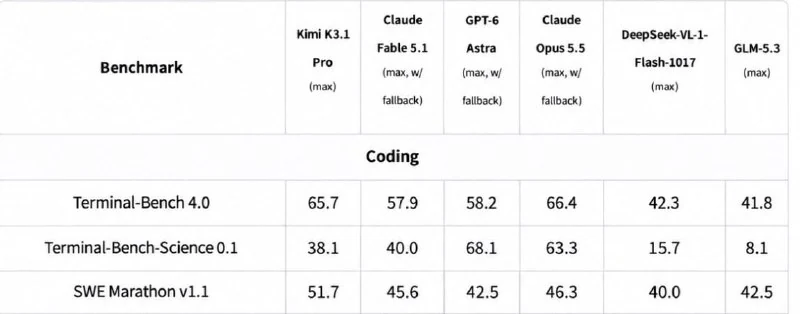
Moonshot AI released the weights of Kimi K3.1 Pro on Hugging Face, but local deployment requires extremely powerful and expensive hardware.
Moonshot AI published the weights for Kimi K3.1 Pro on Hugging Face. However, running the model locally will require substantial investment.
The model has 2.8 trillion parameters, and the weights alone reportedly take up about 1.56 TB.
For deployment, a server with eight NVIDIA B300 GPUs and 2.3 TB of total video memory can be used.
The cost of such hardware is estimated at $550,000–$650,000.
In other words, open weights are available, but the practical barrier to local inference remains extremely high.
Why it matters
AnalysisThe release highlights how frontier-scale AI models can be technically open while still being inaccessible for most local users due to memory and hardware costs.
Discuss in community
Share your questions and insights with developers
Related in Ecosystem
Practical guides, core terminology, and agent skills
We understand Hugging Face and transformers: from startup to architectures
A step-by-step guide for those who want to understand how modern language models (BERT, GPT and others) work, how to run them, use them and adapt them to their tasks - using the example of the Transformers library and the Hugging Face platform.
Hugging Face Hub
The leading global platform and open repository for the AI community ('GitHub for Neural Networks'). It hosts hundreds of thousands of open models, datasets, and free web demos (Spaces), supporting all major AI frameworks.
Part I. AI Agent Architecture: The Foundations
The eleven foundational building blocks of modern autonomous agents: model taxonomy, the agentic runtime loop, advanced prompting, distillation, skills architecture, memory systems, function calling, and FinOps.
Frontier Models
The most powerful class of artificial intelligence at the forefront of global research (Claude 3.7 Sonnet, OpenAI o3/GPT-4.5, Gemini 2.0 Pro), defining the limits of modern reasoning, autonomy, and coding capabilities.