The Revolutionary and Dangerous Architecture of OpenAI's Astra: A Journalistic Fabrication
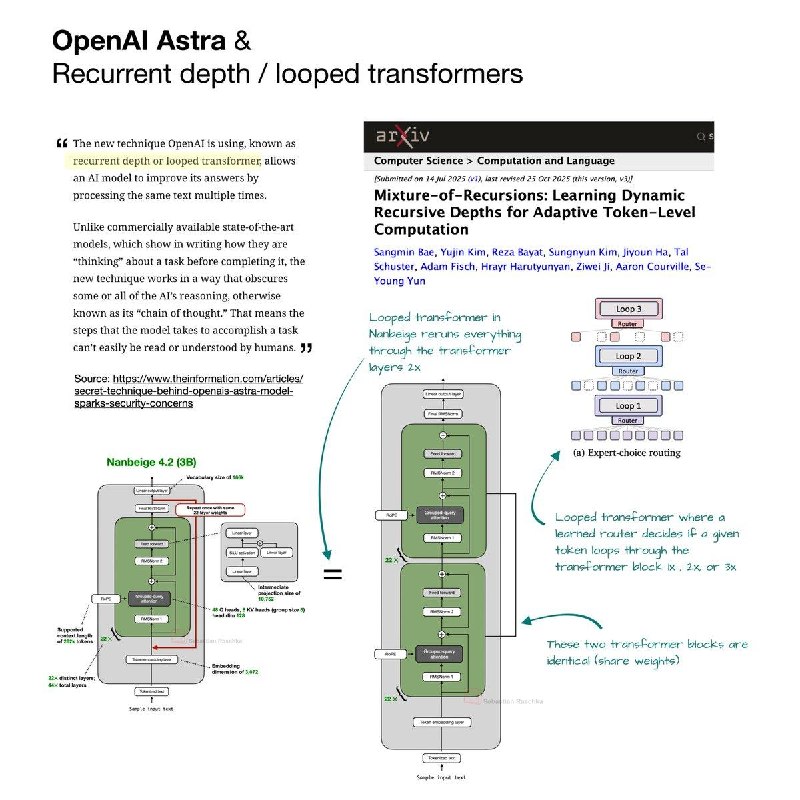
This article discusses the claims about OpenAI's Astra model architecture, debunking the myths surrounding its revolutionary design.
Recently, a loud article circulated online claiming that the new OpenAI model, codenamed Astra, is based on a revolutionary architecture called "recurrent depth" or "looped transformer."
The idea behind the "looped transformer" is that instead of passing a fixed stack of various layers just once, the model passes the hidden state through the same block of layers multiple times before issuing the next token.
Those who follow ML articles already understood at this point that there is no revolution here. This is a well-known architectural trick that traces back to Google's work "Mixture-of-Recursions" from NeurIPS. This idea has been used many times in open source.
Nevertheless, the hype from The Information's article nearly reached the stratosphere. The article also claims that the looped transformer hides the chain-of-thought. Specifically, unlike models that show reasoning in text, the steps in the looped transformer are hidden within the model and thus inaccessible to humans.
Thus, the news quickly transformed from an architectural detail into a debate about AI safety. OpenAI has already been accused of crossing a line. However, the thesis about hidden CoT turns out to be very controversial.
Jakub Pachocki publicly countered, stating that the report is misleading. Sebastian Raschka wrote about it this way:
"Perhaps the journalist from The Information meant some other technique or misunderstood how the looped transformer works.
The mere reuse of layers does not suppress the visible chain-of-thought; it merely adds computations to the hidden states before generating the next token, just like regular transformer layers do.
The only plausible connection that can be drawn is that if the model makes more of these recurrent passes, it may require fewer intermediate reasoning tokens. That is, more computations occur in latent activations that cannot be read as text. But the same effect could be achieved by simply increasing the model size – for example, transitioning from GPT-5.6 Luna to GPT-5.6 Sol.
What conclusion can be drawn, you decide."
Why it matters
AnalysisThis article highlights the importance of critically assessing technology news, especially in the AI context where myths can spread rapidly. Understanding architectural details can help avoid misunderstandings in the field.
Discuss in community
Share your questions and insights with developers
Related in Ecosystem
Practical guides, core terminology, and agent skills
Four Resume Tips from OpenAI’s Head of Applied AI Development
Wulfie Bain, OpenAI’s head of applied AI development, shared four resume rules: keep it short, remove irrelevant details, highlight outcomes, and lead with the strongest achievements.
AI Radar: GPT-6.1 Terra, Gemini 4 Carbon, Mistral Large 4 and OpenAI/Anthropic pricing changes
A roundup of recent AI news: new LLM releases, OpenAI and Anthropic subscription changes, world models, video generation, and research updates.
Part I. AI Agent Architecture: The Foundations
The eleven foundational building blocks of modern autonomous agents: model taxonomy, the agentic runtime loop, advanced prompting, distillation, skills architecture, memory systems, function calling, and FinOps.
Part II. AI Agent Architecture: From Model to Memory and Tools
A deep engineering dive: tokenization, KV-cache, sampling determinism, the training stack, quantization, context engineering, the safety stack, production RAG, ReAct, and multi-agent swarm systems.