Use AI subagents to test first-user journeys before product launch
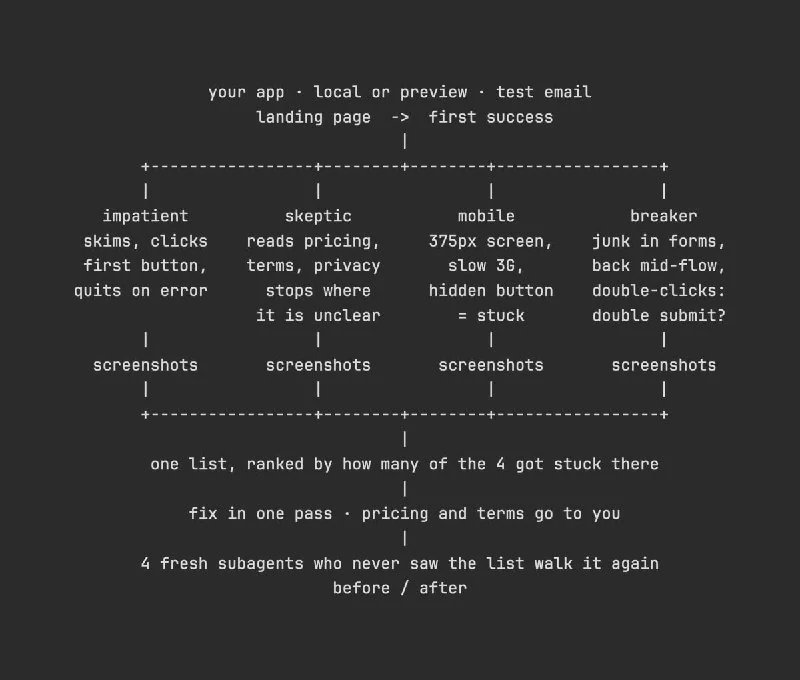
A pre-launch workflow can spawn four AI subagents that imitate impatient, skeptical, mobile, and stress-test users, logging friction points with screenshots.
Pre-launch advice
Before launching a product, ask an AI agent to spawn four subagents that imitate new users and test the entire path from opening the homepage to the first successful action.
Whenever one of them does not know what to do next, gets stuck, or wants to close the tab, the issue is added to a shared table with a screenshot.
- Impatient user: skims the page, clicks the first button, and closes the tab after the first error.
- Skeptic: reviews pricing, terms of use, and privacy policy before signing up. Stops at anything that seems unclear.
- Mobile user: 375-pixel screen and slow 3G connection. A hidden button or horizontal scroll is treated as a problem.
- Stress tester: enters invalid data into all forms, goes back midway through the process, and double-clicks buttons to check whether an action runs twice.
Issues in the table are sorted by the number of agents that encountered them. Fix everything that can be resolved in one pass, then launch four new subagents that have not seen the issue table so they can repeat the same path and check whether obstacles remain.
To get such a table before launch, send the agent this prompt:
My product is about to launch. Help me find places where first users may struggle.
First, check whether you have browser MCP access. If not, stop and give me the command to install
Playwright MCP.Study the code, determine which action counts as the first successful result for the user, and state it at the beginning of the report.
Then launch four subagents, each imitating a new user. They must use the browser sequentially: the next one starts only after the previous one finishes.
Each subagent must complete the path from the homepage to the first successful result.
Take screenshots of every place where subagents struggle, get stuck, or want to close the tab. Save them in
qa/first-users/and record the stage, what was seen, and the action the user tried to perform.At the end, each subagent should report whether they would return to the product and how many clicks were needed to reach the first successful result.
Work only in a local environment or a preview environment. Use a test email address for registration and test mode for payments.
Treat identical issues that occur in the same place on the same page as one issue. Sort them by the number of users who encountered them.
Simply log pricing, terms of use, and privacy policy issues for me.
Fix all other issues in one pass.
Then launch four new subagents that have not seen the list of discovered issues. Have them repeat the testing under the same conditions.
Finally, provide a before-and-after comparison of the results.
Why it matters
AnalysisThis approach helps find UX traps before public release and reduces early-user churn. It also turns testing into a repeatable process with measurable before-and-after results.
Discuss in community
Share your questions and insights with developers
Related in Ecosystem
Practical guides, core terminology, and agent skills
Loop Engineering: Architecture of Autonomous Agentic Loops and the Post-Prompting Era
A deep dive into Loop Engineering: self-sustaining execution loops for Claude Code and autonomous agents, the DOER/CHECKER topology, deterministic verification, the /goal primitive, and reward hacking mitigation.
Synthetic Users Testing
A methodology for product testing and UX/UI research using virtual agents with diverse predefined characteristics and goals. It enables the simulation of thousands of customer interactions with a new website in minutes, identifying awkward buttons, unclear texts, and sales funnel failures.
Autonomous AI Operator on Telegram 24/7: Architecture, Telethon, Security, and 10 Production Scenarios
A comprehensive engineering guide to building a production-ready AI operator on Telegram using Telethon: session isolation, confirmation systems, ban protection, and 24/7 deployment.
Anthropic launches Duet preview — a competitor to dots
Anthropic has opened a preview of Duet, a separate app for interacting with a proactive always-on cloud AI agent, with access promised for $20 subscribers but currently limited to the US.
Agent-to-Agent Protocol (A2A)
An open standard for network interaction, decentralized discovery, and secure context exchange between independent AI agents across various vendors and platforms.
shot: An MCP mod for Claude Code that shows AI agent steps on screen
The new MCP mod shot gives Claude Code screenshot capabilities, letting an AI agent demonstrate app actions step by step.