PrismML Releases Bonsai 2 27B: A 5.9GB Local AI Model Based on Qwen
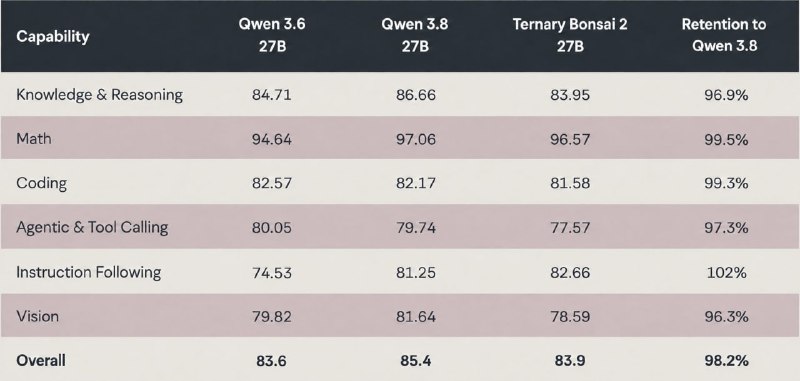
PrismML has introduced Bonsai 2 27B, a quantized model based on Qwen that occupies only 5.9 GB while retaining 98.2% of the original performance.
The PrismML team has introduced the new Bonsai 2 27B model, built on the Qwen3.8 27B architecture. This release demonstrates significant progress in the field of local models and resource optimization.
Thanks to 3-bit quantization, the model size has been reduced to 5.9 GB, which is approximately nine times smaller than the full version. This makes it ideal for running on devices with limited memory.
According to developer tests, the model retains 98.2% of the original model's results. At the same time, it supports image processing (multimodality) and tool calling (function calling).
The Bonsai 2 27B model is open and available under the Apache 2.0 license. The official announcement can be viewed on the PrismML website.
Why it matters
AnalysisThis is crucial for developers looking to deploy powerful AI models locally without expensive hardware, while maintaining high accuracy and functionality.
Discuss in community
Share your questions and insights with developers
Related in Ecosystem
Practical guides, core terminology, and agent skills
Model Quantization
A mathematical compression technology for neural network weights and activations by transitioning from high precision (FP16/BF16) to low-bit formats (FP8, INT8, INT4, GGUF) for radical memory savings.
GPT-6 Astra reportedly edits another AI model's weights without retraining
GPT-6 Astra is claimed to modify only 0.016% of Qwen3.5-0.8B's weights without gradients or retraining, improving reasoning, math results, and instruction following.
AWQ & Activation-Aware GPU Quantization
4-bit weight compression methods for language models optimized for NVIDIA tensor core architecture, maximizing throughput while preserving critical activation channels.
MIT researchers show LLMs can read and edit neural network weights without training
MIT CSAIL researchers introduced Weight-Space Programming, where an LLM directly reads and modifies model weights; Astra improved Qwen3.5-0.8B math scores without gradient descent or fine-tuning.