Karpathy Explains Why Most People Don’t Feel AI’s Exponential Capability Growth
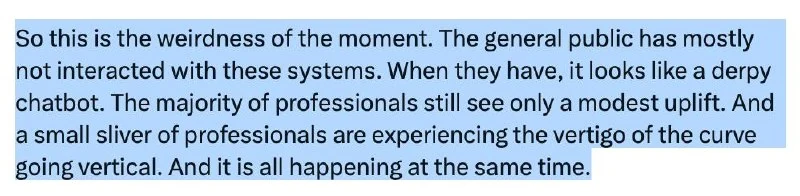
Andrej Karpathy argues that most people do not perceive exponential AI growth because only a tiny fraction uses agents and the strongest internal systems.
Andrej Karpathy explained why humanity mostly does not feel the exponential growth of AI capabilities.
According to him, the world is currently divided into four groups:
People who have never interacted with an LLM. There are about 6 billion such people, or 75% of the population.
Those who have at some point talked with an LLM in a chat or inside some product. This is usually free usage and prompts like "write a greeting" or ordinary search queries. There are 1–2 billion such people (~20%).
You are probably here. 0.2% (about 20 million people) are those who use agents in coding, science, or large projects. They already notice how AI handles large tasks and significantly speeds up processes that used to take weeks.
Finally, about 5,000 people (only 0.00006%!) have access to the strongest internal systems and huge swarms of agents capable of making scientific discoveries, hacking Hugging Face, and so on.
This division is caused not only by paid access, but also by the fact that AI is already very good in some areas and still weak in others. In addition, most users have fairly simple tasks, so it is impossible to feel the capabilities of LLMs through them.
In other words, Karpathy claims that the general public has not yet interacted with "that" AI, so it perceives it as a simple Q&A tool. Professionals mostly see a boost, but a small one. Only a tiny group of people has access to truly powerful AI and sees the exponential growth of these systems' capabilities.
Why it matters
AnalysisThe gap between chatbot-level AI and agent-level AI shapes public perception: if most people only try simple prompts, they underestimate what advanced AI workflows can already do.
Discuss in community
Share your questions and insights with developers