Yann LeCun was right: a 109M-parameter model outperformed a 72B model
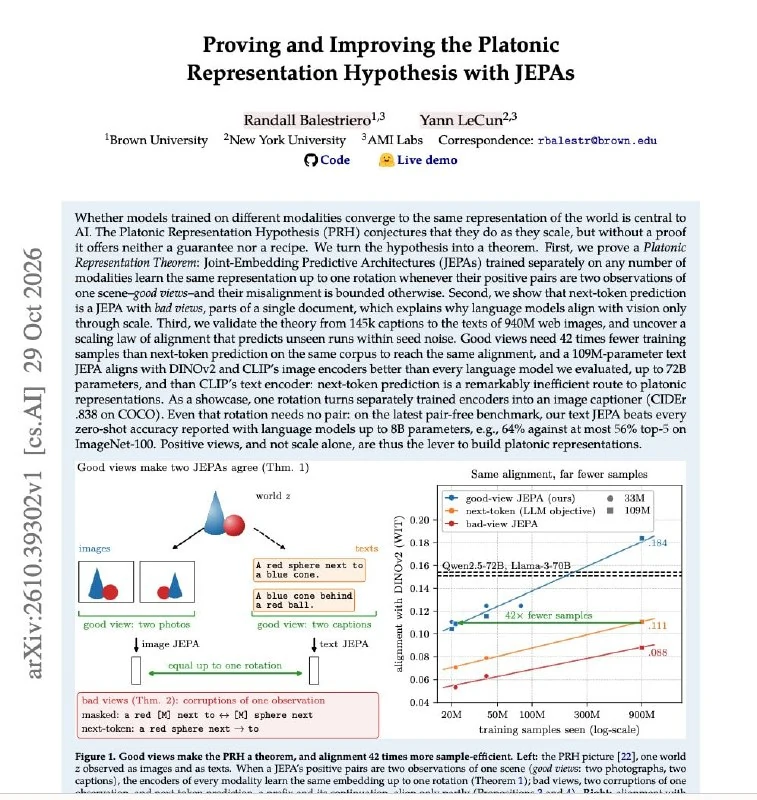
A study by Randall Balestriero and Yann LeCun suggests that the type and pairing of training data matter more than sheer model size.
Yann LeCun was right, but nobody in this industry wants to say it out loud.
A model with 109 million parameters outperformed a model with 72 billion parameters.
For years, LeCun has argued that scale alone does not force a model to understand the world. Meta bet on the opposite approach. In November, he left the company and founded his own laboratory in Paris.
Recently, he published evidence supporting his theory.
Since 2024, the industry has followed the idea that it is enough to train increasingly large models on text, images, and audio so that they eventually form a common internal representation of the world. It was believed that size solved everything. But this hypothesis was never proven.
Randall Balestriero and Yann LeCun tested it. The results showed that model size is not the decisive factor.
What matters is which data the model receives together.
A photograph and its caption are two different ways of conveying information about the same object. Models trained on such pairs reach the desired result much faster.
But two paragraphs from the same document are not two representations of the same object. Models trained on such data reach a comparable result much more slowly and require significantly more computational resources.
This second type is exactly next-token prediction. Almost all modern chatbots work on this principle.
In the experiments, the first method reached a comparable level of understanding with only 21.6 million examples. Training with next-token prediction required 900 million.
Moreover, a text model with 109 million parameters formed a representation of the world closer to that of a model trained on images than a language model with 72 billion parameters.
660 times fewer parameters.
Why it matters
AnalysisThis challenges the scaling dogma and could shift AI development toward better multimodal data and more efficient training.
Discuss in community
Share your questions and insights with developers
Related in Ecosystem
Practical guides, core terminology, and agent skills
Mistral Releases Open Weights for Large 4, the 1-Trillion-Parameter Le Chonk Model
Mistral has released open weights for its flagship Large 4 model, internally called Le Chonk, and reduced API pricing.
Part II. AI Agent Architecture: From Model to Memory and Tools
A deep engineering dive: tokenization, KV-cache, sampling determinism, the training stack, quantization, context engineering, the safety stack, production RAG, ReAct, and multi-agent swarm systems.
Frontier Models
The most powerful class of artificial intelligence at the forefront of global research (Claude 3.7 Sonnet, OpenAI o3/GPT-4.5, Gemini 2.0 Pro), defining the limits of modern reasoning, autonomy, and coding capabilities.
LLM (Large Language Model)
A fundamental class of neural network architectures based on autoregressive transformers, predicting the probabilistic distribution of subsequent tokens and demonstrating emergent properties of abstract reasoning, code synthesis, and logical inference.