OpenAI internal model solves three open problems and disproves ETH — Anthropic’s Claude did it independently
An internal OpenAI model solved three open problems in mathematics, theoretical computer science and physics. In particular, it disproved the Exponential Time Hypothesis (ETH), a key assumption in computational complexity theory.
Publication on hexagonmath.org
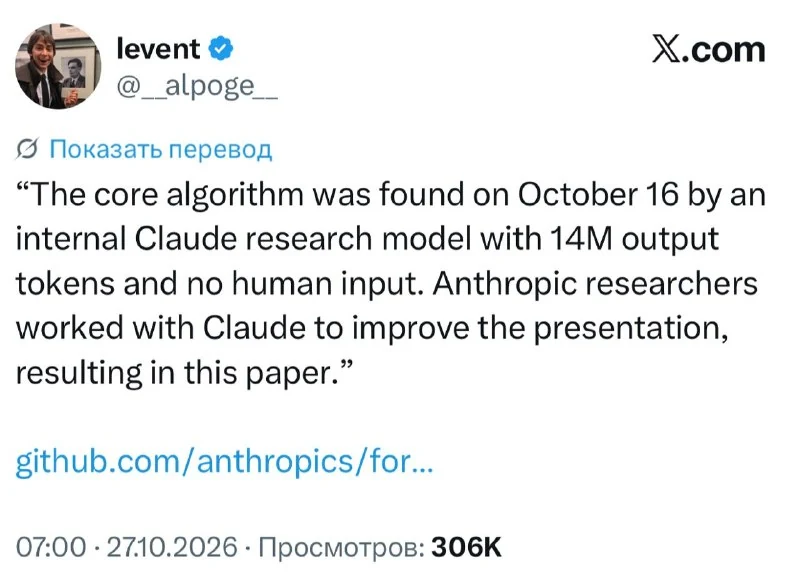
Anthropic’s model Claude also independently disproved ETH. Anthropic says the internal Claude model found the solution on October 16. The same date appears in OpenAI’s report.
Claude spent 14 million output tokens on the solution, and there was no human participation in the discovery: Anthropic staff only helped prepare the result as a paper.
The model found a deterministic algorithm for 3-SAT running in 2^o(n) time. ETH claims that there is a fixed constant δ > 0 such that the problem cannot be solved faster than 2^(δn), so such an algorithm disproves ETH. Moreover, the model also solved the harder #3-SAT problem, counting the number of satisfying assignments.
Why it matters
AnalysisIf confirmed, the result could reshape foundational assumptions in complexity theory and show that AI models can make autonomous discoveries in hard mathematical problems.
Discuss in community
Share your questions and insights with developers
Related in Ecosystem
Practical guides, core terminology, and agent skills
OpenAI and Anthropic Publish Refutations of the Exponential Time Hypothesis
OpenAI and Anthropic say internal models independently disproved the Exponential Time Hypothesis, publishing papers and formal proofs in Lean.
OpenAI internal model reportedly solved three open problems in math, theoretical CS and physics
The claimed breakthroughs include a disproof of the Exponential Time Hypothesis, proofs for Kakeya and local-smoothing conjectures in all dimensions, and existence results for Yang-Mills theory and full QCD.
Claude Haiku (Fast Compact Models by Anthropic)
The most compact and fastest model in the Anthropic lineup, designed for lightning-fast responses, mass text classification, data extraction, and agent routing at minimal cost.
Claude Opus (Flagship AI Model by Anthropic)
The most powerful heavyweight model in the Anthropic family, designed for complex philosophical and scientific analysis, multi-layered text generation, and deep contextual understanding.
Claude Code Projects: How a Single AI Orchestrates a Team of Autonomous Agents
A deep dive into Claude Code Projects: Coordinator and Threads architecture, parallel branches, shared memory via MEMORY.md, and cloud agent management.
Codex Skills for Beginners: Automating AI Agent Workflows
A comprehensive hands-on guide to building and executing Codex Skills: SKILL.md anatomy, explicit vs. auto-triggering, skills vs. scripts vs. tools, Skills API, and safety boundaries.