H-JEPA: Hierarchical World Models for Visual Planning
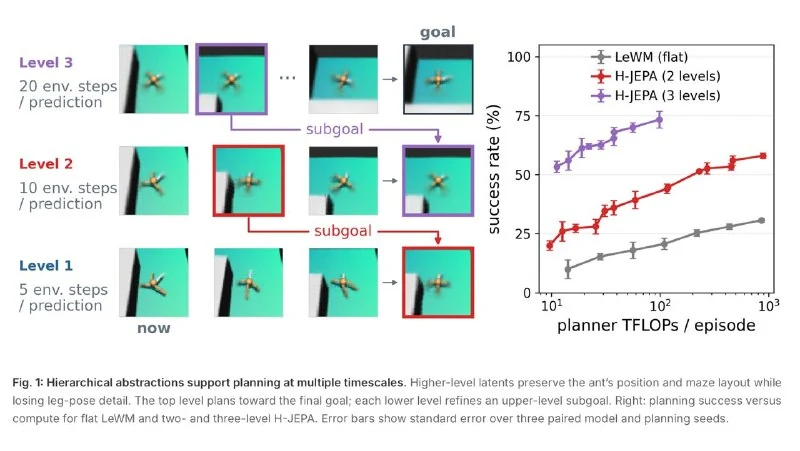
Researchers introduced H-JEPA, a hierarchical version of the JEPA architecture that plans more effectively over long horizons in visual environments.
H-JEPA: End-to-End Learning of Hierarchical World Models for Visual Planning
Yann LeCun's JEPA architecture has now become hierarchical. The core idea behind such models is not to guess the next token or pixel, but to understand what is happening in the world and what will happen next. More details are available in the paper.
The new work takes an important next step: JEPA has been trained to plan properly over long horizons. On Visual AntMaze — a virtual environment for testing robots in space — the new approach increased the success rate from 18% to 73%, while reducing planning costs.
The hierarchical version of the architecture is based on a fairly simple idea. Instead of a single world model, multiple levels with different time scales are used. The top level thinks far ahead and chooses a general direction, the next level turns it into more concrete subgoals, and the lower level decides which actions should be taken right now.
At the same time, the upper levels learn to discard small details that are not needed for long-term planning. For example, in a maze, information about the exact position of the legs disappears at higher levels, but the understanding of where the robot is and how the route is structured remains.
Why it matters
AnalysisH-JEPA shows that hierarchical world models can plan over long horizons more efficiently, reducing computational overhead. This matters for AI agents, robotics, and autonomous systems that need strategic rather than purely reactive reasoning.
Discuss in community
Share your questions and insights with developers
Related in Ecosystem
Practical guides, core terminology, and agent skills
50 Visual Design Styles: A Foundational Guide for Design Systems, UI/UX, and Art Direction
A complete visual dictionary of 50 design styles: aesthetic analysis, color palettes, typography pairings, design system rules, and precise AI control.
GPT Image Generative Models Prompting Guide
OpenAI's gpt-image generative models are designed to produce production-quality visuals and fully controllable creative workflows. They are suitable for both professional design ta...
Process Reward Models (PRM)
AI evaluation models that analyze the correctness of each individual logical step or agent tool invocation, preventing the accumulation of errors before reaching the final outcome.
Supervisor Pattern (Hierarchical Multi-Agent)
An architectural template for organizing AI agents, where a central supervisor agent manages the lifecycle, task decomposition, and delegation to a pool of specialized workers.