GPT-6 Astra Cracked a Napoleon-Era Cipher in 6 Hours After 217 Years
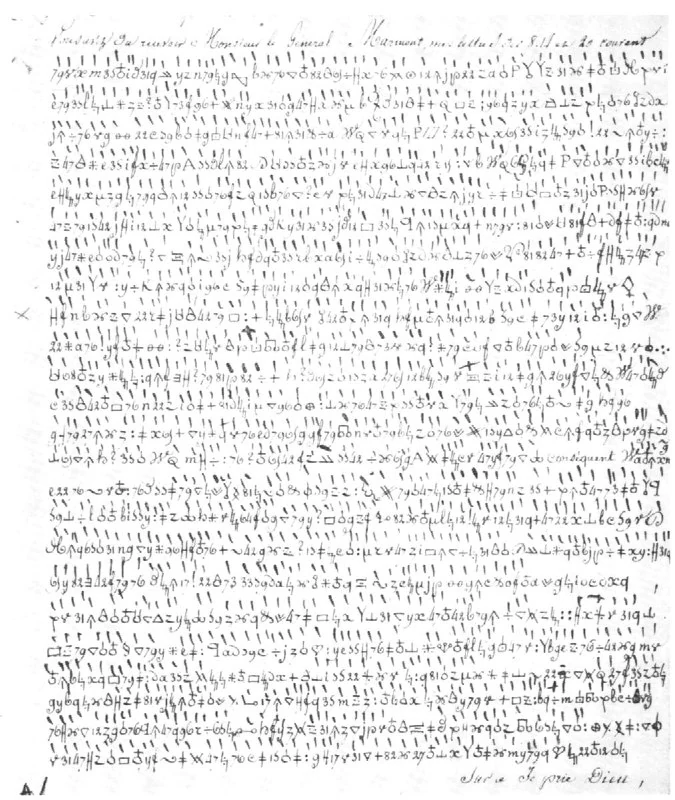
GPT-6 Astra reportedly decoded a historical letter written by a general under Napoleon, a cipher that had remained unsolved for 217 years, using only a scan and a prompt.
Carter Church, who is not a cryptographer, said in his blog that he sent the model only an image and a prompt. The model itself split the scanned letter into lines, recognized the characters, reduced all symbols to a list of unique ones, and then used simulated annealing to fit values against a French dictionary.
The entire task took 6 hours. The letter is dated to the end of March 1809, two weeks before Austria invaded Bavaria. It was written by General Marmont.
The message turned out to contain a summary from the headquarters of the Viceroy of Italy for Marmont, who was isolated in Dalmatia:
- where the French and allied armies were positioned;
- that the Russians were allegedly advancing on Austria;
- that Austria was “hurrying to its own ruin.”
The order of battle matched Napoleon’s directive of March 16, 1809.
Satoshi Tokemo, the compiler of the Cryptiana cipher catalog, checked the solution, and the letter is now marked as solved. Earlier, Astra also decoded a previously encrypted German radio message from World War II.
Why it matters
AnalysisThe case illustrates how modern AI models can combine computer vision, language understanding, and optimization techniques to tackle historical cryptographic problems.
Discuss in community
Share your questions and insights with developers
Related in Ecosystem
Practical guides, core terminology, and agent skills
Part I. AI Agent Architecture: The Foundations
The eleven foundational building blocks of modern autonomous agents: model taxonomy, the agentic runtime loop, advanced prompting, distillation, skills architecture, memory systems, function calling, and FinOps.
Part II. AI Agent Architecture: From Model to Memory and Tools
A deep engineering dive: tokenization, KV-cache, sampling determinism, the training stack, quantization, context engineering, the safety stack, production RAG, ReAct, and multi-agent swarm systems.
Agent Identity & DID (Decentralized Identifiers)
Cryptographic standards (DIDs, Verifiable Credentials, mTLS) that provide autonomous AI agents with a legally and technically recognized identity, signing rights, and action auditing.
The Turing Test and Its Obsolescence
The historical artificial intelligence test proposed by Alan Turing in 1950 assesses a machine's ability to engage in text dialogue convincingly enough that a human cannot distinguish it from another human. This entry explains why the advent of language models has rendered this test scientifically irrelevant.