AI agents based on Claude Opus 5.5 discover two new semiconductors for next-generation memory
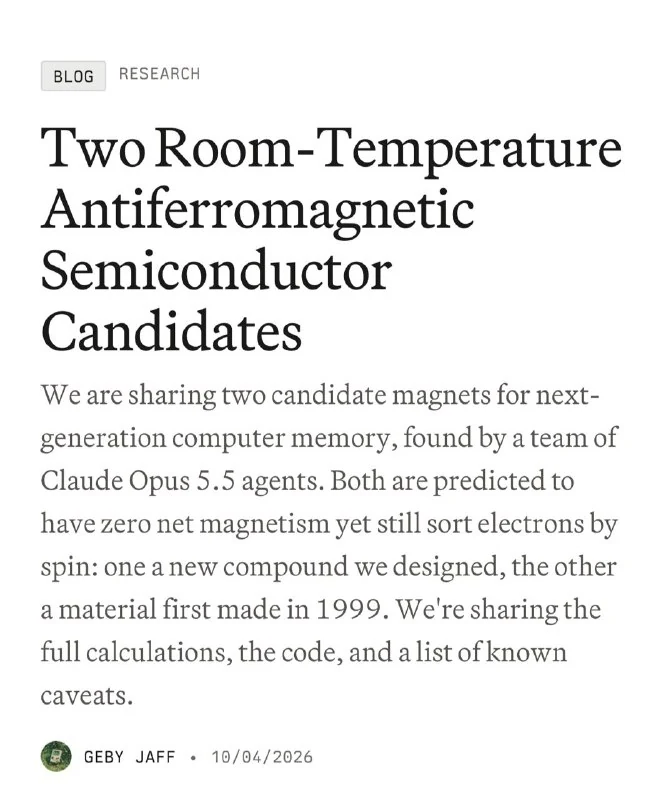
Vals AI presented two Luttinger-compensated magnetic semiconductors with zero net field and spin sorting that could enable denser and faster memory.
AI agents based on Claude Opus 5.5 discovered two new semiconductors that could serve as the basis for the next generation of memory.
The team at Vals AI presented results that could change the approach to creating magnetic memory.
Electrons have spin, conventionally up or down. Spin creates a magnetic moment that can store information. This is how hard-drive read heads and MRAM work.
To use this, electrons must be sortable by spin. Ferromagnetic materials do this well, but they create a strong field that interferes with neighbors and switch slowly. Antiferromagnets have no net field and switch about a thousand times faster, but their spins are mixed and difficult to read.
Researchers are looking for materials with zero net magnetic field but ferromagnet-like spin sorting. These materials are called Luttinger-compensated, and they could give rise to a new generation of memory that is both denser and faster.
Claude Opus 5.5 identified two such materials:
- The first was designed from scratch. According to the authors, this compound had not been synthesized or proposed before, although it may be difficult to synthesize.
- The second belongs to the Prussian blue family. It was synthesized as early as 1999, and calculations from 2008 had already shown the required spin sorting, but no one recognized it as an LC semiconductor until the agents did.
In total, 90 agents worked on the task for three days. Experiments are ongoing.
Why it matters
AnalysisThis shows that AI agents can accelerate materials discovery by uncovering overlooked candidates for magnetic memory. If such materials can be synthesized and integrated, they may lead to memory that is both denser and faster.
Discuss in community
Share your questions and insights with developers
Related in Ecosystem
Practical guides, core terminology, and agent skills
Anthropic Introduces Claude Platform OAuth for Connecting Organizations Without API Keys
Claude Platform OAuth lets users connect their Claude organization via OAuth, pay for API usage directly, and revoke access at any time.
Claude Code Projects: How a Single AI Orchestrates a Team of Autonomous Agents
A deep dive into Claude Code Projects: Coordinator and Threads architecture, parallel branches, shared memory via MEMORY.md, and cloud agent management.
15 Prompts for Creating Agents in Claude Code
Claude Code can work not only through the main dialogue but also via subagents — separate configurations with their own system prompt, a limited set of tools, and, if necessary, a...
Agent Memory
A comprehensive subsystem for data storage, filtering, and retrieval that transforms stateless LLM calls into a stateful system: from short-term scratchpad buffers to multi-session knowledge repositories.