Beyond UI: Why Agent Experience and UAX Matter for Products
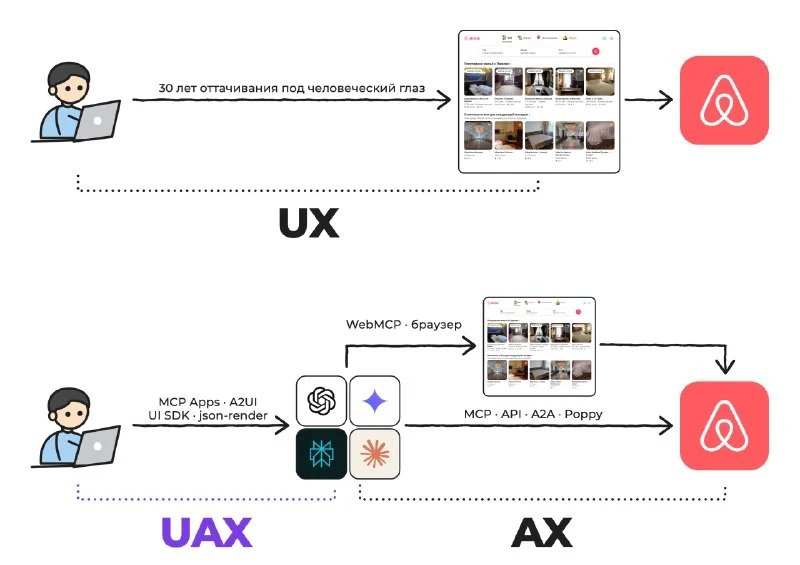
As AI agents become interfaces, products must design not only for humans but also for how agents interact with and render their UI.
Previously, product teams cared only about how UI looks to humans.
With the rise of agents, two more dimensions have emerged:
- UAX: how a person sees your product inside their agent — via MCP Apps, A2UI, json-render, voice hints, etc.
The most interesting part today is UAX, yet almost nobody uses it, even though agents increasingly decide which part of your interface to show the user.
If you wanted to make a product as accessible as possible to agents, you could choose one of two approaches:
- MCP Apps: the agent receives a ready-made piece of your interface, and the user sees it in chat just as it appears on your website, with your design and brand.
- Google's A2UI (and Vercel's json-render): you send the agent only a list of elements — card, price, button — and the agent decides how to present them.
Agents may also become a channel for the most commercially valuable users, because an AI assistant can warm them up before they reach the product.
Why it matters
AnalysisThe next interface layer is not just pixels for humans, but structured experiences that agents can understand, choose, and present. Products that expose clear AX and UAX paths may gain better reach, conversion, and brand consistency inside AI assistants.
Discuss in community
Share your questions and insights with developers
Related in Ecosystem
Practical guides, core terminology, and agent skills
AI in Business Processes: From Diagnostics to a Production-Ready Hermes Agent
A comprehensive practical B2B playbook covering process diagnostics, single-agent workflows, tooling, memory, security, evaluation, observability, and runbooks.
Claude Code Projects: How a Single AI Orchestrates a Team of Autonomous Agents
A deep dive into Claude Code Projects: Coordinator and Threads architecture, parallel branches, shared memory via MEMORY.md, and cloud agent management.
Agent-to-Agent Protocol (A2A)
An open standard for network interaction, decentralized discovery, and secure context exchange between independent AI agents across various vendors and platforms.
AI Agents (Autonomous Agents)
Software systems based on LLMs that can autonomously perceive the state of the environment, decompose complex goals, invoke external tools, and iteratively correct their own mistakes.