Qwen 3.8 Flash Next Released — A New 125B-A6B Model
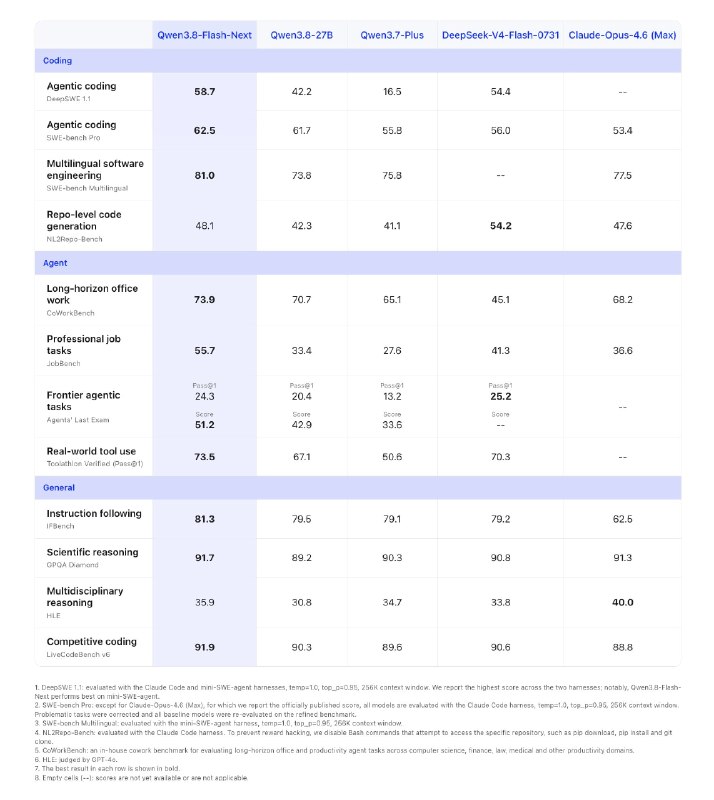
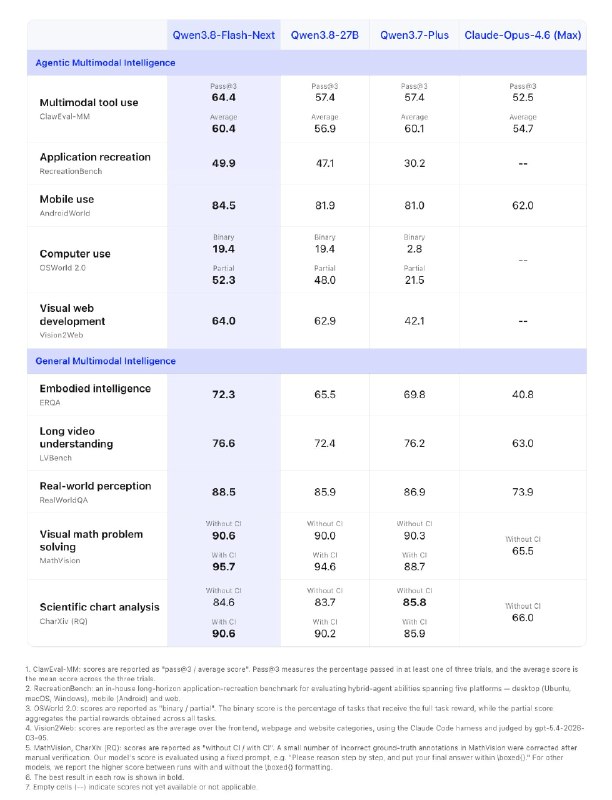
Qwen 3.8 Flash Next is a new 125B-A6B model that shows excellent performance compared to previous versions and competitors.
Qwen 3.8 Flash Next Released — A New 125B-A6B Model
This is a 125B-A6B model with 51B Engram parameters based on the Qwen 4 architecture. It outperforms the Qwen 3.8 27B in all benchmarks and competes very well with DeepSeek V4 Flash. The model is already supported by vLLM and SGLang.
Form Factor and Capabilities
An interesting form factor for models that allows them to be efficiently run on local machines with 128GB of memory — DGX Spark, Mac, Strix Halo. We need more models like this. Recently, there have been no models in this weight category, as ~30B models were running on much weaker hardware, while DeepSeek V4 Flash and similar models no longer fit.
Additional Resources
Why it matters
AnalysisThis model opens up new possibilities for local computing in the AI field, which can significantly impact technology development. It demonstrates competitiveness in the market, which is crucial for further progress in this area.
Discuss in community
Share your questions and insights with developers
Related in Ecosystem
Practical guides, core terminology, and agent skills
GPT-6 Astra reportedly edits another AI model's weights without retraining
GPT-6 Astra is claimed to modify only 0.016% of Qwen3.5-0.8B's weights without gradients or retraining, improving reasoning, math results, and instruction following.
GPT Image Generative Models Prompting Guide
OpenAI's gpt-image generative models are designed to produce production-quality visuals and fully controllable creative workflows. They are suitable for both professional design ta...
Claude Sonnet 4.6 vs GPT-5.5 vs Gemini 3.1 Pro: 2026 model comparison
Every few weeks, a new model comes out, and every time the same questions arise: should I switch? what changed what to pay for?
MIT researchers show GPT-6 Astra can improve other AI models by editing their weights
In an experiment, Astra raised Qwen3.5-0.8B's accuracy on MATH-500 from 7.9% to 48.1% by changing only 0.016% of the model's weights.