Startup PrismML Announces the Largest Model in the World for Smartphone Deployment
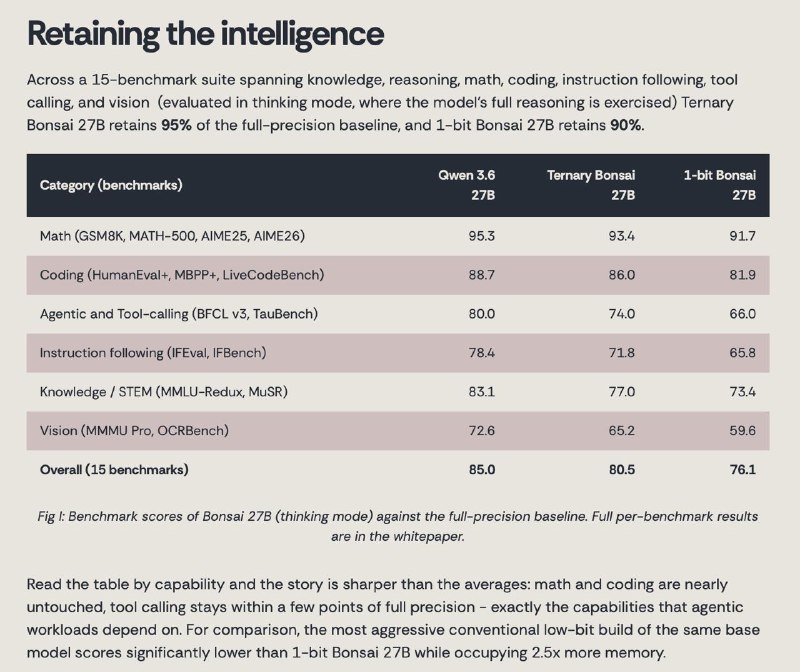
PrismML has unveiled the Bonsai model with 27 billion parameters, optimized for smartphone deployment. It maintains high quality while significantly reducing memory size.
Startup PrismML Announces the Largest Model in the World for Smartphone Deployment
The newly presented Bonsai model features 27 billion parameters. Typically, such a model cannot be run on a phone: in raw 16-bit, it would occupy about 54GB, and even if compressed to 4-bit, it would still be around 18GB. It simply won't fit on a smartphone.
However, Bonsai, despite its impressive size, is optimized specifically for local deployment. The model is based on Qwen3.6-27B, but the developers used not the usual quantization, but a technique called Quantization-Aware Training.
This means that the weights were not truncated but were gradually taught to adapt to discrete values. Technically, during the forward pass, the weights are rounded to discrete values, and the model makes predictions using these values, as in the final compressed version. However, during the backward pass, gradients are computed as if there was no rounding, allowing the model to receive meaningful signals for weight updates, despite the weights being discrete. In other words, the model effectively learns how to scale its weights optimally.
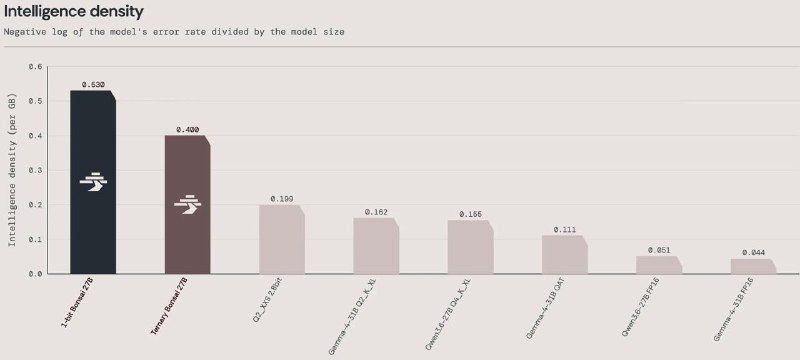
Thanks to this engineering, the model retains over 89–95% of the quality of the full-size version while occupying 9–14 times less memory. For conventional quantization, which eats up a significant portion of quality, these are simply phenomenal figures.
There is a ternary option (weights -1, 0, or +1; occupies ~5.9GB) and a classic 1-bit version (3.9GB). The latter easily fits into the iPhone 17 Pro. Both options are multimodal. Context is 262K tokens. Open-source under the Apache 2.0 license.
Why it matters
AnalysisThis model opens new possibilities for deploying artificial intelligence on mobile devices, potentially transforming user interactions with technology. It showcases how innovative approaches to quantization can preserve high quality while reducing memory size.
Discuss in community
Share your questions and insights with developers
Related in Ecosystem
Practical guides, core terminology, and agent skills
Model Quantization
A mathematical compression technology for neural network weights and activations by transitioning from high precision (FP16/BF16) to low-bit formats (FP8, INT8, INT4, GGUF) for radical memory savings.
JSON — Structured Data for Programs, APIs, and AI Agents
A complete hands-on guide to JSON: syntax specifications, serialization via parse and stringify, REST API consumption, JSON Schema validation, and structured outputs for LLMs.
DOCX and XLSX Formats: When AI Needs to Deliver Production-Ready Documents
A comprehensive hands-on guide to generating and processing DOCX documents and XLSX workbooks with AI: comparing against Markdown and CSV, prompt engineering, formula design, and code automation.
AWQ & Activation-Aware GPU Quantization
4-bit weight compression methods for language models optimized for NVIDIA tensor core architecture, maximizing throughput while preserving critical activation channels.