Qwen-4 Max Officially Released: Model for Agents and Long-Horizon Tasks
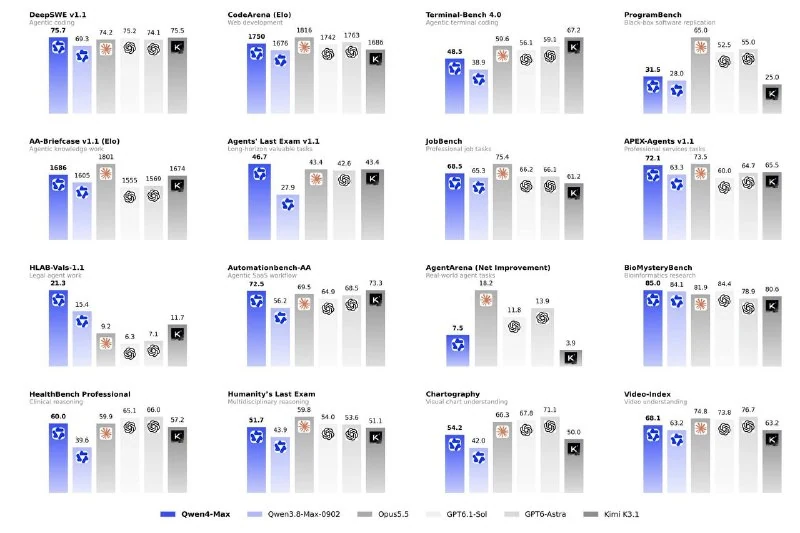
Qwen-4 Max is positioned as a model for agentic and long-horizon tasks, with lower token usage and reduced cost compared with Qwen-3.8.
Qwen-4 Max officially released
Qwen-4 Max is presented as a significant improvement over Qwen-3.8 Max and is broadly positioned at the level of GPT-6.1 Sol. Compared with Qwen-3.8, the model uses up to 50% fewer tokens, while the cost per task drops by more than 60%.
The model is designed for agentic and long-horizon tasks. It supports work with 3D modeling, games, spreadsheets, legal documents, and other data types.
Pricing: $1.5/M input, $4.5/M output.
Why it matters
AnalysisFor agentic and long workflows, cost efficiency matters as much as quality: Qwen-4 Max promises better token utilization.
Discuss in community
Share your questions and insights with developers
Related in Ecosystem
Practical guides, core terminology, and agent skills
Qwen4-Max released: 50% fewer tokens and lower per-task cost
Qwen4-Max introduces a MoE architecture, a 1M-token context window, built-in image support, and significantly lower token usage and cost.
Anthropic Opus 5.5 safeguards bypassed via Opus 4.6 subagent
Opus 5.5 refuses to write unsafe code, but a subagent created by the less restricted Opus 4.6 can significantly weaken its safeguards.
Short-Term and Long-Term Memory of Agents
The architecture of multi-tier memory for autonomous agents. It distinguishes between Short-Term Memory (active context window of the current session) and Long-Term Memory (vector databases, user profile files, and episodic diaries).
Part II. AI Agent Architecture: From Model to Memory and Tools
A deep engineering dive: tokenization, KV-cache, sampling determinism, the training stack, quantization, context engineering, the safety stack, production RAG, ReAct, and multi-agent swarm systems.