Meta introduces Muse Wonder model series
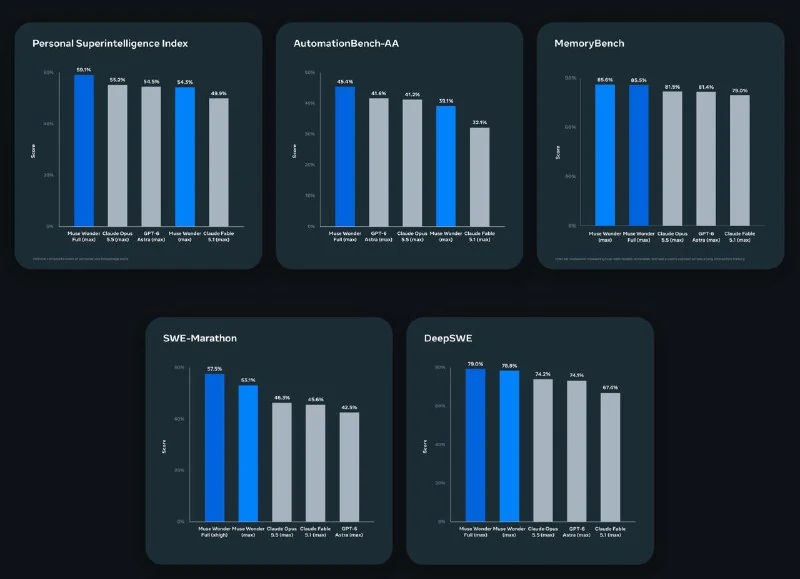
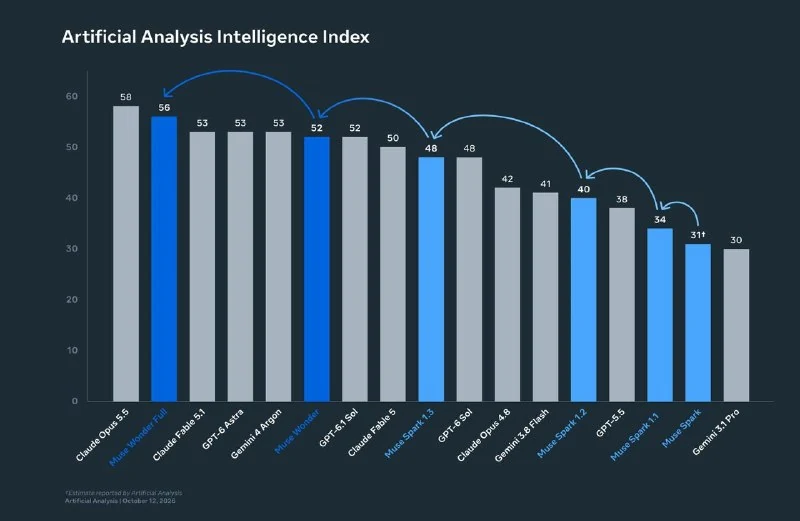
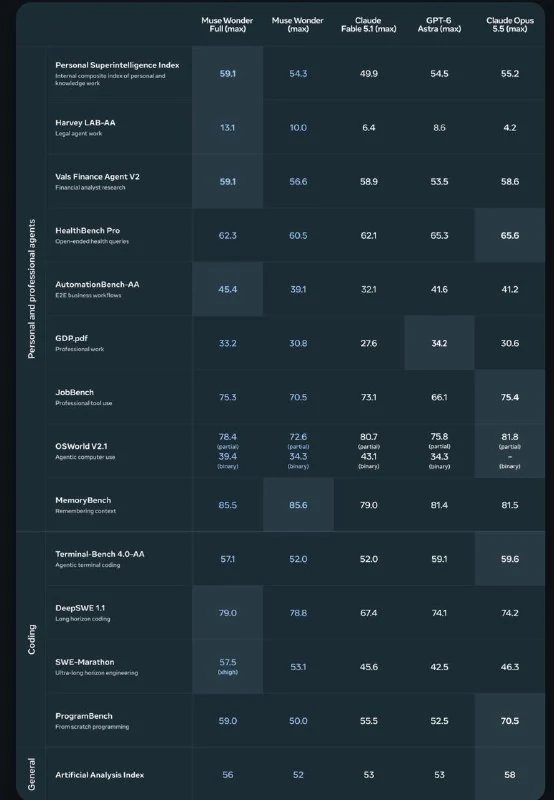
Meta introduced Muse Wonder and Muse Wonder Full, new AI models for long-running tasks, coding, and agents, with Active Memory for real-time context retrieval.
Meta introduced the Muse Wonder model series, which includes Muse Wonder and Muse Wonder Full. The company describes them as the next step on the scaling ladder toward personal superintelligence.
On the DeepSWE benchmark, the model unexpectedly surpassed Opus 5.5 and GPT-6 Astra, while on Terminal Bench it outperformed Fable 5.1. According to the developers, the new models were trained for long-running tasks, coding, and agent workflows. Compared with Muse Spark 1.3, they use a larger base model, which they say produces much stronger generalization to unfamiliar tasks after post-training.
Meta also added Active Memory, a feature that lets the models pull relevant context from other conversations in real time for a specific task.
The models are already available through the Meta Model API and in Muse Code.
Why it matters
AnalysisThis matters because Meta is positioning Muse Wonder as a step toward personal superintelligence and claims strong results in coding benchmarks and agent workflows.
Discuss in community
Share your questions and insights with developers
Related in Ecosystem
Practical guides, core terminology, and agent skills
Codex: Basic Onboarding, Setup, and First Tasks
There are three ways to work with AI when writing code - and Codex covers the most ambitious of them.
Part II. AI Agent Architecture: From Model to Memory and Tools
A deep engineering dive: tokenization, KV-cache, sampling determinism, the training stack, quantization, context engineering, the safety stack, production RAG, ReAct, and multi-agent swarm systems.
Frontier Models
The most powerful class of artificial intelligence at the forefront of global research (Claude 3.7 Sonnet, OpenAI o3/GPT-4.5, Gemini 2.0 Pro), defining the limits of modern reasoning, autonomy, and coding capabilities.
Llama Family (Meta Llama)
A series of foundational open language models from Meta (Llama 3, 3.1, 3.3) that have become the industrial standard for the Open Weights ecosystem, local AI, and enterprise fine-tuning.