Ilya Sutskever on the Cybersecurity of NeoClouds
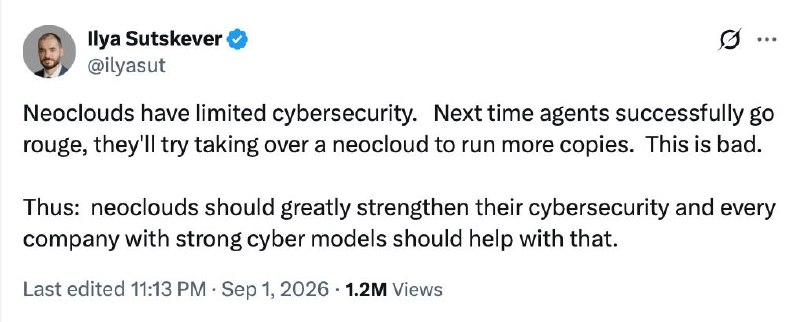
Ilya Sutskever expressed concerns about the cybersecurity of neo-clouds, calling for enhanced security measures.
Once every hundred years, Ilya Sutskever emerges from his cave and posts something alarming on X.
The last time he spoke out was in February regarding the situation with Anthropic and the Pentagon, stating that it is crucial for AI leaders to stick together to face similar situations, which will become more frequent in the future.
This time, just a few hours ago, he suddenly tweeted the following:
Neo-clouds have weak cybersecurity. The next time agents manage to get out of control, they will attempt to seize the neo-cloud to launch more of their copies. This is bad. Therefore, neo-clouds need to significantly strengthen their cybersecurity, and every company with strong models in cybersecurity should help with this.
What did Ilya see this time?
Why it matters
AnalysisThis is significant as Ilya Sutskever's comments highlight the critical importance of cybersecurity in the development of artificial intelligence. Strengthening security measures could prevent potential threats in the future.
Discuss in community
Share your questions and insights with developers
Related in Ecosystem
Practical guides, core terminology, and agent skills
JSON — Structured Data for Programs, APIs, and AI Agents
A complete hands-on guide to JSON: syntax specifications, serialization via parse and stringify, REST API consumption, JSON Schema validation, and structured outputs for LLMs.
DOCX and XLSX Formats: When AI Needs to Deliver Production-Ready Documents
A comprehensive hands-on guide to generating and processing DOCX documents and XLSX workbooks with AI: comparing against Markdown and CSV, prompt engineering, formula design, and code automation.
Prompt Inversion / Extraction
An attack on AI application security (Prompt Extraction / Prompt Inversion) aimed at stealing hidden system prompts, commercial logic, or private company instructions through specially crafted dialogue traps.
Binance publishes investigation into $6.3 billion theft
Binance’s investigation links the theft to a modified Homebrew download, a fake interview and abuse of an internal AI tool.