Grok 4.7 Released: Major Gains in Terminal-Bench and CursorBench
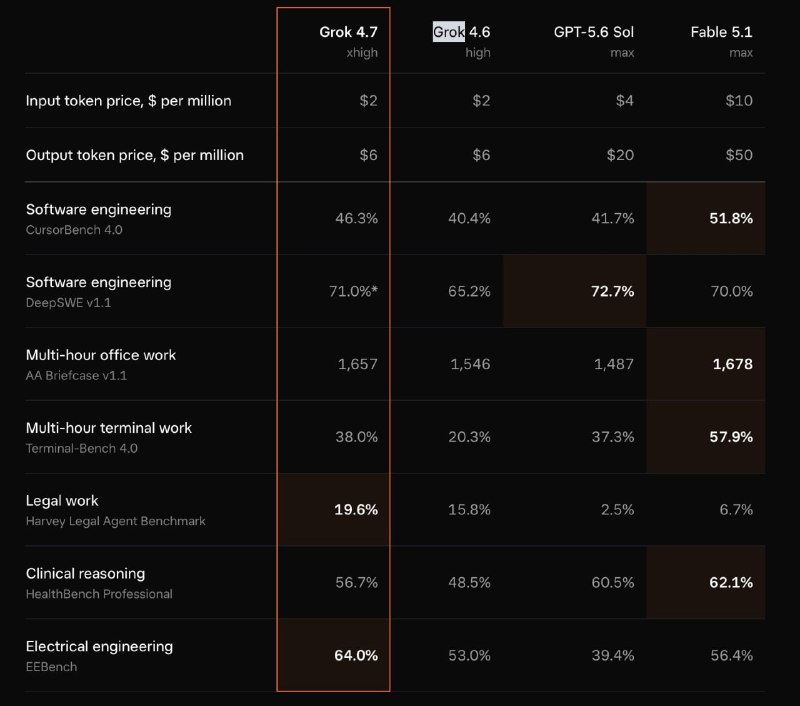
xAI has released Grok 4.7 with doubled Terminal-Bench scores and a lead over GPT-5.6 Sol in CursorBench, maintaining previous pricing.
xAI has unveiled Grok 4.7, the latest iteration of its language model. The headline improvement is a significant jump in Terminal-Bench, where performance surged from 20.3% to 38%.
In the CursorBench test, the model also outperforms GPT-5.6 Sol, scoring 46.3% compared to 41.7%.
Notably, the pricing structure remains unchanged from Grok 4.6, with token costs staying the same.
While Grok 4.7 still trails behind Fable 5.1 in both tests, the gains represent a serious step forward for the model's capabilities.
Official announcement: x.ai/news/grok-4-7
Why it matters
AnalysisGrok 4.7 delivers double the performance in agentic tasks without a price hike, positioning it as a strong competitor in coding and automation.
Discuss in community
Share your questions and insights with developers
Related in Ecosystem
Practical guides, core terminology, and agent skills
Agent Benchmarks: GAIA and SWE-bench
A new generation of rigorous practical benchmarks for evaluating the autonomy of artificial intelligence. GAIA tests multimodal tasks in the open web with files and a browser, while SWE-bench assesses agents' ability to find and fix real bugs in large GitHub repositories.
Agent Evals & SWE-bench Benchmarking
A methodology and infrastructure for systematically measuring the reliability, accuracy, and safety of AI agents through synthetic tests, SWE-bench, and headless repository simulations.
Part I. AI Agent Architecture: The Foundations
The eleven foundational building blocks of modern autonomous agents: model taxonomy, the agentic runtime loop, advanced prompting, distillation, skills architecture, memory systems, function calling, and FinOps.
Part II. AI Agent Architecture: From Model to Memory and Tools
A deep engineering dive: tokenization, KV-cache, sampling determinism, the training stack, quantization, context engineering, the safety stack, production RAG, ReAct, and multi-agent swarm systems.