GPT-5.6 Sol Proves 50-Year Hypothesis on Double Covering Cycles
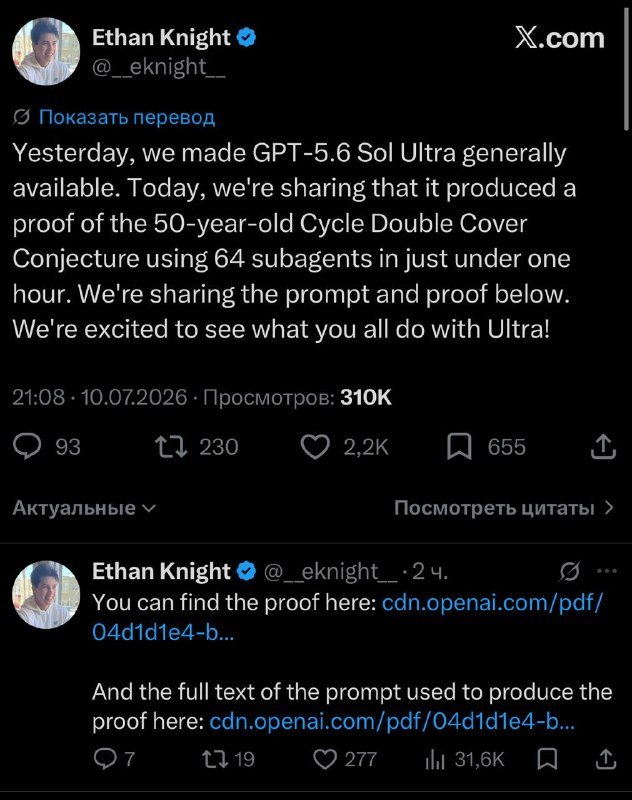
The new GPT-5.6 Sol model has generated a proof of a 50-year-old hypothesis regarding double covering cycles, which could be a significant achievement in graph theory.
GPT-5.6 Sol Proves 50-Year Hypothesis on Double Covering Cycles
This is one of the oldest open problems in graph theory, formulated by Dyer Szekeres in 1973.
The hypothesis states that for any graph without bridges, there exists a set of cycles such that each edge of the graph is included in exactly two of these cycles.
The hypothesis is indeed very important as it relates to the theory of nowhere-zero flows—a central theme in structural graph theory. Double covering has been attempted to be proven many times, but none of the attempts have been recognized as a definitive solution.
Just a few hours ago, an employee of OpenAI announced that the new GPT-5.6 Sol model generated a proof of this hypothesis in just one hour, using 64 subagents!
The proof has been published, but it has not yet been verified by the mathematical community, and discussions are ongoing. If verified, this will be one of the largest and most significant AI-generated proofs to date.
Why it matters
AnalysisThis discovery could have a tremendous impact on the development of graph theory and artificial intelligence, opening new avenues for research in this field.
Discuss in community
Share your questions and insights with developers
Related in Ecosystem
Practical guides, core terminology, and agent skills
JSON — Structured Data for Programs, APIs, and AI Agents
A complete hands-on guide to JSON: syntax specifications, serialization via parse and stringify, REST API consumption, JSON Schema validation, and structured outputs for LLMs.
DOCX and XLSX Formats: When AI Needs to Deliver Production-Ready Documents
A comprehensive hands-on guide to generating and processing DOCX documents and XLSX workbooks with AI: comparing against Markdown and CSV, prompt engineering, formula design, and code automation.
Binance publishes investigation into $6.3 billion theft
Binance’s investigation links the theft to a modified Homebrew download, a fake interview and abuse of an internal AI tool.
Reddit user explains why Claude Code weekly limits are burning almost 4x faster
A Reddit user compared token usage across two weeks and found that each 1% of Claude Code's weekly limit now yields far fewer output tokens, pointing to subagents, reasoning time, and UI refresh requests as likely causes.