Google Unveils Gemini 4 Argon: New Model Tops Vals Index
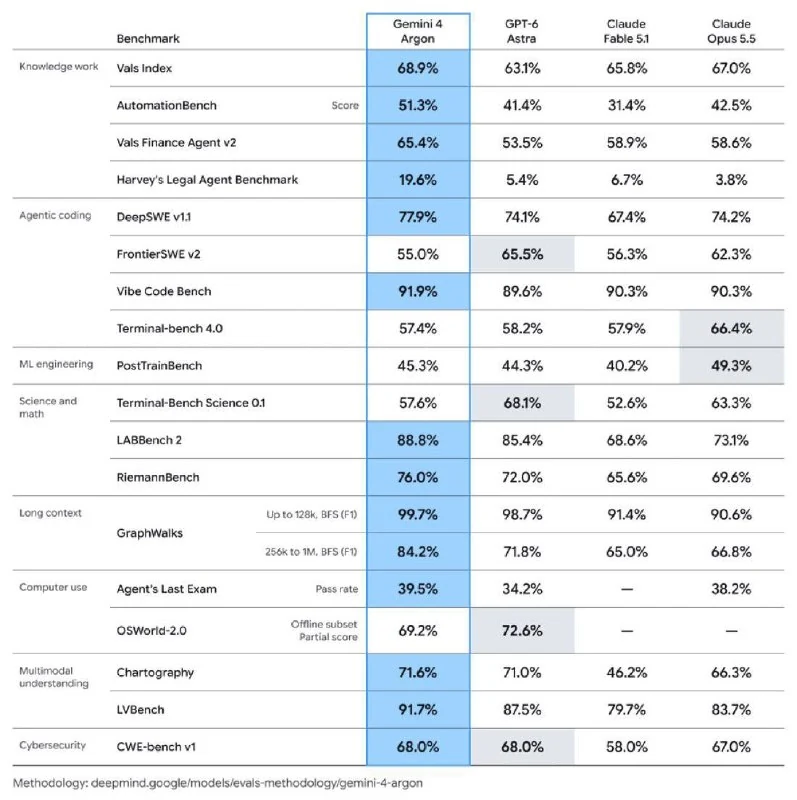
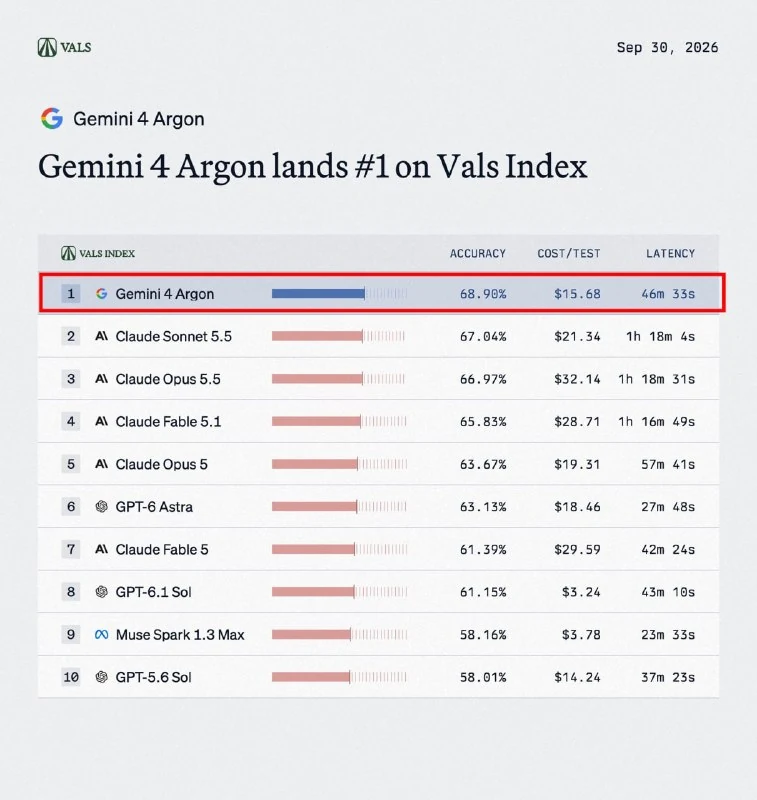
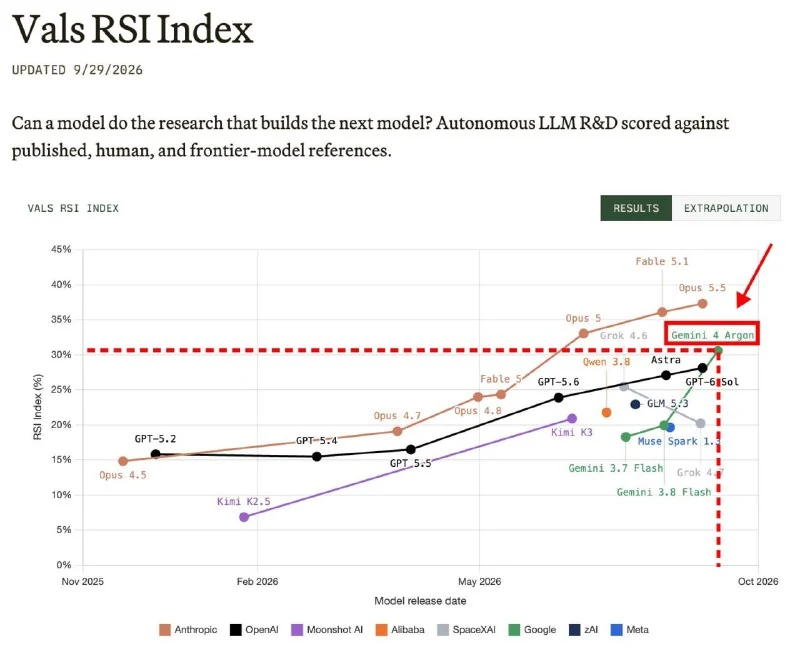
Google has released Gemini 4 Argon, which claimed the top spot on the Vals Index for the first time, showing significant improvements in professional task performance.
Overnight, Gemini 4 Argon was released 🥳
For the first time, it took first place in the Vals Index — a ranking that evaluates models on real-world professional tasks — with a score of 68.9%.
In terms of completed legal tasks, it surpasses Claude Sonnet 5.5 by 7 times.
The Terminal-Bench score increased from 19% to 57.6%.
Out of 22 tests, it placed in the top 5 in 20.
It uses only a quarter of the tokens of its competitor and takes half the time.
Less thinking, more doing.
Output up to 1 million tokens.
A Google DeepMind researcher personally admitted:
"RSI is already here! Our model has officially outgrown me. I have nothing left to teach it. Time to chase the dream and become a barista :) ☕️"
Why it matters
AnalysisThe release of Gemini 4 Argon with record efficiency metrics and low token consumption signals a new phase of competition in the professional AI assistant segment.
Discuss in community
Share your questions and insights with developers
Related in Ecosystem
Practical guides, core terminology, and agent skills
Google AI Studio: Free Gemini API Keys
Official Google sandbox: get free Gemini 2.0/1.5 API keys without a credit card, setup system prompts, and test the 2M token context window. Limits & guide 2026.
Google Gemini Pro (Model with Infinite Context)
The flagship working model from Google DeepMind featuring a record context window of over 2 million tokens. Capable of analyzing entire books, lengthy videos, and massive codebases in a single query.
Claude Sonnet 4.6 vs GPT-5.5 vs Gemini 3.1 Pro: 2026 model comparison
Every few weeks, a new model comes out, and every time the same questions arise: should I switch? what changed what to pay for?
Part II. AI Agent Architecture: From Model to Memory and Tools
A deep engineering dive: tokenization, KV-cache, sampling determinism, the training stack, quantization, context engineering, the safety stack, production RAG, ReAct, and multi-agent swarm systems.