How LLM Can Switch Between Low, Medium, and High Levels of Computational Effort in Reasoning
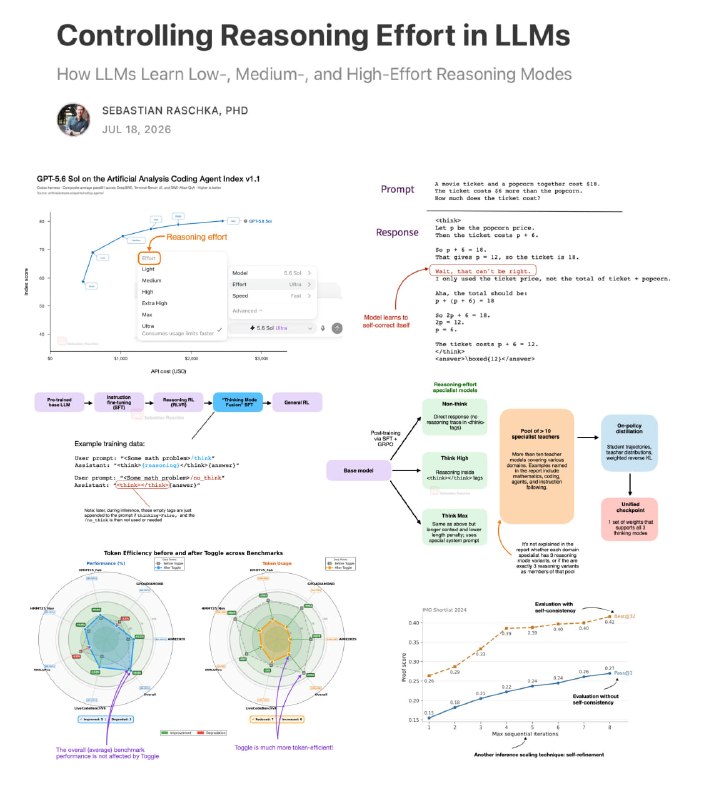
The article discusses how LLM can adjust the level of computational effort during reasoning and how it learns to reason at different depths.
How LLM Can Switch Between Low, Medium, and High Levels of Computational Effort in Reasoning
How can LLM switch between low, medium, and high levels of computational effort during reasoning? And how does LLM learn to reason more or less deeply?
Sebastian Raschka prepared a brief article explaining how these levels of effort are implemented during inference and training.
Why it matters
AnalysisUnderstanding the mechanisms behind LLM's adjustment of computational effort can aid in optimizing their use across various applications.
Discuss in community
Share your questions and insights with developers
Related in Ecosystem
Practical guides, core terminology, and agent skills
Frontier Models
The most powerful class of artificial intelligence at the forefront of global research (Claude 3.7 Sonnet, OpenAI o3/GPT-4.5, Gemini 2.0 Pro), defining the limits of modern reasoning, autonomy, and coding capabilities.
AI Radar: GPT-6.1 Terra, Gemini 4 Carbon, Mistral Large 4 and OpenAI/Anthropic pricing changes
A roundup of recent AI news: new LLM releases, OpenAI and Anthropic subscription changes, world models, video generation, and research updates.
MIT researchers show GPT-6 Astra can improve other AI models by editing their weights
In an experiment, Astra raised Qwen3.5-0.8B's accuracy on MATH-500 from 7.9% to 48.1% by changing only 0.016% of the model's weights.
ReAct Pattern (Reasoning + Acting)
A fundamental algorithmic pattern for autonomous agents that alternates between internal reasoning steps (Thought), executing external tools (Action), and analyzing the resulting output (Observation).