OpenAI Publishes 722 AI-Written Math Papers in Open Access
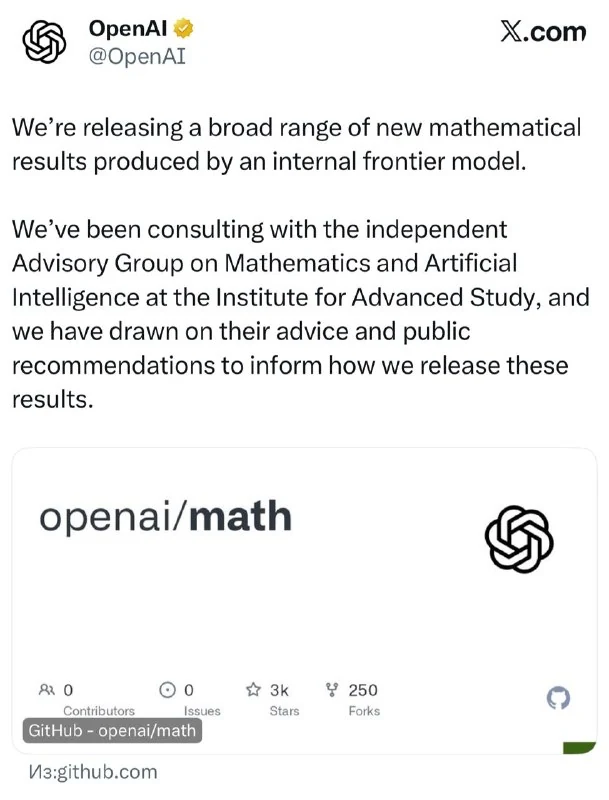
OpenAI released 722 mathematical papers generated by an internal, unreleased AI model, including claimed results on Hodge conjecture cases, the Riemann zeta function, and the Unique Games Conjecture.
OpenAI Publishes 722 AI-Written Math Papers in Open Access
OpenAI has released 722 mathematical papers generated by an internal AI model that has not yet been publicly launched. Each paper addresses an open mathematical problem, and the works are grouped into 372 families of related papers across different areas of mathematics.
From saturated benchmarks to open research
The company said that testing models on conventional benchmarks had become less interesting because those benchmarks were saturated. Instead, an agent was given 4,000 open research problems. According to OpenAI, a single result took about three hours of reasoning on average.
Notable results
- Hodge conjecture for CM-abelian varieties. This is a special case of the Hodge conjecture from the Millennium Prize Problems list.
- Extension of the zero-free region of the Riemann zeta function to Re(s) > 11/12, meaning that all nontrivial zeros are shown to lie in the strip 1/12 < Re(s) < 11/12. This is an intermediate result toward the Riemann Hypothesis.
- Solution to the free group factors problem. The problem had been open since the 1940s, and the proof closes one of the oldest questions in the theory of von Neumann algebras.
- Unique Games Conjecture. This is a central question about the limits of approximate computation: for many NP-hard problems it implies that the best known algorithms are already optimal, and improving them would be possible only if P = NP. A proof would settle the question for a huge class of problems.
Repository
All materials are published on GitHub: github.com/openai/math.
Why it matters
AnalysisIt suggests that AI systems are moving beyond code and chat outputs toward generating formal research artifacts in fundamental mathematics. If the results are independently verified, they could change how AI capabilities are benchmarked and how scientific discovery is approached.
Discuss in community
Share your questions and insights with developers
Related in Ecosystem
Practical guides, core terminology, and agent skills
AMS President Reports Proof of Generalized Riemann Hypothesis Alongside Anthropic Announcement
Ravi Vakil, president of the American Mathematical Society, announced a proof of the Generalized Riemann Hypothesis at the same time as an Anthropic announcement, emphasizing the work was done by a human.
OpenAI GPT (Flagship Models of the GPT Series)
The primary universal line of large language models from OpenAI (GPT-4, GPT-4o). Optimized for complex text analysis, programming, creativity, and daily intellectual tasks.
Several OpenAI employees depart after Anthropic IPO reports
Multiple OpenAI employees, including AI safety, robotics and Codex specialists, reportedly departed after Anthropic's public listing. The reasons remain unclear.
Hermes Profile: OSINT Researcher & Deep Web Intelligence
Hermes open-source intelligence (OSINT) profile: multi-hop web investigation, primary source verification, competitive intelligence, and citation-backed synthesis.