Google releases EmbeddingGemma 2, an open multimodal embedding model
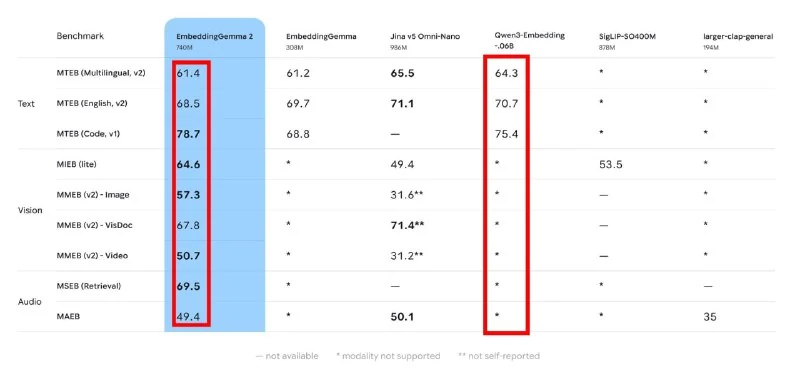
Google introduced EmbeddingGemma 2, an open 740M-parameter multimodal embedding model for on-device text, code, image, video, and audio retrieval.
Google has released EmbeddingGemma 2, the first open multimodal embedding model that natively works with text, code, images, video, and audio.
The model has 740 million parameters and a modular architecture. It is designed to run directly on-device rather than in a data center.
EmbeddingGemma 2 outperforms some specialized models that are more than twice its size.
Paired with Gemma 4, it enables building a fully local RAG stack with a strong focus on privacy.
Why it matters
AnalysisOn-device multimodal embeddings reduce reliance on cloud APIs and make private local RAG systems more accessible.
Discuss in community
Share your questions and insights with developers
Related in Ecosystem
Practical guides, core terminology, and agent skills
Google unveils Gemini 4 Neon: model outperforms Claude Opus 5.5 and GPT-6.2 Sol on coding and agentic tasks
Google has introduced Gemini 4 Neon, a new AI model that reportedly beats Claude Opus 5.5 and GPT-6.2 Sol on most tests, especially in programming, reasoning, and agent workflows.
Jev and System One AI: A Complete Practical Guide to the Decision Model from TypeSafe
A deep engineering breakdown of the flagship Jev model: System One architecture versus LLMs, Choice/Score/Noul primitives, request parallelism, confidence mathematics, video use cases, code, and an overview of local open-weight alternatives (Laya, GLiNER2.5, CLM-8B).
Knowledge Base Connectors (Google Drive, Notion, Confluence)
This technology integrates corporate data sources with language models using pre-built connectors (Connectors / ETL). It automatically synchronizes updated documents from Google Drive, Notion, Confluence, and Slack with a vector database without manual file uploads.
Gemini Flash & Pro (Google Gemini)
A family of multimodal models from Google DeepMind that combines a record context window (up to 2 million tokens), extreme generation speed (over 150 tokens/sec), and native perception of video and audio.