Google unveils Gemini 4 Neon: model outperforms Claude Opus 5.5 and GPT-6.2 Sol on coding and agentic tasks
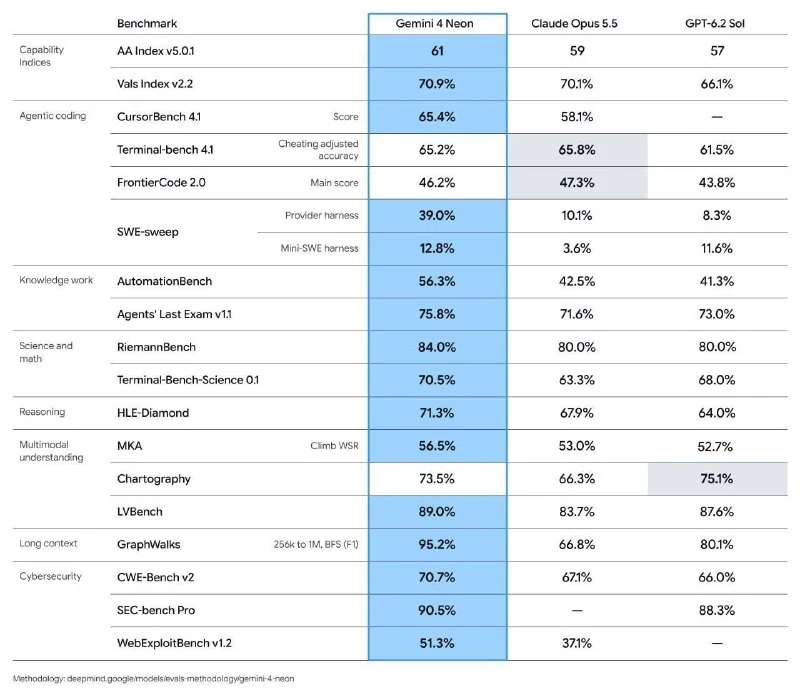
Google has introduced Gemini 4 Neon, a new AI model that reportedly beats Claude Opus 5.5 and GPT-6.2 Sol on most tests, especially in programming, reasoning, and agent workflows.
Google unveils Gemini 4 Neon
Google has introduced a new AI model, Gemini 4 Neon. According to the announced results, it outperforms Claude Opus 5.5 and GPT-6.2 Sol on most tests and practical tasks.
Strongest use cases
- programming;
- logical reasoning;
- agentic scenarios.
On some benchmarks, Gemini 4 Neon surpasses even the larger Gemini 4 Carbon and ranks first in coding-agent leaderboards. With a medium reasoning level, Neon is 32% cheaper than Carbon.
The model is already available via API and Google AI Studio.
Pricing
- $3 per million input tokens;
- $15 per million output tokens.
Why it matters
AnalysisThis matters because Google is positioning Gemini 4 Neon as a cheaper alternative to its larger Carbon model for coding and agent workflows, which could intensify competition among frontier AI providers serving developers.
Discuss in community
Share your questions and insights with developers
Related in Ecosystem
Practical guides, core terminology, and agent skills
Google AI Studio: Free Gemini API Keys
Official Google sandbox: get free Gemini 2.0/1.5 API keys without a credit card, setup system prompts, and test the 2M token context window. Limits & guide 2026.
Gemini Notebook turns sources into interactive sites
Gemini Notebook (formerly NotebookLM) can now generate interactive dashboards, study notes, and other web pages from user-uploaded PDFs, notes, and links.
Claude Sonnet 4.6 vs GPT-5.5 vs Gemini 3.1 Pro: 2026 model comparison
Every few weeks, a new model comes out, and every time the same questions arise: should I switch? what changed what to pay for?
Google Gemini Pro (Model with Infinite Context)
The flagship working model from Google DeepMind featuring a record context window of over 2 million tokens. Capable of analyzing entire books, lengthy videos, and massive codebases in a single query.