SkillCache: Semantic Skill Caching for AI Coding Agents
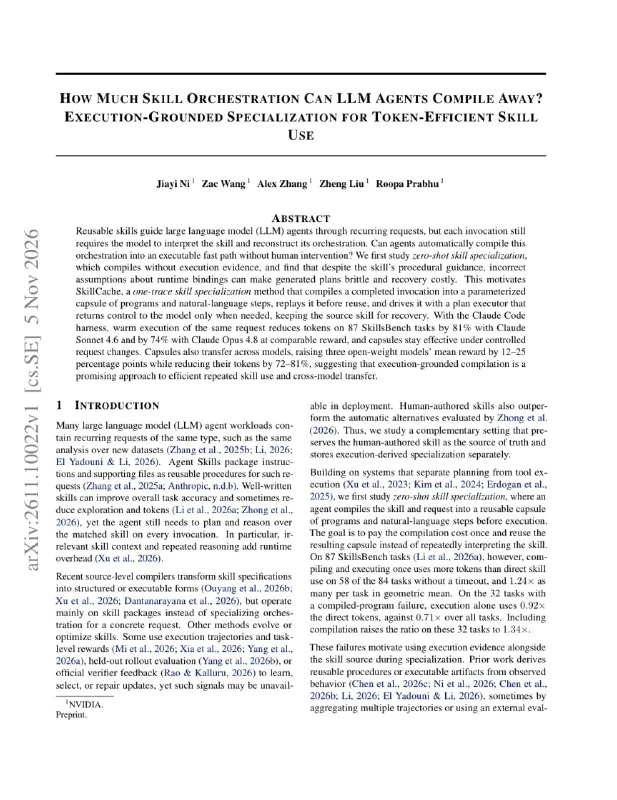
Researchers introduced SkillCache, a semantic skill-caching system for AI coding agents that reduces repeated token spend on project discovery.
Teams that actively use Claude Code and other multi-step AI coding agents often notice an unpleasant pattern by the end of the month. Only a small share of tokens goes toward writing new code. Up to 70–80% is spent on the same environment-discovery and skill-setup actions.
For example, every time a developer starts a new session to fix a bug or add an API, the agent first rereads a multi-page SKILL.md file, then runs the same find and grep commands, inspects package.json or Cargo.toml, looks for build scripts, and tries different test-launch parameters through trial and error.
Even if the project structure has not changed at all, the agent repeats everything in the next session as if it remembers nothing. That again costs tens of thousands of tokens.
The authors of the recently published SkillCache paper proposed a solution. They developed a semantic skill-caching system that sits between the agent runtime and the tools the agent uses. Filesystem fingerprints are used to validate cache freshness.
When the agent activates a skill or starts exploring the environment, SkillCache stores the results of repeatable operations and a structured description of the environment.
If hashes of dependent configuration files and directory structures remain unchanged, subsequent sessions receive a compact snapshot of the saved state in milliseconds. The agent no longer needs to repeat many tool calls.
In tests on real programming tasks, SkillCache reduced token usage by 81% and total task execution time by nearly two thirds, without lowering the success rate.
Why it matters
AnalysisCoding agents often burn most of their token budget on repeated environment scanning rather than writing code; caching validated agent state can cut cost and latency without hurting task success.
Discuss in community
Share your questions and insights with developers
Related in Ecosystem
Practical guides, core terminology, and agent skills
New stick-scene skill for Claude Code creates animated stick-figure explanations
Roadmap.sh creator Kamran Ahmed released stick-scene, a free Claude Code skill that generates animated stick-figure explanations from a prompt.
How to Integrate Monobank Acquiring Without a Developer via Vibe-Coding
A step-by-step guide to integrating Monobank online payments: FOP compliance, terminal setup, ECDSA webhook verification, robust UX, and security test matrix.
Claude Code Projects: How a Single AI Orchestrates a Team of Autonomous Agents
A deep dive into Claude Code Projects: Coordinator and Threads architecture, parallel branches, shared memory via MEMORY.md, and cloud agent management.
AI Agents (Autonomous Agents)
An autonomous system based on a large language model that not only responds to messages but independently plans a sequence of actions, utilizes external tools (browser, terminal, databases), and executes complex tasks without constant human oversight.