OpenAI begins rolling out text watermarks in ChatGPT and Codex
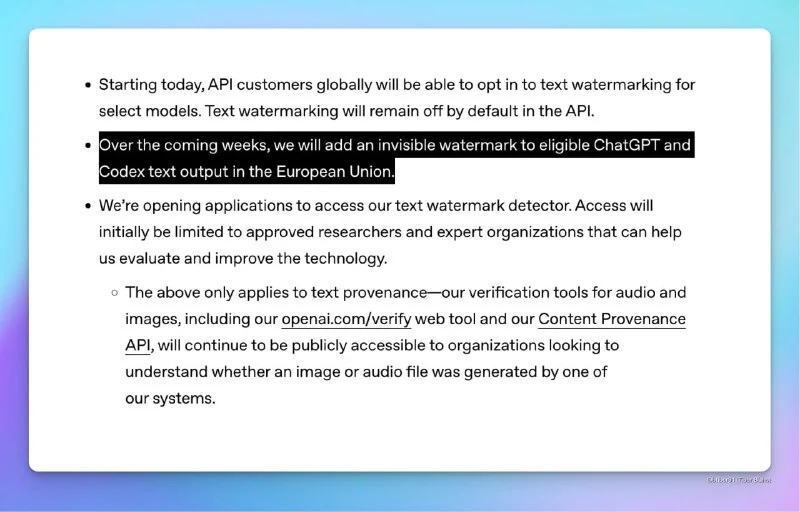
OpenAI has started adding text watermarks to ChatGPT and Codex, initially limiting the rollout to EU countries.
This is the first day of OpenAI's promised releases.
ChatGPT and Codex are beginning to embed watermarks in generated text.
Unlike Anthropic and Google, OpenAI is currently deploying its textGrain technology only in European Union countries.
More details are available in OpenAI's announcement.
Why it matters
AnalysisText watermarks can make AI-generated content easier to identify and may shape provenance standards for large language models. The EU-only rollout also highlights how regulation can influence feature availability.
Discuss in community
Share your questions and insights with developers
Related in Ecosystem
Practical guides, core terminology, and agent skills
ChatGPT Updates: Plugin Development and Codex Workflows
Comprehensive engineering guide to creating, packaging, testing, and submitting plugins for ChatGPT and Codex: manifest specification, MCP servers, lifecycle hooks, custom marketplaces, and OpenAI review.
Codex Skills for Beginners: Automating AI Agent Workflows
A comprehensive hands-on guide to building and executing Codex Skills: SKILL.md anatomy, explicit vs. auto-triggering, skills vs. scripts vs. tools, Skills API, and safety boundaries.
OpenAI GPT (Flagship Models of the GPT Series)
The primary universal line of large language models from OpenAI (GPT-4, GPT-4o). Optimized for complex text analysis, programming, creativity, and daily intellectual tasks.
ChatGPT Memory (Storing Facts Between Dialogues)
The ChatGPT Memory feature enables the AI to retain your name, profession, favorite technologies, response formats, and personal details across entirely different chats, enhancing user experience and personalization.