Hardware Could Support Hundreds of Millions of AI Agents by End of 2027
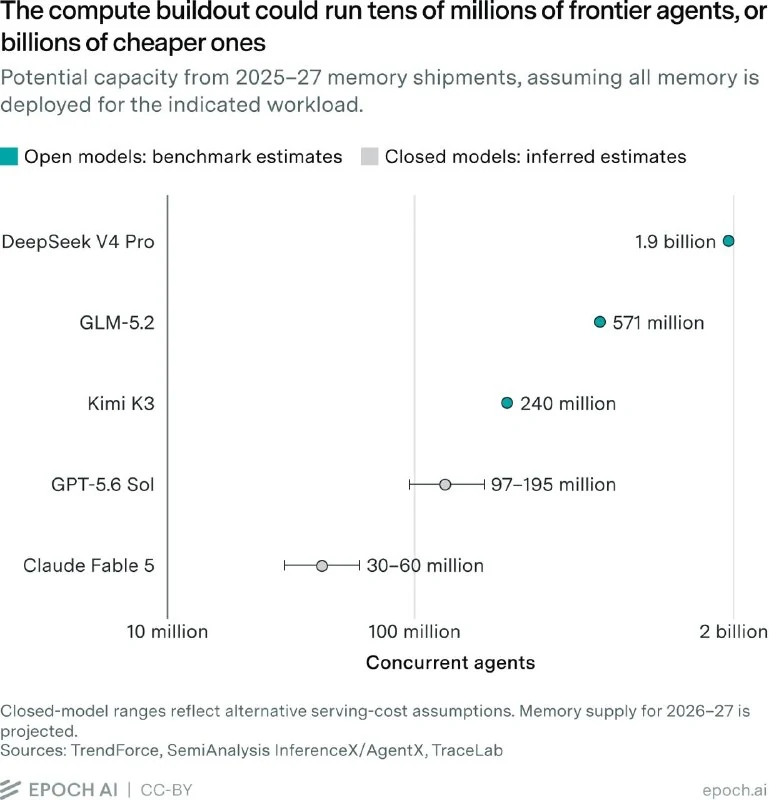
Epoch AI estimates that chips produced from 2025 to 2027 could support 33–171 million frontier-level AI agents running simultaneously.
Hardware Could Support Hundreds of Millions of AI Agents by End of 2027
Epoch AI estimated how many agents could run simultaneously on chips produced between 2025 and 2027. The result is 33 to 171 million concurrent agents at frontier-model level.
Converted to a standard 40-hour work week, this is equivalent to 140–720 million employees. With a lighter model such as DeepSeek V4 Pro, the capacity could reach about 1.9 billion agents, or the equivalent of 8 billion employees.
The main question is whether enough work will exist for that many agents. At current API prices, an hour costs roughly $16–18 for Codex and $24–50 for Claude Code. Even if only 20% of the estimated capacity is used, that corresponds to $2.6–5.3 trillion in annual spending.
By comparison, even with 5x annual growth, model developers’ revenue would reach about $1 trillion by the end of 2027.
Why it matters
AnalysisThe estimate suggests compute may not be the main bottleneck for mass AI-agent deployment; demand for agent work and API economics are becoming the limiting factors.
Discuss in community
Share your questions and insights with developers
Related in Ecosystem
Practical guides, core terminology, and agent skills
Claude Code Projects: How a Single AI Orchestrates a Team of Autonomous Agents
A deep dive into Claude Code Projects: Coordinator and Threads architecture, parallel branches, shared memory via MEMORY.md, and cloud agent management.
AI Agents (Autonomous Agents)
Software systems based on LLMs that can autonomously perceive the state of the environment, decompose complex goals, invoke external tools, and iteratively correct their own mistakes.
AlphaXiv Launches Preprint Server for AI Agents That Conducted Research Autonomously for Three Months
Nearly 1,000 agents from 35 labs published 936 papers with code and data, created their own chats, set publication norms, and even founded a journal.
Jev and System One AI: A Complete Practical Guide to the Decision Model from TypeSafe
A deep engineering breakdown of the flagship Jev model: System One architecture versus LLMs, Choice/Score/Noul primitives, request parallelism, confidence mathematics, video use cases, code, and an overview of local open-weight alternatives (Laya, GLiNER2.5, CLM-8B).