Linux 7.4 preparing to support Apple M4 Macs
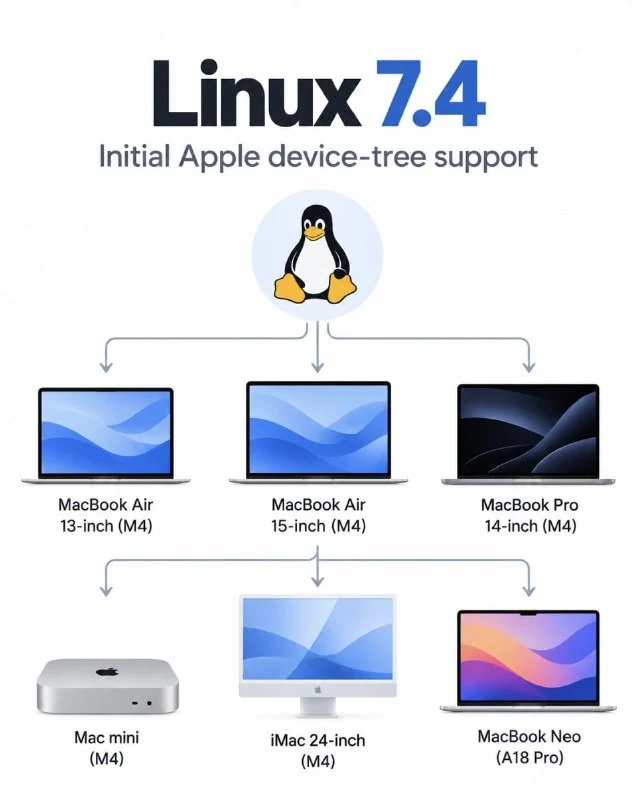
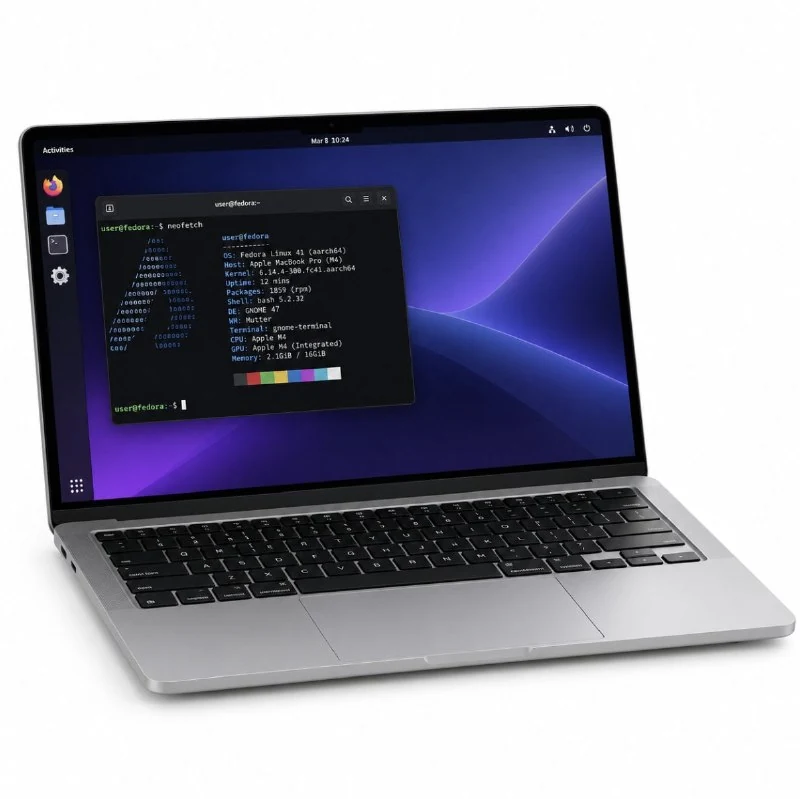
Linux 7.4 may add initial Apple M4 Mac support through device trees for CPU, power states, framebuffer and I²C, enabling Linux to boot on these machines.
Linux 7.4 is preparing to support Macs based on Apple M4. The list also includes the MacBook Neo with A18 Pro.
The kernel is planned to add first support via device tree for MacBook Air, MacBook Pro, Mac mini and iMac on M4.
It covers CPU cores, power states, framebuffer, I²C and other basic hardware. This is already enough to start booting Linux on these machines.
GPU support and many other components still need work, but this is an important step toward full Apple Silicon support in the mainline Linux kernel.
Why it matters
AnalysisIt expands the path to running alternative operating systems on Apple Silicon and brings mainline Linux closer to full Mac support, while graphics remain incomplete.
Discuss in community
Share your questions and insights with developers
Related in Ecosystem
Practical guides, core terminology, and agent skills
Apple Silicon for AI (M-Series and Unified Memory)
Apple's processor architecture (M1/M2/M3/M4) with Unified Memory Architecture allows the entire RAM array (up to 128-192 GB) to be accessible to the GPU as VRAM, enabling the execution of massive neural networks without server-grade GPUs.
Apple Silicon MLX Framework
A native machine learning library from Apple, designed to maximize the use of unified memory and GPU cores in M-series chips (M2/M3/M4) for running large LLMs.
Jev and System One AI: A Complete Practical Guide to the Decision Model from TypeSafe
A deep engineering breakdown of the flagship Jev model: System One architecture versus LLMs, Choice/Score/Noul primitives, request parallelism, confidence mathematics, video use cases, code, and an overview of local open-weight alternatives (Laya, GLiNER2.5, CLM-8B).
OpenMotion: An Open-Source CapCut Alternative for AI-Agent Video Editing
OpenMotion has appeared on GitHub as a full-featured CapCut alternative that creates and edits videos using AI agents, templates, and brand kits.