Kimi K3.1 and DeepSeek V4.1 Flash reportedly distilled from Astra
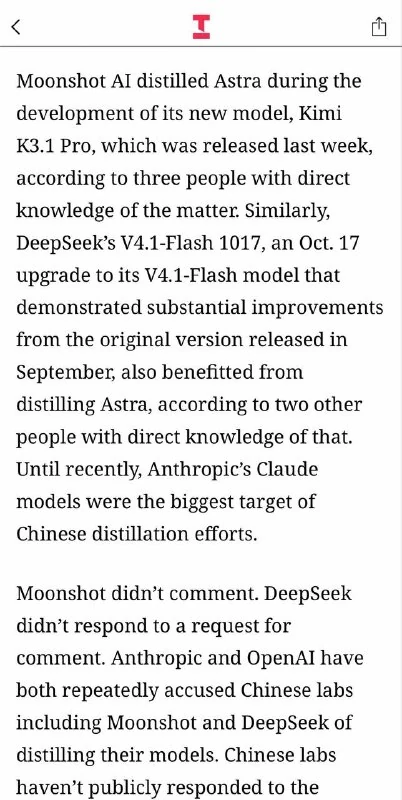
The Information reports that Kimi K3.1 and DeepSeek V4.1 Flash may have been created through distillation from Astra, a model linked to OpenAI.
The Information reports that Kimi K3.1, a recently released Chinese model, was allegedly distilled from Astra, a model associated with OpenAI.
The same publication claims a similar approach may have been used for DeepSeek's new checkpoint, DeepSeek V4.1 Flash.
Why this matters
- Model distillation trains a smaller model on the outputs or hidden states of a larger one.
- If true, Astra could be a key knowledge donor for Chinese AI labs.
- The case highlights how capability transfer may reshape competition among major AI ecosystems.
Why it matters
AnalysisIf confirmed, the claim shows how distillation can accelerate capability transfer between leading AI ecosystems and raises questions about model provenance.
Discuss in community
Share your questions and insights with developers
Related in Ecosystem
Practical guides, core terminology, and agent skills
DeepSeek V4.1 Flash becomes available in Cursor
DeepSeek V4.1 Flash is now available in Cursor; according to CursorBench results, a single task costs $0.60–$0.98, making it attractive for everyday coding.
DeepSeek (Chinese Breakthrough in Open AI)
A series of groundbreaking open models from the Chinese lab DeepSeek (V3, R1). Demonstrates top-tier coding and reasoning capabilities at a cost 10–20 times lower than Western commercial counterparts.
How to Run Local LLMs: Setup Guide, Model Benchmarks, and Optimization
The definitive guide to running local LLMs on your hardware: hardware requirements, Ollama and Open WebUI deployment, Llama 3, Qwen 2.5, DeepSeek, and GGUF quantization.
RLVR (Reinforcement Learning with Verifiable Rewards)
A post-training method for optimizing AI agent reasoning, where the reward function is based on objective mathematical verifications, compilers, and unit tests instead of subjective human evaluations.