Claude’s internal model helped scientists design a protein that could become a scorpion toxin antidote
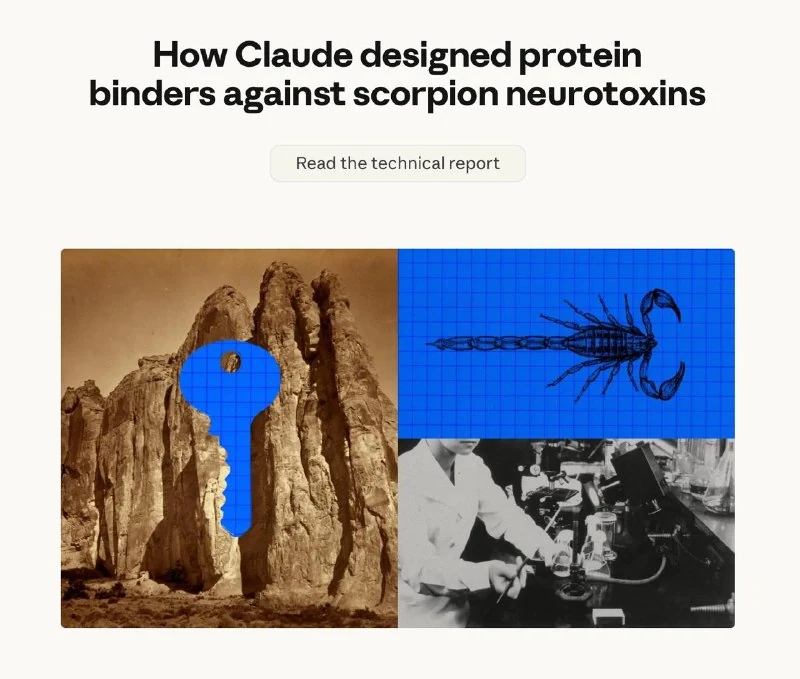
Anthropic and Citrini Research used Claude to generate and screen candidate proteins that bind scorpion toxins, producing a lab-validated shortlist in about three days.
Each year, more than a million people are stung by scorpions and thousands die, mostly children in poor regions. Existing antivenoms are made from horse blood, which is slow and expensive, and they do not work against all toxin variants.
Scorpion venom works by toxins attaching to nerve cells and causing nerves to fire incorrectly. Researchers have proposed creating small proteins that bind to the toxin at the right spot and prevent it from reaching cells.
Anthropic and Citrini Research decided to test whether Claude could help generate such decoy proteins. The agent was given a prompt and an environment and ran autonomously for almost three days. It proposed more than 300,000 candidate proteins, then filtered out weak ones and selected the 180 best. The process took about 10,000 GPU-hours.
Seventeen of the selected proteins passed strict laboratory validation, and the two best turned out to bind the toxin very tightly. However, scorpion toxins differ by region, and Claude has not yet produced a universal protein.
Even for individual toxins, these are not antidotes yet: testing continues and success is not guaranteed. Still, producing such a shortlist in three days is already a major result that previously took humans months.
All proteins were released as open .co/datasets/Anthropic/scorpion-toxin-binder-design).
Why it matters
AnalysisIt shows that an AI agent can compress months of early-stage protein design into days, while reminding that clinical antidotes still require extensive validation and region-specific solutions.
Discuss in community
Share your questions and insights with developers
Related in Ecosystem
Practical guides, core terminology, and agent skills
Computer Use via AI
Anthropic's technology (introduced in Claude 3.5 Sonnet) enables neural networks to control operating systems like a human: taking screenshots, analyzing window coordinates, moving the mouse cursor, clicking buttons, and entering text without using specialized APIs.
Constitutional AI (RLAIF)
A behavior alignment method developed by Anthropic (creators of Claude). Instead of relying on millions of hours of human labor, the model critiques and corrects its own responses based on a clear set of ethical principles ('Constitution').
Anthropic details how it reviews code written by AI
Anthropic says Claude generates about 90% of Claude Code's code, and its review pipeline uses multiple AI agents, risk-based approvals, and feature flags to reduce production incidents.
Anthropic engineer shares how to set more ambitious AI tasks and publishes a ready prompt
Felix Rieseberg, a lead engineer at Anthropic working on Claude, outlined three ways to make AI work like a top specialist instead of just a faster assistant, and shared a reusable prompt.
Vibe Coding for Non-Developers: How Marketers, Designers, and PMs Build Products with Claude and Cursor
A practical guide to Vibe Coding without the terminal: 45 techniques for working in Claude and Cursor tailored for marketers, designers, and PMs. From website edits to routine automation.
Building a Design System in Figma with Claude Code
Step-by-step guide to building a complete Figma design system using Claude Code: tokens, components, variables, and responsive screens.