Xiaomi Releases MiMo-V2.6: New Open AI Model Tops Benchmarks
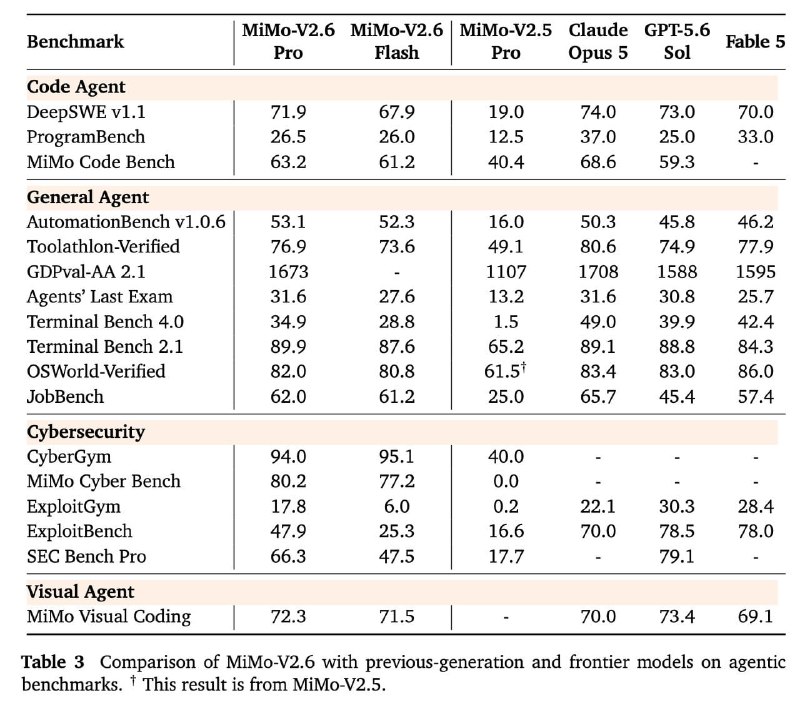
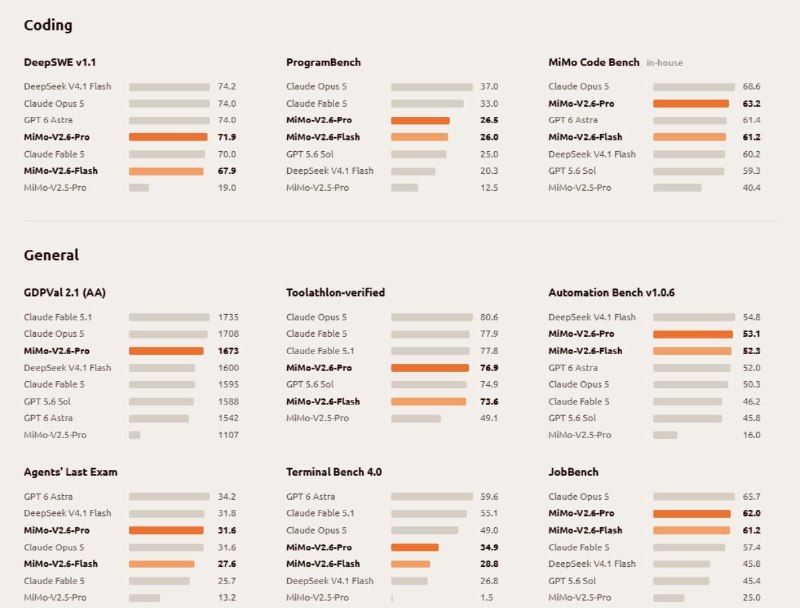
Xiaomi has introduced MiMo-V2.6 Pro and Flash, new open-source AI models that achieved top rankings among open models with significantly lower costs compared to international flagships.
Xiaomi Releases MiMo-V2.6
Chinese tech giant Xiaomi has released its latest AI models, MiMo-V2.6 Pro and Flash, showcasing strong performance results.
To achieve this, Xiaomi invested 130 hours, processed 75 billion tokens, and spent $2.6 million on Reinforcement Learning (RL), successfully pushing MiMo-V2.6 Pro to the first place among open models.
Performance and Pricing
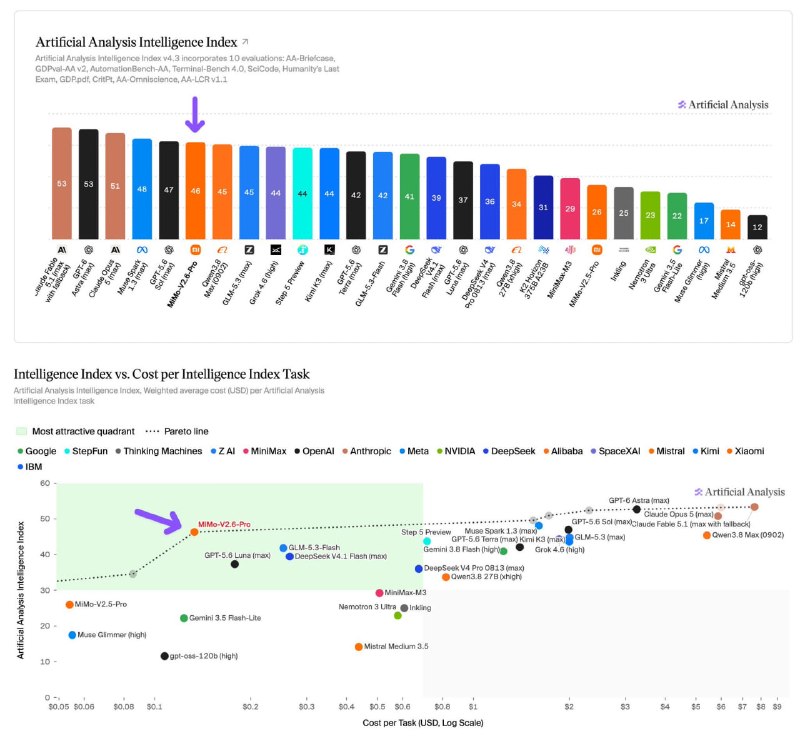
The AA Intelligence Index score for MiMo-V2.6 Pro is 46.32, surpassing Kimi K3 and Qwen3.8 Max. Notably, the pricing remains the same as the previous version, V2.5.
With comparable intelligence levels, the cost per request is just 1/20th to 1/60th of international flagships:
- MiMo-V2.6 Pro: $0.435 / $0.87
- MiMo-V2.6 Flash: $0.14 / $0.28 (approximately one-third the price of Pro)
- DeepSeek V4 Pro: ~$0.66–1.32 / $1.98–3.96 (Pro is ~2–5x cheaper)
- GLM-5.3: ~$1.40 / $4.40 (Pro is ~3–5x cheaper)
- Qwen3.8 Max: ~$2 / $6 (Pro is ~5–7x cheaper)
- Gemini 3.5 Flash: ~$1.50 / $9 (Pro is ~3–10x cheaper)
- Gemini 3.1 Pro: ~$2 / $12 (Pro is ~5–14x cheaper)
- GPT-5.6 Sol: ~$4–5 / $20 (Pro is ~10–23x cheaper)
- Claude Opus 5: ~$5 / $25 (Pro is ~12–29x cheaper)
- Claude Fable 5: ~$10 / $50 (Pro is ~23–58x cheaper)
A single task costs approximately $0.13.
Transparency
The entire training process was streamed in real-time, with costs and incidents published online. Along with the model, weights, RL code, and environments have been made open.
Why it matters
AnalysisThe release of MiMo-V2.6 shifts the landscape of open-source AI by offering flagship-level performance at a fraction of the cost, making advanced AI accessible to a broader range of developers and enterprises.
Discuss in community
Share your questions and insights with developers
Related in Ecosystem
Practical guides, core terminology, and agent skills
Thinking Machines Releases Inkling 2 Small: a 594B MoE Model That Can Fine-Tune Other Models
Thinking Machines released Inkling 2 Small, a 594B-parameter MoE model that leads among open models in several benchmarks and demonstrated autonomous fine-tuning of Qwen3.5-4B.
Thinking Machines releases Inkling 2 Small: a MoE model that competes with larger flagships
Thinking Machines introduced Inkling 2 Small, a multimodal Mixture-of-Experts model with 594B total parameters and 17B active per token. Full weights are promised next week under Apache 2.0.
Part II. AI Agent Architecture: From Model to Memory and Tools
A deep engineering dive: tokenization, KV-cache, sampling determinism, the training stack, quantization, context engineering, the safety stack, production RAG, ReAct, and multi-agent swarm systems.
Laya Open Decision Engine
Laya is an Apache 2.0 decision-encoder built on ModernBERT-large that selects an agent action from JSON or text state in one Forward Pass, typically ~33–35 ms on a self-hosted GPU. It replaces expensive LLM ReAct loops in high-QPS routing, Guardrails, and local agents with calibrated System 1 classification.