Types of Loops in the AI Model Claude
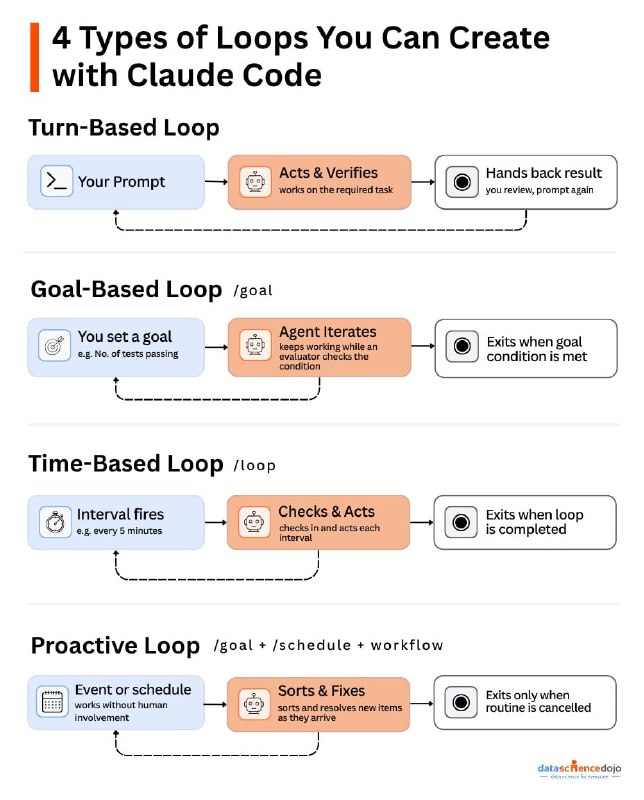
Anthropic described four types of loops that can be built using Claude. Each of them conveys a different part of the decision-making process to the agent.
The term loop engineering is now used so broadly that it is important to clearly understand how these four options differ: what triggers the loop and what defines its completion moment.
Request-based Loop. You send a request, Claude performs the task, checks the result independently, and returns it to you. This loop operates practically with every message you send, regardless of whether you call it that or not. Goal-based Loop (/goal). You set a measurable completion criterion in advance. Each time Claude attempts to complete the task, the evaluator model checks whether the goal has been achieved. If not, Claude continues working. Time-based Loop (/loop, /schedule). Instead of a user request, the trigger occurs via a timer. The /loop command rechecks at specified intervals but stops working if your machine stops. The /schedule command carries the same idea to the cloud, so the loop continues to operate independently of your current session. Proactive Loop. This is a combination of /schedule, /goal, and workflow that is triggered by an event without any user request at the moment of execution. Each element is brought to its own goal, and the process continues to run until someone turns it off.
However, goal-based loops only work when the completion criterion can actually be measured. Proactive loops are the simplest way to encounter scaling issues if their operation is not first tested on at least a few real scenarios. For most tasks, a regular request-based loop is still better suited than a more complex scheme where there is currently no need.
It is not necessary to choose the most advanced mechanism just because it is more complex. It is more important to select the type of loop depending on whether the task has a clear completion criterion or truly needs to be performed continuously.
Why it matters
AnalysisThis information is crucial for understanding how to effectively utilize AI models for automating processes. Knowledge of different loop types will help in choosing the optimal approach for specific tasks.
Discuss in community
Share your questions and insights with developers
Related in Ecosystem
Practical guides, core terminology, and agent skills
Markdown Format: The Complete Guide for AI Workflows and Automation
A comprehensive hands-on guide to Markdown syntax for AI development: CommonMark standards, heading hierarchy, GFM tables, character escaping, system prompts, and CLAUDE.md guidelines.
Claude + Excel for Logistics: 10 Ready-to-Use Scenarios for Rate, OTD, and Cost Audits
A practical B2B playbook on integrating Claude with Excel: ready-made system prompts, formulas, and algorithms for analyzing freight variance, OTD, suppliers, and inventory.
Computer Use via AI
Anthropic's technology (introduced in Claude 3.5 Sonnet) enables neural networks to control operating systems like a human: taking screenshots, analyzing window coordinates, moving the mouse cursor, clicking buttons, and entering text without using specialized APIs.
Community Discusses Anthropic Bans Over the Past Week
Comments mention users reporting accounts banned by Anthropic during the past week, with no details provided.