Revolut shifts 2,000 engineers to locally deployed GLM models for coding
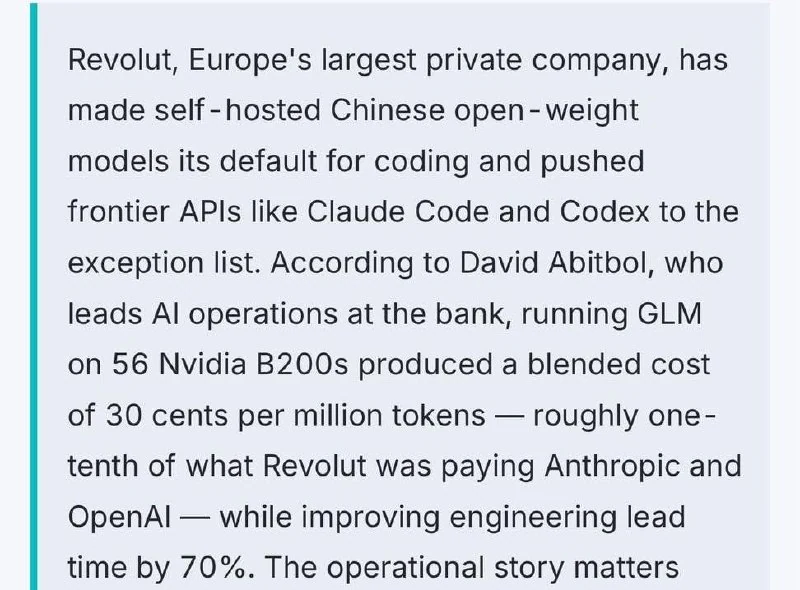
Revolut moved about 2,000 engineers to locally deployed GLM models, cutting AI coding costs by roughly tenfold and reducing task completion time by 70%.
Revolut has moved about 2,000 engineers to locally deployed GLM models for programming, while Claude Code and Codex are now used only in exceptional cases.
According to David Abitbol, head of AI operations at the company, the rollout uses 56 Nvidia B200 accelerators. The average cost came to just 30 cents per million tokens — roughly ten times less than what Revolut paid Anthropic and OpenAI.
At the same time, the execution time of engineering tasks dropped by 70%.
The more interesting detail is that the gains became noticeable when engineers no longer had to economize on tokens. They stopped using AI only for complex tasks and began using it almost everywhere.
Advanced proprietary models are becoming the exception, while open-weight models are becoming the main tool. For every AI company preparing for an IPO, this creates a serious pricing problem.
Why it matters
AnalysisThe case shows that local open-weight models can become the default for engineering teams, not just a cheaper fallback. That puts pressure on proprietary AI vendors’ pricing and their IPO narratives.
Discuss in community
Share your questions and insights with developers
Related in Ecosystem
Practical guides, core terminology, and agent skills
Frontier Models
The most powerful class of artificial intelligence at the forefront of global research (Claude 3.7 Sonnet, OpenAI o3/GPT-4.5, Gemini 2.0 Pro), defining the limits of modern reasoning, autonomy, and coding capabilities.
Mistral AI (European Open and Efficient Models)
A series of high-performance open and commercial models from the French startup Mistral AI (Mistral 7B, Mixtral 8x7B, Mistral Large). Known for their compactness, speed, and respect for data privacy.
MIT researchers show GPT-6 Astra can improve other AI models by editing their weights
In an experiment, Astra raised Qwen3.5-0.8B's accuracy on MATH-500 from 7.9% to 48.1% by changing only 0.016% of the model's weights.
Part I. AI Agent Architecture: The Foundations
The eleven foundational building blocks of modern autonomous agents: model taxonomy, the agentic runtime loop, advanced prompting, distillation, skills architecture, memory systems, function calling, and FinOps.