Nvidia Invests in Creating an Open Model to Compete with Chinese Open Source
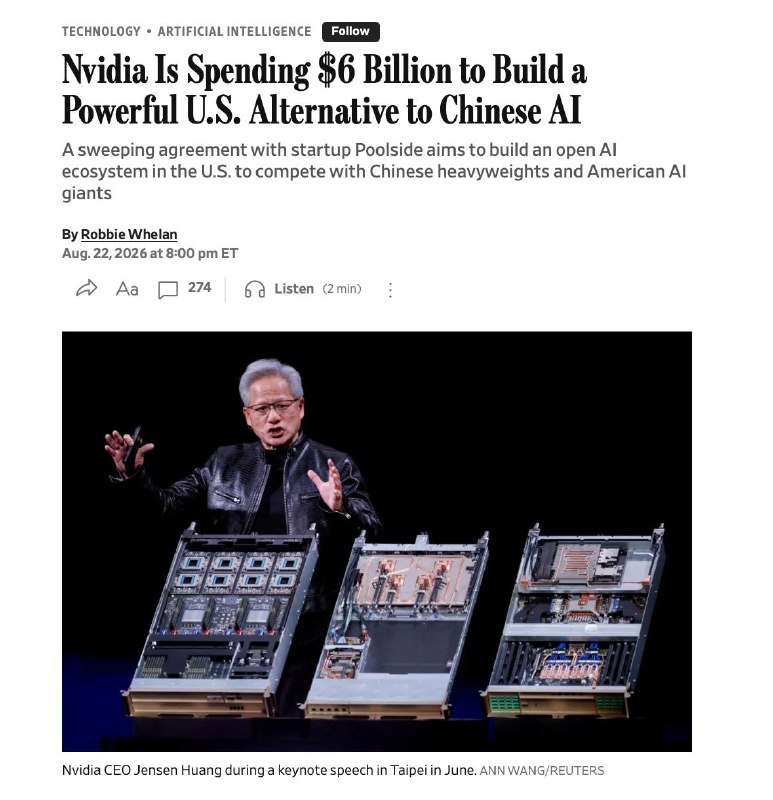
Nvidia is investing $7 billion in creating an open model that can compete with Chinese solutions. The deal with startup Poolside will allow the company to acquire technologies for developing new AI models.
Nvidia Invests in Creating an Open Model to Compete with Chinese Open Source
Nvidia is investing around $7 billion in this idea.
The company has struck a major deal with startup Poolside, which is developing its own models (primarily for coding). Poolside's creator, Jason Warner, was previously the CTO of GitHub and released Copilot.
For $6 billion, Nvidia gains an exclusive license for Poolside's technology and takes most of its employees for its projects, while the startup formally continues to exist as an independent company. Additionally, Nvidia is investing another billion dollars as an investment (Poolside is currently valued at around $12 billion).
With the acquired technology and about a hundred Poolside employees, Nvidia plans to revive Nemotron – its line of open models. The goal is to release a model that could compete with DeepSeek and Moonshot.
When informing shareholders about the reorganization, Poolside noted that "this deal is intended to prevent AI from becoming a closed technology controlled by a narrow circle of people." It sounds altruistic, but for Huang, of course, the motivation is not only to elevate American open source to a new level.
It is important for him to remain a monopolist, and he sees open models as an infrastructural lever that strengthens the world's dependence on his GPUs. The Chinese are developing their own chips, and top AI players are doing the same. An open model optimized solely for Nvidia hardware, which thousands of companies around the world deploy on their infrastructure, is an excellent way to retain more market share.
Why it matters
AnalysisThis deal could significantly impact the AI market, as open models may become a crucial tool for technological advancement. Nvidia's investment in Poolside highlights the importance of competition with Chinese technologies.
Discuss in community
Share your questions and insights with developers
Related in Ecosystem
Practical guides, core terminology, and agent skills
Four Resume Tips from OpenAI’s Head of Applied AI Development
Wulfie Bain, OpenAI’s head of applied AI development, shared four resume rules: keep it short, remove irrelevant details, highlight outcomes, and lead with the strongest achievements.
AI Radar: GPT-6.1 Terra, Gemini 4 Carbon, Mistral Large 4 and OpenAI/Anthropic pricing changes
A roundup of recent AI news: new LLM releases, OpenAI and Anthropic subscription changes, world models, video generation, and research updates.
Nvidia's Monopoly and the CUDA Platform
An analysis of Nvidia's technological and economic dominance in the AI market. The CUDA (Compute Unified Device Architecture) platform, created in 2006, transformed ordinary gaming GPUs into the planet's primary computational tool, making it difficult for competitors like AMD and Intel to break this monopoly.
JSON — Structured Data for Programs, APIs, and AI Agents
A complete hands-on guide to JSON: syntax specifications, serialization via parse and stringify, REST API consumption, JSON Schema validation, and structured outputs for LLMs.