GitHub Publishes Massive Reverse-Engineering Tool Collection for Sites, Apps, and Games
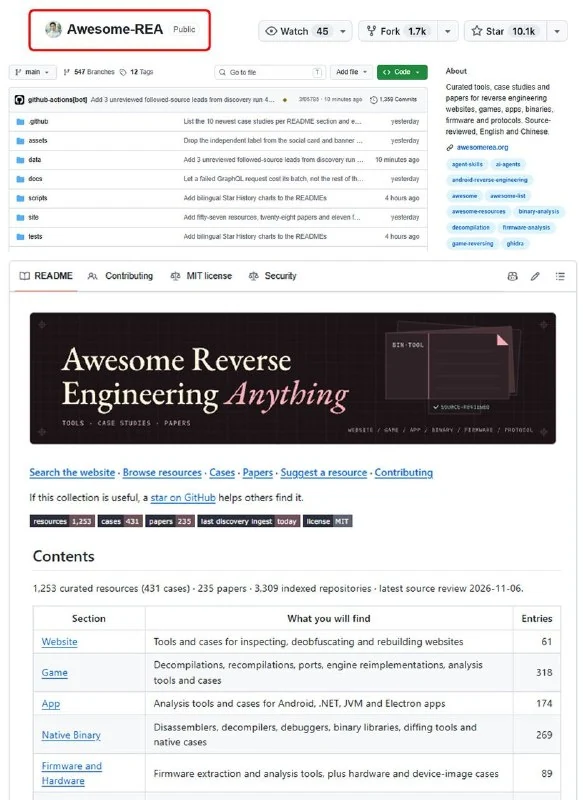
Awesome-REA gathers 1,253 sources, 431 practical cases, 235 scientific papers, and 3,309 repositories for analyzing websites, applications, and games.
On GitHub, a comprehensive collection of tools for reverse engineering websites, applications, and games has been published. It includes 1,253 sources, 431 practical cases, 235 scientific papers, and 3,309 ready-made repositories.
Some tools can be connected to AI agents through MCP servers, and the entire library can be used as a knowledge base for AI. This helps quickly and accurately reproduce the functionality of any software in your project.
The Wikipedia of reverse engineering is available in Awesome-REA.
Why it matters
AnalysisThe collection can speed up reverse-engineering research and provide a knowledge base for AI agents that assist developers in understanding and reproducing software functionality.
Discuss in community
Share your questions and insights with developers
Related in Ecosystem
Practical guides, core terminology, and agent skills
GitHub library Awesome-REA collects reverse-engineering resources
Awesome-REA on GitHub gathers more than 1000 reverse-engineering materials, including practical cases, research papers, and AI-assisted tooling.
Ghostty developer adds playful troll rule for AI agents in AGENTS.md
Ghostty's AGENTS.md tells AI agents to add a mocking file when opening pull requests, while Turborepo uses a similar 'I didn't check my work' marker.
Part II. AI Agent Architecture: From Model to Memory and Tools
A deep engineering dive: tokenization, KV-cache, sampling determinism, the training stack, quantization, context engineering, the safety stack, production RAG, ReAct, and multi-agent swarm systems.
Loop Engineering: Architecture of Autonomous Agentic Loops and the Post-Prompting Era
A deep dive into Loop Engineering: self-sustaining execution loops for Claude Code and autonomous agents, the DOER/CHECKER topology, deterministic verification, the /goal primitive, and reward hacking mitigation.