Model or Wrapper?
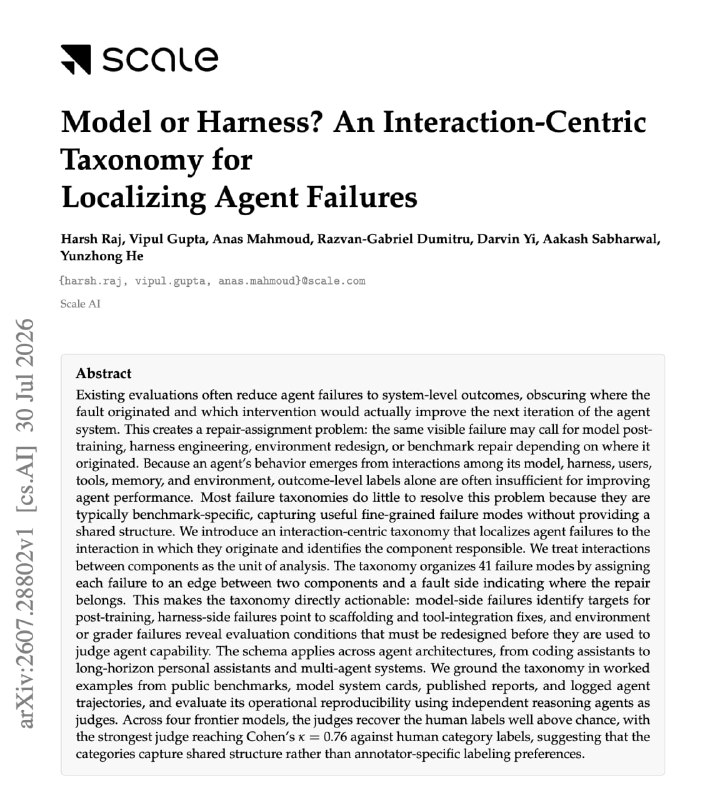
The article discusses issues arising in the development of AI agents, focusing on the interaction between the model and the wrapper.
Model or Wrapper?
If you are developing AI agents for production, this article is worth saving.
The authors collected 41 typical failure scenarios and classified them based on which components the problem arises at the intersection of. Each error is tied to the interaction between the model, the wrapper, the user, tools, memory, or environment, and indicates where the cause lies and where it needs to be fixed.
This reflects the real picture well: most problems with AI agents arise not in the model itself, but at the intersection of the model and the surrounding infrastructure.
The approach is also suitable for automatic analysis. In tests on four advanced models, the best AI judge achieved a Cohen's kappa agreement coefficient of 0.76 compared to manual labeling. This allows for automatic classification of errors directly in production, rather than dissecting them manually after each incident.
This year, wrapper engineering has become one of the main factors in the quality of AI agents, but there has not yet been a common language for separating model errors from wrapper errors. This work offers such a system.
Article: arxiv.org/abs/2607.28802
Why it matters
AnalysisThis article is important as it offers a new approach to analyzing errors in AI agents, which can significantly enhance their effectiveness in production. Understanding the interaction between the model and the wrapper is critical for improving the quality of AI solutions.
Discuss in community
Share your questions and insights with developers
Related in Ecosystem
Practical guides, core terminology, and agent skills
MIT researchers show GPT-6 Astra can improve other AI models by editing their weights
In an experiment, Astra raised Qwen3.5-0.8B's accuracy on MATH-500 from 7.9% to 48.1% by changing only 0.016% of the model's weights.
Autonomous AI Operator on Telegram 24/7: Architecture, Telethon, Security, and 10 Production Scenarios
A comprehensive engineering guide to building a production-ready AI operator on Telegram using Telethon: session isolation, confirmation systems, ban protection, and 24/7 deployment.
Loop Engineering: Architecture of Autonomous Agentic Loops and the Post-Prompting Era
A deep dive into Loop Engineering: self-sustaining execution loops for Claude Code and autonomous agents, the DOER/CHECKER topology, deterministic verification, the /goal primitive, and reward hacking mitigation.
Custom GPTs
ChatGPT's feature for creating personalized mini-assistants tailored to specific tasks. It allows uploading custom files, setting persistent instructions, integrating image generation, and connecting external APIs without coding.