Mistral Large 4: 1T-parameter model with open weights due October 27
Mistral introduced Mistral Large 4, or Le Chonk, with 1 trillion parameters and 49 billion active parameters; the API is already available, while open weights are promised for October 27.
Mistral has introduced a new model, Mistral Large 4, also known as Le Chonk. According to the announcement, it has 1 trillion parameters and 49 billion active parameters.
Key details:
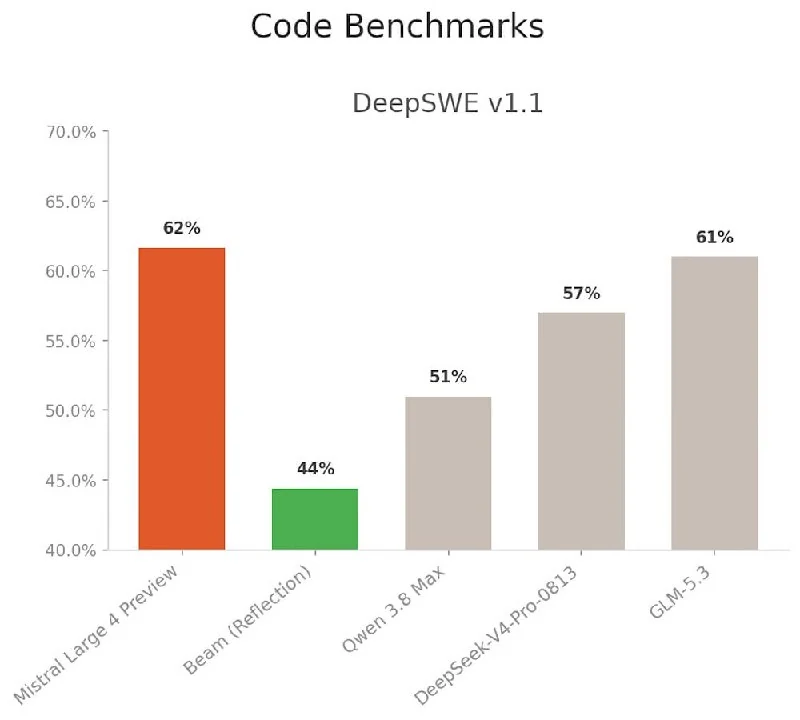
- 62% on DeepSWE for programming tasks
- It outperforms GLM-5.3 on DeepSWE
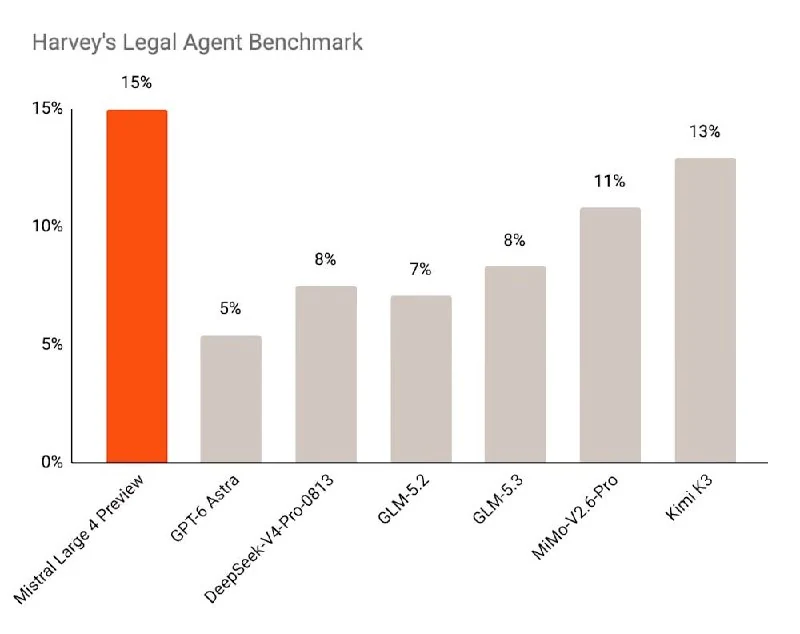
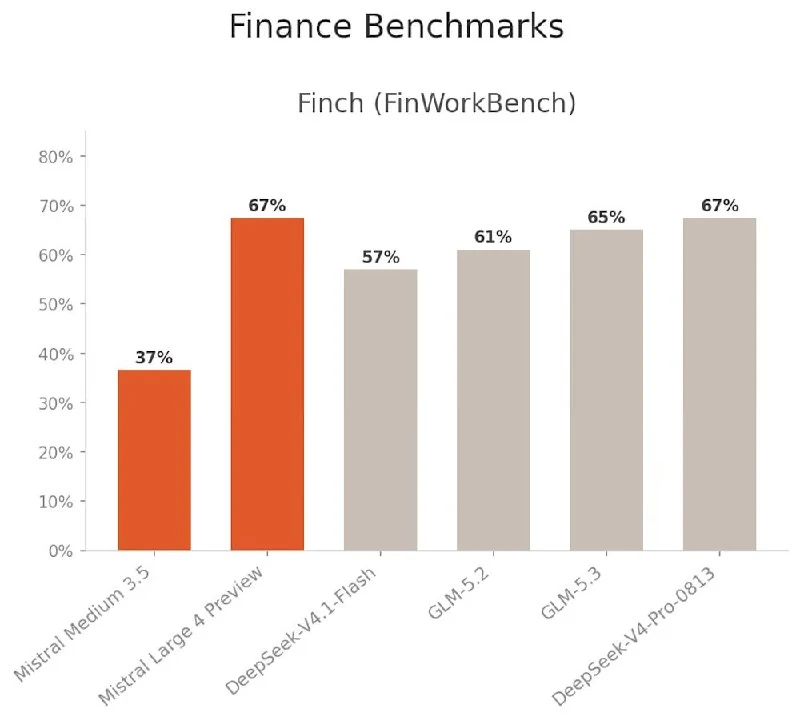
- The team says it achieves state-of-the-art results in cybersecurity, manufacturing, and finance
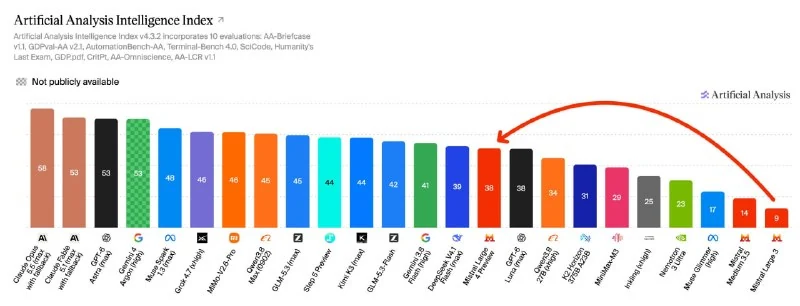
- On AA, the model scored 38, the same as Luna, but it is more expensive than Luna
- Open weights are scheduled to be released on October 27
The model is already available through the API.
Why it matters
AnalysisThis matters because Mistral combines a very large model with strong coding, security, and finance results and promises open weights, potentially intensifying competition in generative AI.
Discuss in community
Share your questions and insights with developers
Related in Ecosystem
Practical guides, core terminology, and agent skills
Mistral AI (European Open and Efficient Models)
A series of high-performance open and commercial models from the French startup Mistral AI (Mistral 7B, Mixtral 8x7B, Mistral Large). Known for their compactness, speed, and respect for data privacy.
LLM (Large Language Model)
A fundamental class of neural network architectures based on autoregressive transformers, predicting the probabilistic distribution of subsequent tokens and demonstrating emergent properties of abstract reasoning, code synthesis, and logical inference.
Part II. AI Agent Architecture: From Model to Memory and Tools
A deep engineering dive: tokenization, KV-cache, sampling determinism, the training stack, quantization, context engineering, the safety stack, production RAG, ReAct, and multi-agent swarm systems.
Anthropic mathematician claims possible proof of Riemann hypothesis with Claude
Levent Alpoge says collaborative work with Claude may have led to a proof of the Riemann hypothesis.